
Every farmer knows that machinery isn’t just a set of tools; it is a massive portion of your net worth. When you look at your balance sheet, that line item for “Machinery & Equipment” often represents millions of dollars in capital.
We often focus on the purchase price or the input costs, but we sometimes overlook the asset management side of the equation.
The difference between a tractor stored in a shed and one parked along the fence line isn’t just cosmetic, but also financial. Research from agricultural extension services (including data from NDSU and Kansas State) suggests that storage is one of the highest-return investments you can make on the farm.
Here is the breakdown of how storage impacts your trade-in value, maintenance costs, and cash flow.
1. The “Shedded” Premium: Resale Value
When it comes time to upgrade, the “Shedded” label is golden. It is arguably the most powerful keyword in a listing. But what is that word actually worth in dollars?
Studies show that equipment kept indoors retains significantly more value over a 5-year ownership cycle compared to equipment left exposed to the elements.
Impact of Storage on Trade-In Value (After 5 Years)
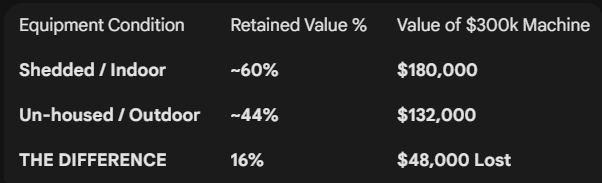
The Takeaway: On a single high-value asset, parking outside can cost you nearly $50,000 in lost equity over five years. That is roughly $10,000 per year in invisible depreciation.
2. The Maintenance Gap
Depreciation is a non-cash cost, but maintenance comes directly out of your operating cash flow.
Storage doesn’t just keep paint shiny, but also protects the moving parts. Farmers who store equipment indoors report roughly half the downtime of those who don’t. When the window to plant or harvest is tight, downtime is the most expensive cost of all.
Estimated Annual Repair Costs (% of List Price)
- Shedded Equipment: 2.8%
- Un-housed Equipment: 4.5%
If you own $1,000,000 worth of fleet, storing it indoors saves you roughly $17,000 a year in parts, labor, and service calls.
3. Vulnerability by Machine Type
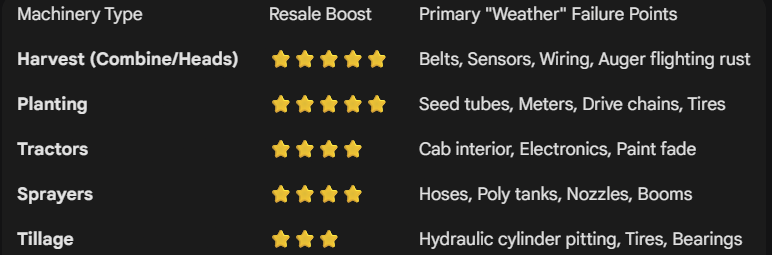
Not all iron reacts to the weather the same way. Here is how the elements attack specific equipment on your farm.
Combines & Sprayers (High Risk)
These are your most complex and vulnerable assets.
- The Threat: Rodents and UV Light.
- The Impact: Combines sitting outside are magnets for mice, which chew through complex wiring harnesses. For sprayers, UV light makes plastic tanks brittle and cracks poly fittings.
- Resale Factor: High. Buyers are terrified of electrical gremlins in used combines. A shed-kept machine alleviates that fear.
Row Crop Tractors
- The Threat: The “Greenhouse Effect.”
- The Impact: Sunlight beating down on a cab creates extreme heat fluctuations. This cracks expensive interior upholstery, fades monitors, and damages cab seals.
- Electronics: Modern tractors are rolling computers. Constant freeze/thaw cycles create condensation inside ECUs, leading to ghost codes that are impossible to diagnose and kill resale value.
Planters
- The Threat: Rubber and Plastic degradation.
- The Impact: Planters rely on precision. UV light destroys seed tubes, rubber seals, and hydraulic hoses.
- The Cost: A weathered planter doesn’t just lose resale value; it causes yield loss due to poor seed placement and skipping caused by rusty chains and stiff parts.
Grain Carts & Tillage
- The Threat: Tires and Hydraulics.
- The Impact: While big iron seems harsh, the tires are not. Ozone exposure causes “weather checking” (cracking sidewalls).
- The Cost: Replacing a set of rotted grain cart tires can cost upwards of $10,000, instantly eating up your trade-in profit.
4. Summary: The Return on Investment (ROI)
Is building a machine shed worth it? When you combine the higher trade-in value with the lower annual repair bills, the building often pays for itself faster than the machinery inside it.
Quick Reference: Where Storage Pays Off
Conclusion
We know that you can’t control the markets or the weather during the growing season. But you can control how the weather affects your balance sheet during the off-season.
Keeping your equipment shedded is about more than pride of ownership; it’s about protecting your capital. When you are ready to trade up, that shed will prove to be one of the best investments you ever made.
Leave a Reply