
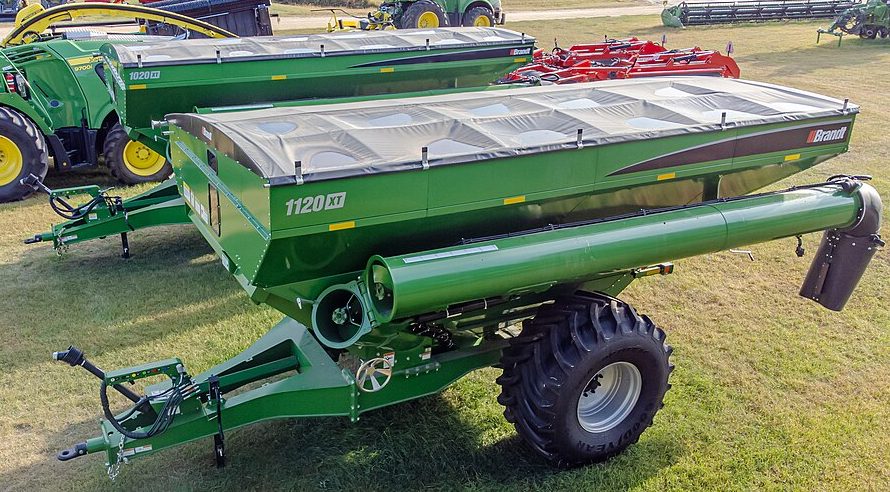
Grain carts and grain handling equipment continue to evolve as farms push to move more grain through tighter harvest windows with fewer people. Recent product introductions show that while size still matters, manufacturers are placing just as much emphasis on safety, control, and ease of use. As reported on recently by Farm Progress, these changes reflect the realities of modern harvest operations, where efficiency, uptime, and operator comfort can matter as much as raw capacity.
Bigger capacity with more precise unloading
Larger grain carts remain a central trend, but the way those carts unload is changing. New high-capacity single auger designs are now delivering unloading speeds that rival traditional dual auger carts, while reducing complexity and maintenance. These carts are designed to handle 1,700 to 2,000 bushels and unload at rates exceeding 900 bushels per minute.
What stands out is improved unloading control. Multi-directional spout systems are becoming more common, allowing operators to place grain more accurately into trucks. Unverferth has added right-hand unloading for its 2026 X1100 Extreme grain cart for 2026. As carts get taller and augers extend farther, precise placement reduces spillage, saves cleanup time, and helps keep harvest moving smoothly.
Fire safety moves into the field
Safety innovations are becoming a core part of grain cart design, especially when it comes to fire risk. Dry harvest conditions have increased the likelihood of field fires, pushing manufacturers to rethink how farmers respond when something goes wrong.
New cart-mounted fire suppression systems from Demco allow operators to carry hundreds of gallons of water directly on the grain cart, along with long hose reels for quick response. Instead of leaving the field to retrieve firefighting equipment, operators can react immediately, which can make the difference between a close call and a major loss.
Practical upgrades for service and maintenance
As grain carts grow in size, manufacturers are paying more attention to service access and everyday usability. Improved access points for augers and driveline components make inspection and maintenance easier. Some carts now include integrated water systems that support cleaning, dust control, or emergency needs in the field.
Manufacturers are also offering more unloading configuration options so farmers can match cart setup to their trucks, fields, and harvest flow. These practical upgrades reflect a shift toward designing equipment that is easier to live with, not just bigger on paper.
Grain handling as a connected system
Innovation is not limited to the grain cart itself. Grain handling is increasingly viewed as a complete system that includes carts, trucks, seed tenders, trailers, and on-farm storage. New equipment introductions show a focus on smoother handoffs between machines, better visibility, safer access points, and equipment sized to match real-world operations.
One nice addition is Shurco’s E Series electric tarp system for older grain trailers. Retrofit kits now allow farmers to convert manual tarps into powered systems, eliminating repetitive pulling and climbing during long days. While these upgrades may seem small, they add up over the course of harvest. Less fatigue, fewer awkward movements, and faster turnaround times all contribute to safer and more efficient operations.
This system-level thinking helps reduce bottlenecks and keeps grain moving from combine to storage with fewer interruptions.
The takeaway for farmers
Grain carts are still growing, but the most meaningful changes are happening in the details. Higher capacity is now paired with better unloading control, built-in safety features, operator-focused automation, and easier maintenance. These innovations are designed to help farmers harvest faster, safer, and with less physical and mental strain.
As harvest demands continue to rise, grain handling equipment that balances size with smart design is becoming just as important as the horsepower pulling it.

Leave a Reply