
Farmers are paying more for nearly every major input than they did before the pandemic. But fertilizer is drawing federal scrutiny and antitrust lawsuits, while equipment, seed and crop protection companies face different competition questions.
Corn prices have surrendered much of the gains they made during the commodity boom, but fertilizer prices haven’t followed nearly as far. In late October, the average retail price of anhydrous ammonia was $987 per ton, according to DTN, more than double its December 2019 price. Diammonium phosphate (DAP) followed a similar pattern, climbing from $443 to $939 per ton over the same period.
Farmers are paying more for other inputs, too. Machinery prices have increased substantially, seed costs remain elevated, and equipment manufacturers continue dealing with higher labor and production costs. Yet fertilizer is facing a growing collection of private antitrust lawsuits and scrutiny from federal investigators, raising questions about why this particular industry has attracted so much legal attention.
The answer involves more than inflation. It comes down to how prices changed, how the industries operate, and whether companies competed fairly as markets recovered from the disruptions of 2021 and 2022. A comparison of major farm inputs shows just how differently those markets have behaved.
| Farm commodity or input | Change since 2019 |
|---|---|
| Anhydrous ammonia, retail | +102% |
| DAP fertilizer, retail | +112% |
| Farm machinery, producer prices | +36% |
| Seed corn, cost per acre | +16% to 21% |
| Corn, season-average farm price | +17% |
| Natural gas, Henry Hub | +15% |
| Pesticides, producer prices | About unchanged |
Sources: DTN fertilizer prices, USDA farm prices, University of Illinois crop budgets, EIA natural gas data and BLS producer price indexes. Figures are rounded and compare the latest available 2025/26 or 2026 data with 2019. Price measures and reference periods differ.
Fertilizer Prices Came Down, but Not Nearly Enough
The pandemic and its aftermath created an extraordinary period for agricultural markets. Global demand recovered, supply chains struggled, and commodity prices climbed. Natural gas, a major feedstock for nitrogen fertilizer production, became considerably more expensive, while Russia’s invasion of Ukraine in February 2022 added another shock to global energy and fertilizer supplies.
Fertilizer prices surged as those pressures intensified. DTN recorded anhydrous ammonia reaching $1,534 per ton in April 2022, roughly three times its December 2019 price. Corn prices also rose sharply, with USDA data showing the national season-average farm price climbing from $3.56 per bushel in 2019/20 to $6.54 in 2022/23. Stronger crop revenue helped offset some of the higher expenses, although the impact varied considerably by farm.
Then the markets began moving in different directions. Corn prices retreated, and natural gas became substantially cheaper than it had been during the 2022 energy crisis. Fertilizer prices also declined, but they remained far above their pre-pandemic levels. By October 2026, DTN’s national retail averages still put anhydrous ammonia more than 100% above its December 2019 price, with DAP up approximately 112%.
Another round of global supply disruptions in 2026 added pressure to fertilizer markets. Conflict involving Iran and shipping disruptions around the Strait of Hormuz contributed to renewed concerns about international fertilizer supplies, as examined in an April analysis from farmdoc daily. For farmers planning another growing season, the result is familiar: crop revenue has fallen considerably from its peak, but some major production expenses remain stubbornly high.
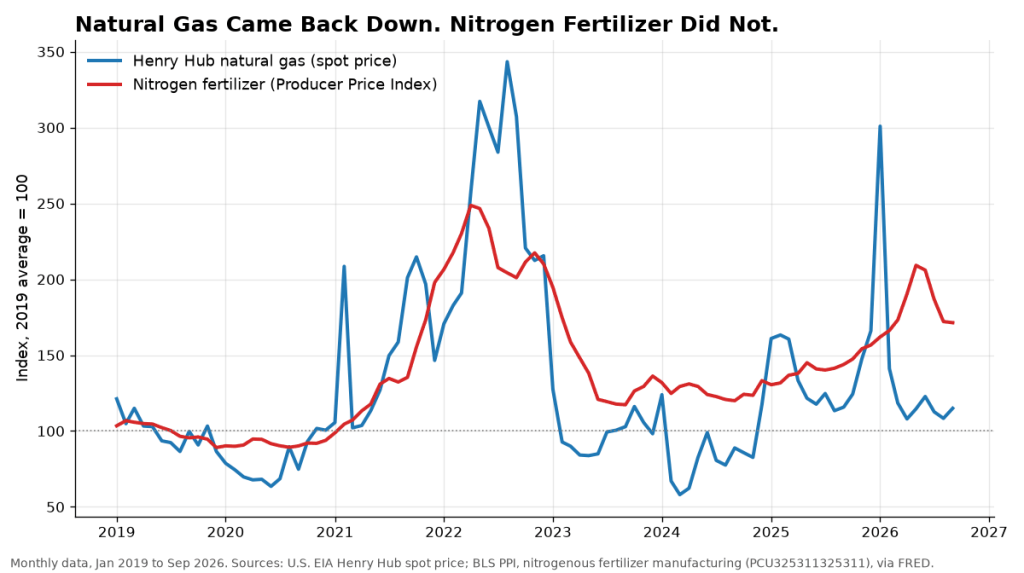
Natural gas prices fell sharply after their 2022 peak, while nitrogen fertilizer producer prices remained substantially above their 2019 levels. Both series are indexed to 2019 = 100. The fertilizer series measures producer prices, not the retail prices farmers pay. Sources: EIA Henry Hub natural gas and BLS nitrogen fertilizer producer prices, via FRED.
Why Fertilizer Is Facing Antitrust Lawsuits
High prices alone do not establish illegal conduct. Companies can charge more because of higher costs, limited supplies, stronger demand or changing market conditions. Antitrust law becomes relevant when competitors coordinate prices, restrict output, divide markets or otherwise interfere with competition. Fertilizer has several characteristics that make those questions particularly important.
Much of the industry sells standardized products. Anhydrous ammonia, urea and other common fertilizers are sold according to established nutrient specifications, making their prices easier to compare across manufacturers. Delivery, service and local availability can affect what a farmer pays, but the underlying products are more interchangeable than competing tractor models or patented seed hybrids.
Major segments of the fertilizer market are also concentrated among relatively few producers. Building a new fertilizer plant requires substantial capital, access to raw materials, specialized infrastructure and regulatory approvals, making it difficult for new competitors to enter quickly. When a relatively small group of companies supplies products that farmers must purchase every growing season, their pricing decisions attract considerable attention.
The third factor is the relationship between fertilizer prices and production costs. Natural gas prices have declined dramatically from their 2022 peak, but nitrogen fertilizer prices have not fallen proportionately. That divergence raises questions about competition, although natural gas is only one component of fertilizer pricing. Transportation, international markets, production capacity, imports and other costs also influence the final price.
Those conditions have attracted attention from farmers, attorneys and federal regulators, but they are not proof that manufacturers violated antitrust laws. In June 2026, a federal judicial panel consolidated fertilizer antitrust lawsuits in the U.S. District Court for the District of Kansas. The litigation, known as In re Nitrogen, Phosphorus, and Potassium (NPK) Fertilizer Antitrust Litigation, includes allegations involving major fertilizer producers and suppliers.
Companies named in the litigation include Nutrien, Mosaic, CF Industries, Koch and others. Plaintiffs allege anticompetitive conduct that inflated fertilizer prices, while the companies dispute those allegations. As reported by Bloomberg Law, the defendants point to global markets, energy costs, international disruptions and competition from producers outside the United States as explanations for the price increases.
Separately, Bloomberg reported in March that the Department of Justice was investigating possible price fixing in the fertilizer industry. In October, DOJ and USDA expanded their agreement to cooperate on competition issues involving agricultural inputs, including fertilizer, seed, equipment, fuel and pesticides. Neither a private lawsuit nor a government investigation establishes that wrongdoing occurred, and the outcome of the fertilizer litigation remains uncertain.
Why Haven’t Rising Tractor Prices Produced the Same Fight?
Equipment manufacturers have faced their own cost pressures since 2019. Steel prices surged during the pandemic recovery, electronic components became difficult to obtain, and manufacturers struggled with labor shortages and production delays. Dealers had limited inventory while demand for new and used equipment remained strong, creating conditions that pushed prices higher across much of the machinery market.
Unlike some other commodities, machinery prices generally did not return to their earlier levels when supply chains improved. Bureau of Labor Statistics producer price data indicates farm machinery prices were approximately 36% higher in September 2026 than their 2019 average. That increase has been relatively steady, rather than the dramatic spike and partial retreat seen in fertilizer markets.
Steel is part of the explanation, but it doesn’t account for everything. The price of iron and steel climbed sharply in 2021, declined afterward and rose again as trade policies and tariffs changed. In June 2025, the White House increased Section 232 tariffs on steel and aluminum to 50%. Machinery prices followed a much steadier upward path, suggesting that other factors have helped sustain higher equipment costs.
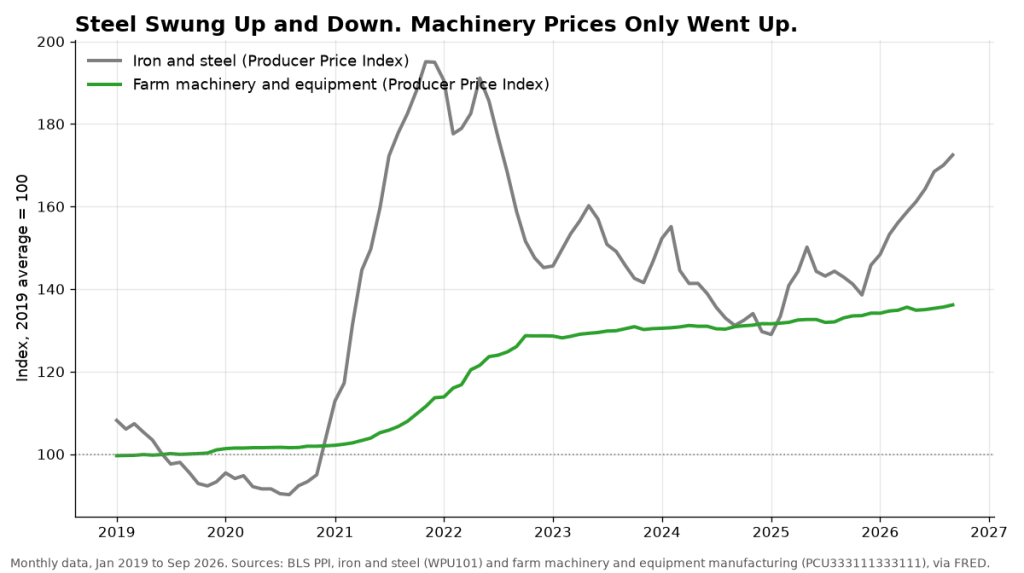
Steel prices experienced dramatic swings after 2019, while farm machinery producer prices increased more steadily. Both series are indexed to 2019 = 100. Producer price indexes do not directly measure the retail price of a particular tractor model. Sources: BLS iron and steel prices and farm machinery producer prices, via FRED.
Modern tractors and combines contain increasingly sophisticated electronics, emissions controls, guidance systems and automation capabilities. Labor, engineering, manufacturing and regulatory compliance costs also contribute to the final price. Manufacturers can adjust production as demand changes rather than immediately reducing list prices, and a new tractor equipped with today’s technology is not necessarily equivalent to the model sold seven years earlier.
None of that means equipment manufacturers are immune from antitrust scrutiny. In January 2025, the Federal Trade Commission and several states sued Deere & Company, alleging the manufacturer unlawfully restricted access to repair tools and software, limiting competition in equipment repair services. Deere disputed the allegations, but in July 2026 the FTC announced a proposed settlement that would require Deere to make repair resources available to farmers and independent repair providers on fair and reasonable terms. The proposed order would last 10 years, subject to court approval.
That dispute focuses on a different aspect of equipment ownership. For farmers, the purchase price matters, but so do repair costs, downtime, access to diagnostic software and the ability to keep older machinery operating. The equipment industry’s most prominent recent antitrust battle has therefore centered on repair competition rather than an alleged industrywide agreement to raise tractor prices.
Seed Prices Have Risen, but the Market Works Differently
Seed is another concentrated agricultural industry, and farmers have seen costs increase over time. But seed pricing is more complicated than comparing two tons of fertilizer because different hybrids offer different genetics, maturity ratings, disease resistance, yield characteristics and patented traits. Companies invest in research, breeding, testing and licensing, and those costs influence what farmers pay.
Seed companies also compete through dealer relationships, volume discounts, financing arrangements and bundled products. Those arrangements can make direct price comparisons difficult because competing seed products are not necessarily interchangeable. They can also create competition concerns of their own, depending on how the arrangements are structured and whether they restrict access to competing products.
University of Illinois crop budgets show that seed costs have generally increased much more gradually than fertilizer prices since 2019. In northern Illinois, budgeted seed corn costs rose from approximately $113.50 per acre in 2019 to $132 to $137 per acre in 2026, an increase of roughly 16% to 21%. That’s a meaningful expense across thousands of acres, but it is far removed from the rapid doubling or tripling experienced in some fertilizer markets.
The Justice Department and USDA nevertheless included seed among the agricultural inputs covered by their expanded October 2026 competition agreement. Seed markets remain part of the broader federal conversation about agricultural competition, even though the legal disputes currently receiving the most attention involve different allegations and business practices.
Crop Protection Companies Are Already in Court
Fertilizer isn’t the only agricultural input industry facing antitrust litigation. In 2022, the FTC and a coalition of states sued pesticide manufacturers Syngenta and Corteva, alleging that their loyalty programs discouraged distributors from purchasing lower-priced generic pesticides. The allegations centered on competition after patent protection expires, when generic manufacturers may be able to offer less expensive alternatives to established branded products.
The FTC alleged that certain distributor incentives limited those competitors’ access to the market, allowing higher prices to persist. In September 2026, Corteva reached a settlement requiring changes to its loyalty programs, including restrictions lasting 10 years and a $35 million payment to participating states. The settlement resolved the claims against Corteva without a trial establishing liability, while litigation against Syngenta continues. An October ruling denied Syngenta’s motion for summary judgment, allowing the case to proceed without resolving the underlying allegations.
Crop protection prices have also followed a different path from fertilizer. Glyphosate and other herbicides experienced severe supply disruptions during 2021 and 2022, with shortages and unusually high prices. As production and availability improved, many prices declined, and the BLS pesticide manufacturing price index has returned close to its 2019 level.
That doesn’t mean every herbicide costs the same as it did seven years ago, or that farmers are spending less on crop protection. Actual pesticide spending per acre can remain elevated because of changes in application rates, product selection, herbicide resistance management and other agronomic decisions. University of Illinois farm cost data shows corn pesticide costs rising substantially since 2019, even as the broader manufacturing price index has declined.
The important distinction is that the crop protection litigation concerns alleged restrictions on generic competition, rather than the same industrywide price coordination allegations facing fertilizer producers. Both cases involve questions about whether companies competed fairly, but the alleged conduct and the markets involved are different.
What the Numbers Mean for Farm Profitability
The economic problem facing farmers is larger than any single lawsuit. Corn prices rose sharply during the commodity boom before retreating, while fertilizer prices declined from their peaks but remained substantially above their pre-pandemic levels. Machinery prices followed a steadier upward trajectory, and some crop protection prices moved closer to their earlier levels.
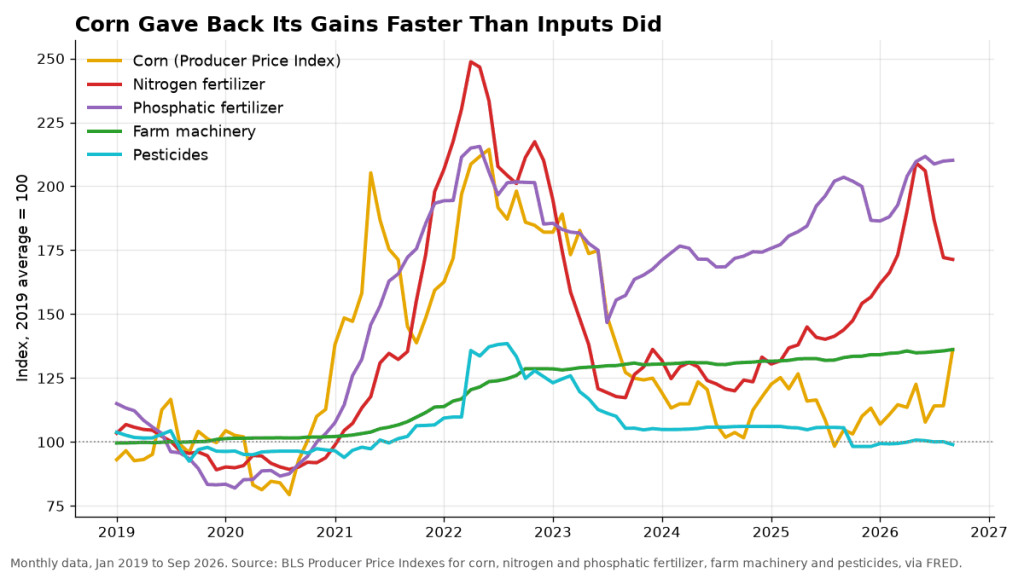
Producer price indexes illustrate how corn, fertilizer, farm machinery and pesticide prices have changed since 2019. All series are indexed to 2019 = 100. These indexes represent different markets and should not be interpreted as a direct farm operating budget. Source: Bureau of Labor Statistics producer price data via FRED.
These differences matter when farmers calculate the cost of raising another crop. A fertilizer price increase affects the cost of planting an acre, while a more expensive tractor can influence depreciation, financing and replacement decisions for years. Higher seed costs affect the planting budget, and repair restrictions can influence how long equipment remains out of service.
The legal cases may eventually determine whether particular companies violated competition laws, and they may change how some agricultural businesses operate. But even a successful antitrust case would not automatically return input prices to 2019 levels. Energy markets, global supply, manufacturing costs and demand would continue to influence what farmers pay.
For now, the central issue is the gap between crop revenue and the cost of production. Farmers have watched corn prices retreat from their highs while many of the expenses required to produce that corn remain elevated. Whether the courts ultimately find wrongdoing in fertilizer markets is still an open question, but the pressure on farm profitability is already here.
Every additional dollar spent on inputs is another dollar a bushel of corn must cover.


Leave a Reply