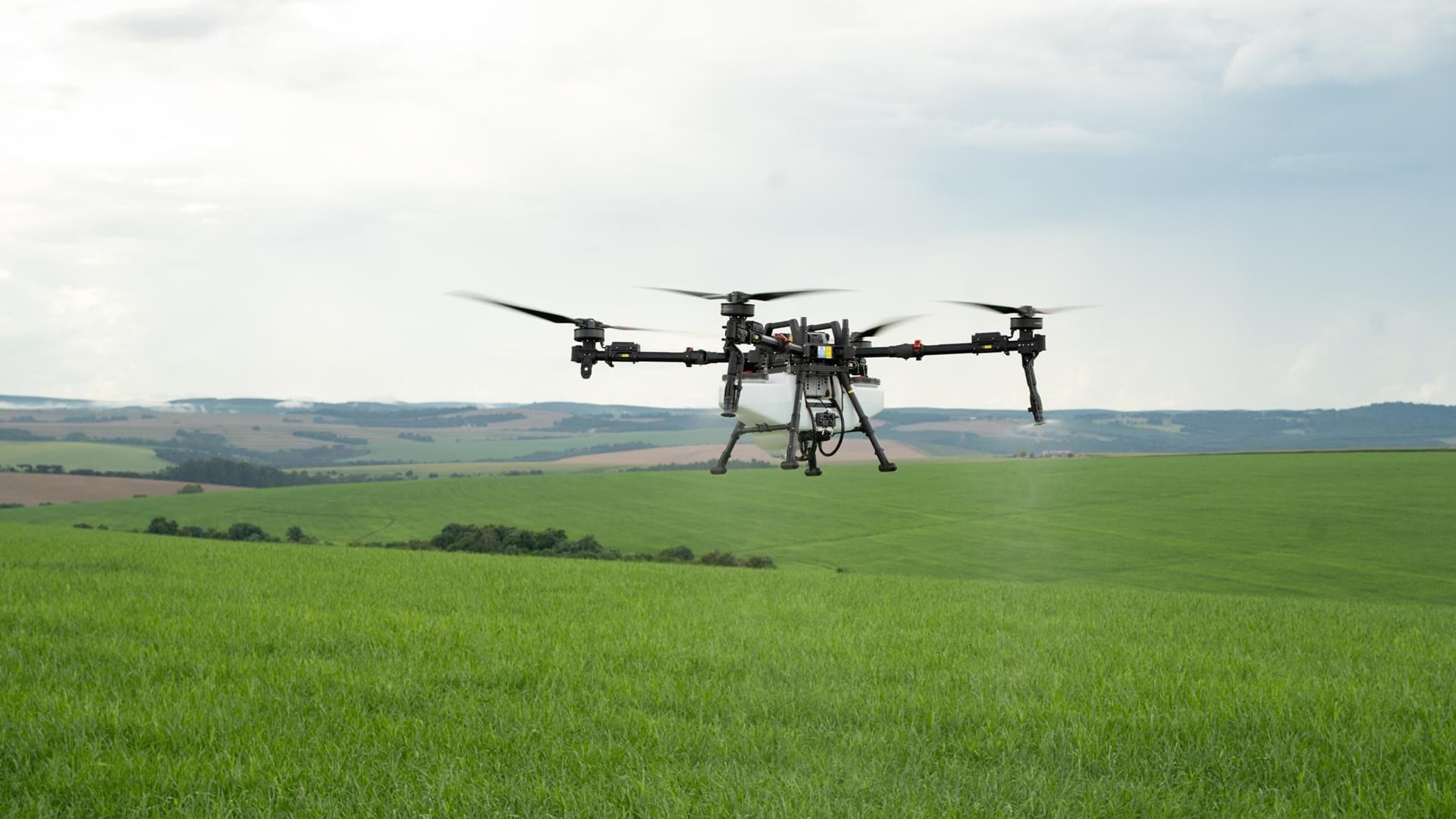
At Tractor Tuesday, we pay close attention to new tools that help farmers do more with fewer passes, fewer inputs, and tighter labor demands. Case IH recently demonstrated what that future can look like with its new application drone during a full-scale field test in Brazil. The test was conducted under real operating conditions and provided a clear picture of how drones could fit into modern farm operations.
The field test took place in Água Boa, Brazil, where Case IH evaluated its P150 application drone over a continuous 24-hour period. During that window, the drone covered 892 hectares across 147 individual flights. It applied more than 7,000 liters of crop protection product while maintaining nearly 99 percent application accuracy. Flight speeds averaged about 64 kilometers per hour, with a working height near six meters and an effective spray width of roughly 11 meters. Total flight time reached nearly 19 hours.
What stood out most from the test results was consistency. The drone maintained uniform application across the entire test period, even as conditions changed. High accuracy means less over-application and fewer wasted inputs, which directly impacts operating costs. Because the drone does not rely on ground contact, it also reduces soil compaction and eliminates wheel traffic through sensitive crop stages.
Efficiency was another major takeaway. Compared to traditional ground sprayers, the application drone required significantly less fuel and fewer support resources. With one operator overseeing operations, the drone completed work that would typically demand multiple machines and labor hours. This can be especially valuable during tight weather windows when timing matters most.
There is also an environmental angle that many people are paying closer attention to. Lower fuel use and more targeted application reduce overall environmental impact while still meeting agronomic goals. Precision placement of crop protection products helps keep chemistry where it belongs and out of surrounding areas.
So how does a drone like this fit into a farmer’s existing machinery lineup? Think of it as a complement rather than a replacement. Tractors, sprayers, and spreaders still handle high-volume work efficiently, but a drone can shine in situations where speed, precision, or access are limiting factors. Irregular fields, wet conditions, steep terrain, or late-season applications are all areas where a drone can keep work moving while larger machines stay parked.
From a cost standpoint, drones can help stretch input dollars further by reducing overlap and waste. They can also free up labor, allowing operators to focus on planting, harvesting, or hauling instead of squeezing in another spray pass. Over time, reduced wear on large equipment can translate into lower maintenance and longer machine life.
The Brazil field test shows that Case IH’s application drone is a practical tool that delivered measurable results in real conditions. For farmers looking to maximize efficiency while minimizing cost, adding a drone to the fleet is becoming a conversation worth having.


Leave a Reply