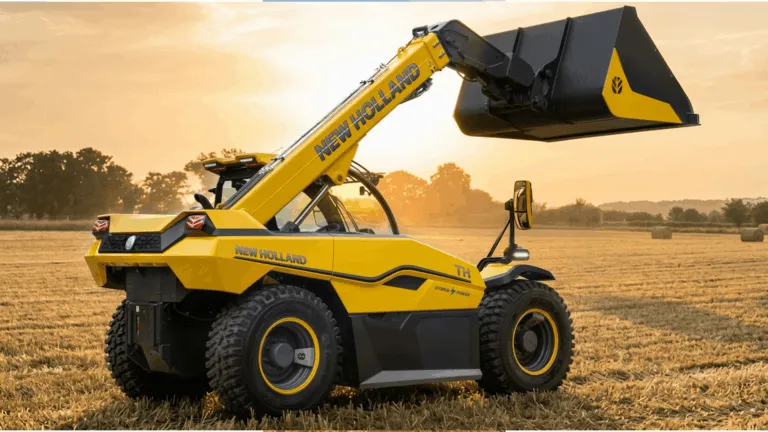
New Holland has earned international recognition for one of its most forward-looking machines. The company’s Hybrid Telehandler prototype recently received the 2026 iF Design Award, one of the world’s most respected industrial design honors.
The award recognizes more than just styling. It highlights a concept that blends practical farm performance and a new approach to powering agricultural equipment.
A Telehandler Designed for the Future
The prototype was first unveiled at Agritechnica 2025 and immediately stood out for its unconventional powertrain. Instead of relying solely on diesel or electricity, the machine combines an electric drivetrain with a methane-powered engine that acts as a range extender.
At the core of the system is a 70 kWh battery that can power the telehandler fully electrically for several hours depending on workload. For heavier tasks or longer operating periods, a 2.8-liter methane engine provides additional power while also recharging the battery.
Despite its alternative power system, the machine is designed to match the performance farmers expect from a conventional telehandler. It offers roughly 9,200 pounds of lift capacity and a maximum lift height near 29 feet, putting it squarely in the range of diesel machines in the same class.
According to New Holland, the hybrid configuration can reduce energy consumption by as much as 70 percent compared to a conventional diesel telehandler.
Why It Won the Award
The iF Design Award judges recognized the machine for how its design integrates new technology into a practical agricultural machine. New Holland noted that the award highlights the prototype’s “unique form, function and differentiation” compared with conventional telehandlers.
Rather than creating a futuristic concept that would be difficult to use in real farm conditions, the goal was to integrate a hybrid power system into a machine layout farmers already understand.
Why Hybrid Instead of Fully Electric?
Battery-only machinery still faces limitations in agriculture, especially when machines are expected to run long hours during busy seasons. The hybrid system helps solve that problem.
The electric drivetrain delivers the efficiency and responsiveness of battery power, while the methane engine allows the machine to keep working when battery levels drop. The engine can also recharge the battery during operation, extending runtime significantly.
Methane also introduces an interesting possibility for farms that produce biogas from manure or other organic waste. In theory, those farms could generate their own fuel on-site.
Pros and Cons of the Hybrid Approach
Hybrid machinery could offer several practical advantages. Electric drive systems typically provide instant torque and smoother control, which can improve precision when loading materials. They are also quieter and produce less vibration, which could be helpful when working near livestock or inside buildings.
The trade-off is increased complexity. Batteries, electric motors, and alternative fuel systems add components that must be maintained. Advanced powertrains can also carry higher upfront costs compared to conventional diesel machines.
Will It Reach Production?
For now, the hybrid telehandler remains a prototype undergoing testing, and New Holland has not announced a production timeline.
Even so, machines like this often serve as a preview of where the industry is heading. Manufacturers are under increasing pressure to reduce emissions while maintaining the productivity farmers rely on. Hybrid systems may provide a practical bridge between traditional diesel equipment and fully electric machinery.
Whether this exact telehandler reaches production or not, the concept points toward a future where agricultural machines combine multiple energy sources to deliver efficiency, flexibility, and lower emissions without sacrificing performance.

Leave a Reply