
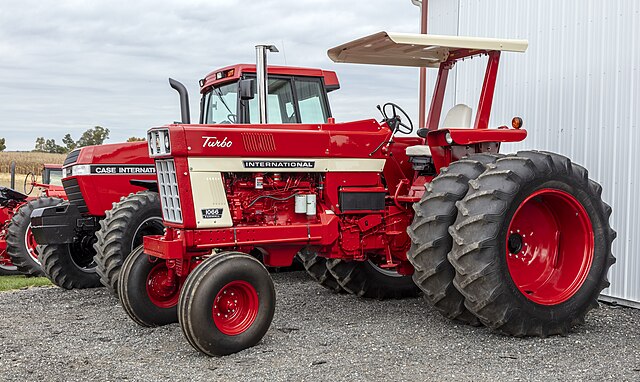
There are tractors that get the job done, and then there are tractors that become part of a farmer’s identity. The International Harvester Farmall 1066 Turbo falls squarely into the second category. Decades after it rolled off the line, the 1066 still turns heads at auctions, draws crowds at shows, and sparks stories that start with, “We had one just like that…”
Built for a Changing Farm Economy
The early 1970s were a turning point in American agriculture. Farms were getting bigger, implements were getting wider, and horsepower demands were climbing fast. Export markets were booming, grain prices were strong, and many operations were scaling up in a hurry.
International Harvester saw the opportunity and the pressure. Competition with John Deere was intense, especially in the high-horsepower row crop segment. Deere’s Sound-Gard cab tractors were gaining attention, and farmers were starting to expect more than just raw pulling power. Comfort, hydraulics, and reliability were becoming just as important.
The 1066 Turbo arrived in 1971 right in the middle of this shift. It was not just another tractor. It was IH’s answer to a new kind of farmer who needed more power without sacrificing versatility.
Power That Farmers Could Count On
At the heart of the 1066 was IH’s DT414 engine, a turbocharged diesel that delivered roughly 125 horsepower. That number mattered, but what really set it apart was how the tractor delivered that power.
The torque rise was strong, and the engine had a reputation for lugging through tough conditions without giving up. Farmers could drop into heavy ground, pull a big load, and trust that the tractor would keep digging instead of falling flat.
The drivetrain was equally important. The 1066 used IH’s tried-and-true transmission setup, often paired with a Torque Amplifier, which allowed operators to shift on the go under load. For many farmers, that feature alone made a long day in the field more manageable.
Hydraulics were solid, the rear end was heavy, and the tractor could handle large implements that smaller machines simply could not. Whether it was pulling a chisel plow, running a big planter, or handling forage equipment, the 1066 proved it could do the work.
The Look, the Sound, and the Feel
Part of what made the 1066 iconic had nothing to do with specs.
The styling, especially the later black stripe models, gave it a sharp, aggressive look that still holds up today. The tall stance, the long hood, and that vertical exhaust stack made it instantly recognizable from across a field.
Then there was the sound. Anyone who has been around a 1066 remembers the distinct tone of that turbocharged engine under load. It was not just noise, but a signal that work was getting done.
Inside the cab, things were more basic compared to modern standards, but at the time, it represented a step forward. IH offered factory cabs and air conditioning, though many operators will tell you comfort was still a work in progress compared to Deere’s Sound-Gard design.
Why It Became So Popular
The 1066 hit a sweet spot.
It had enough horsepower to handle serious work, but it was still maneuverable enough for row crop operations. It was powerful without being overly complicated. And perhaps most importantly, it earned a reputation for reliability when maintained properly.
Farmers tend to stick with what works, and the 1066 worked. It became a backbone tractor on many operations across the Midwest and beyond. Dealers moved a lot of them, and word of mouth did the rest.
There was also brand loyalty at play. International Harvester had built a strong following, and the 1066 reinforced that trust during a time when farmers were making bigger financial bets on equipment than ever before.
The Beginning of the End
By the late 1970s, the industry was moving again.
IH introduced the 86 series, including the International Harvester 1086, which aimed to modernize the lineup with improved cabs and updated controls. While these tractors brought advancements, they also received mixed reviews, particularly regarding cab access and ergonomics.
At the same time, Deere continued refining its designs, and the bar for operator comfort and ease of use kept rising.
Then came the farm crisis of the 1980s, which hit International Harvester hard. Financial struggles led to the eventual merger with Case, forming Case IH. A few years later, the Magnum series arrived and set a new standard for reliability, comfort, and power.
Machines like the Magnum 7100 series represented the next generation. Better cabs, smoother shifting, improved hydraulics, and more refined power delivery made it clear that the era of the 66 series had passed.
Why the 1066 Still Matters Today
Despite being replaced by more advanced machines, the 1066 never faded away.
Collectors love them for their historical significance and unmistakable design. Farmers still use them because many are still capable of doing real work. Parts availability and mechanical simplicity make them easier to maintain than newer, electronics-heavy tractors.
But more than anything, the 1066 represents a moment in time.
It was built during a period of optimism and growth in agriculture. It helped farmers expand their operations and meet rising demand. And it did so with a combination of power, durability, and character that is hard to replicate.
That is why, when a clean 1066 shows up on a sale bill or at auction, it still draws attention. Not just because of what it is, but because of what it represents.
For many, it is not just a tractor. It is a reminder of how farming used to feel when horsepower was king, technology was simple, and a good machine earned its place the hard way.


Leave a Reply