
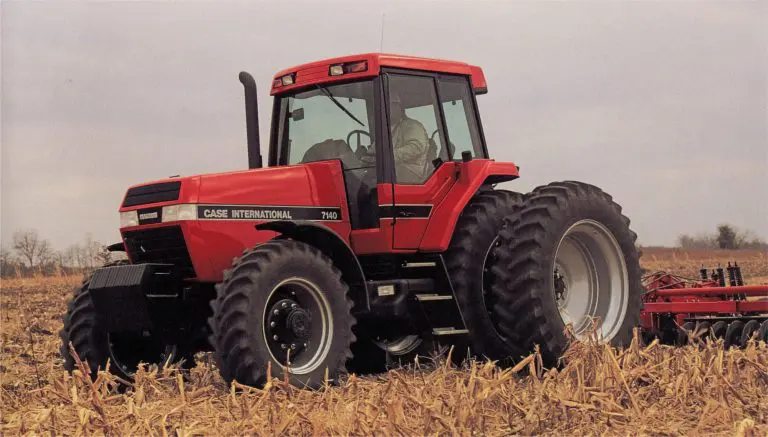
The Magnum entered the market in 1987 at a time when farmers were looking for something dependable, and it didn’t take long to earn that reputation. This was not simply the release of a new tractor series. It was a statement about reliability, simplicity, and getting the fundamentals right at a time when the industry needed stability.
A Tractor Built at the Right Moment
The mid-1980s were a turbulent period for the farm equipment industry. International Harvester had been under significant financial strain before merging its agricultural division with J.I. Case to form Case IH. Farmers had reason to be skeptical. They had seen transitions, product changes, and machines that did not always meet expectations.
Case IH needed to deliver something that would restore confidence. The Magnum was designed to do exactly that. It focused on durability, straightforward operation, and consistency in the field. Those priorities shaped every part of the machine.
The 7100 Series Sets the Standard
The original 7100 series, including the 7110, 7120, 7130, and 7140, replaced the outgoing 50 series tractors and quickly earned a reputation that endures to this day.
The full powershift transmission gave operators smooth, dependable control across the entire range. It allowed shifting under load without hesitation, which made a real difference during heavy fieldwork. The system proved tough over time, and that reliability became one of the Magnum’s defining traits.
The cab was another major step forward. Operators spent long days inside these machines, and the Magnum made that time more manageable. Visibility improved, noise levels dropped, and the control layout felt intuitive. It was the kind of upgrade that farmers noticed immediately.
Power came from Cummins engines that delivered steady performance day after day. These engines built trust quickly. Farmers knew what to expect when they hooked onto an implement, and that predictability mattered.
Built for Real Farm Work
Farms were growing in size and complexity during this period. Equipment had to keep up. The Magnum fit that shift well because it handled multiple roles without becoming overly complicated.
It worked as a primary tillage tractor, then moved into planting, and later handled grain cart duties during harvest. That flexibility reduced the need for multiple specialized machines. Farmers could rely on one platform to cover a wide range of jobs.
Durability reinforced that versatility. Many of these tractors accumulated thousands of hours with minimal issues. That kind of performance created loyalty that extended well beyond the original buyers.
Evolving Without Losing Its Identity
As the Magnum moved through the 7200 and 8900 series and into the MX and later generations, Case IH continued to refine the platform while staying true to its core strengths.
Horsepower increased to meet growing demands. Hydraulic capacity improved to support larger and more complex implements. Suspension systems and operator comfort continued to advance. Electronics and precision agriculture features became part of the package as farming practices changed.
Even with those updates, the Magnum remained recognizable. It stayed grounded in the idea of being a dependable, high-horsepower tractor that could handle a wide range of tasks without unnecessary complication.
The Magnum Today
Modern Magnum tractors, especially those equipped with AFS Connect and Rowtrac configurations, reflect how much the role has expanded.
These machines operate as part of a connected system. They manage data, integrate with guidance platforms, and support precision applications across the farm. At the same time, they continue to handle the core work they were built for.
You will still find them pulling large planters, running grain carts during harvest, and handling tillage when conditions require it. The addition of Rowtrac options has improved traction and flotation while maintaining row crop capability, giving operators more flexibility in varying field conditions.
Why the Magnum Still Holds Its Place
There are larger tractors designed for extreme workloads and smaller machines built for specialized tasks. The Magnum continues to occupy a space in between, where versatility matters most.
It remains one of the most widely used tractors on many operations because it can move from job to job without needing major adjustments. That level of usefulness keeps it relevant, even as equipment categories continue to evolve.
Consistency over time has also played a major role. Farmers trust what they know, and the Magnum has built that trust over decades of steady performance.
Looking Ahead
Future versions of the Magnum will likely continue along the same path that brought it this far. Connectivity, automation, and operator assistance will expand. Systems will become more integrated, and machines will continue to adapt to changing farm demands.
At the same time, the core expectations remain unchanged. Farmers still need equipment that starts every day, performs under load, and holds up over time.
The Magnum has met those expectations for nearly forty years. That kind of staying power does not come from chasing trends. It comes from understanding what matters in the field and building a machine that delivers on it, season after season.


Leave a Reply