For decades, the American farm equipment landscape has been defined by geography. If you wanted to run green, red, or anything else, your options were shaped by how close you were to a dealership. Service coverage, parts availability, and technician access were tied directly to physical locations. That reality helped cement the dominance of John Deere and made it difficult for competitors like AGCO to scale brands such as Fendt and Massey Ferguson across the United States.
AGCO’s AgRevolution model is starting to chip away at that structure by attacking the one advantage incumbents have always held. Instead of trying to match dealership density, it is changing what “coverage” actually means. The concept was built around direct feedback from farmers who made it clear they do not want to spend time hauling equipment back and forth or waiting on service during critical windows. They want support to come to them.
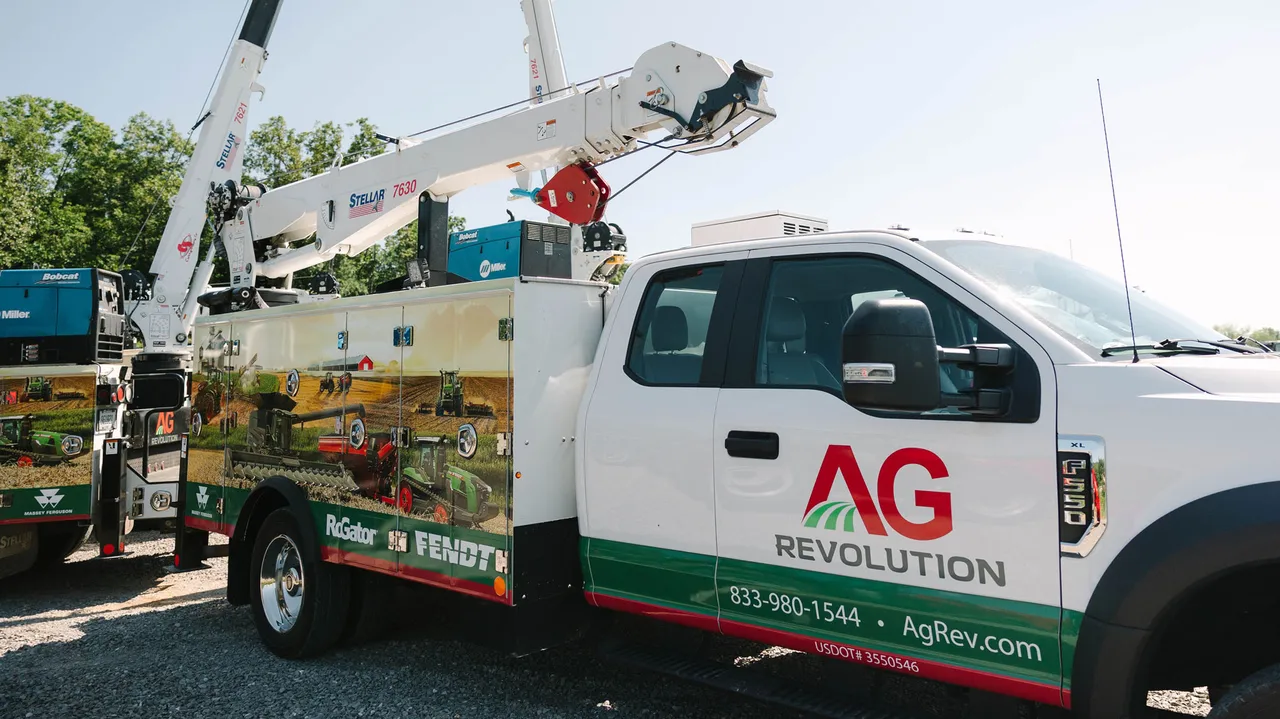
AgRevolution leaned into that idea with a mobile-first approach that prioritizes on-farm service over physical footprint. Fully equipped service trucks handle repairs, diagnostics, and parts delivery directly in the field, and the economics behind that shift are compelling. Outfitting a fleet of mobile units can rival the cost of a single dealership, but it allows coverage across a much wider area. When most of the work is done on the farm, the importance of having a dealership every 20 miles starts to fade, and farmers begin to evaluate service based on responsiveness rather than proximity.
That change matters because dealership expansion has always been the limiting factor for AGCO in the United States. Building or acquiring a dense network of stores to match Deere is expensive, slow, and often unrealistic in established territories. A mobile-first system allows AGCO to expand reach without taking on that burden, effectively creating a new path to compete on service coverage.
The model also changes how relationships with farmers begin. Instead of leading with a sale, AgRevolution often enters the operation as a service provider, working on all brands, including Deere and others. That creates familiarity and trust before any conversation about equipment even starts. Over time, that relationship opens the door to demonstrations and eventually to adoption of AGCO products.
That dynamic is especially important for Fendt, which has long been viewed as a premium, technology-forward brand with limited visibility in the U.S. market. Globally, Fendt has a strong reputation for engineering and efficiency, but in North America the challenge has always been access. That barrier is beginning to ease as distribution models evolve and AGCO increases its focus on the region. Fendt has been gaining market share gradually, and while it remains a smaller player compared to Deere, its growth trend is consistent and increasingly noticeable.
Massey Ferguson is on a different trajectory but may be just as important to AGCO’s broader strategy. The brand has deep historical roots in American agriculture but has experienced long periods of limited relevance in key segments. Recent product development has changed that perception, with a more complete lineup that now spans from compact tractors to high horsepower machines. There is growing momentum behind the brand, supported by improvements in quality and design as well as a clearer positioning in the market.
Taken together, Fendt and Massey Ferguson give AGCO a two-tiered approach that can address very different customer needs. Fendt appeals to operations looking for advanced technology and premium performance, while Massey offers a more straightforward, dependable option across a wide range of applications. The ability to present both brands under a single distribution model strengthens AGCO’s position, particularly when that model is not constrained by traditional dealership limitations.
The bigger question is what this means for the future of equipment distribution. If farmers continue to respond positively to on-farm service and mobile-first support, the importance of dense dealership networks may gradually decline. Brick and mortar locations will still play a role, but they may no longer define the boundaries of a brand’s reach. Coverage becomes a function of mobility, efficiency, and service capability rather than real estate.
AgRevolution is still early in its development, but it offers a clear signal that the traditional model is not the only way forward. For AGCO, it creates a path to compete more directly with Deere without replicating its infrastructure. For farmers, it aligns more closely with the realities of modern operations, where time, labor, and uptime carry more weight than ever.


Leave a Reply