
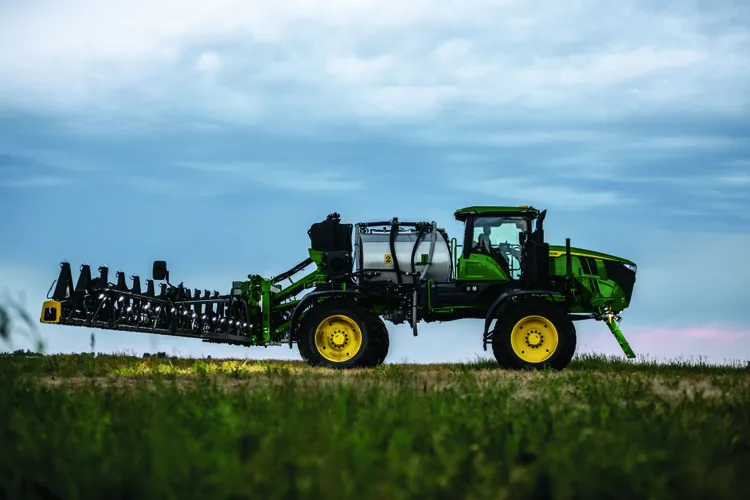
When John Deere first introduced See & Spray, the technology was sold on a simple promise: reduce herbicide use by spraying only where weeds are present. The value proposition was easy to understand. Less chemical applied should mean lower input costs and a faster return on investment.
The latest generation of See & Spray suggests Deere is thinking about something much bigger.
Along with expanded crop compatibility and hardware upgrades, the company is adding capabilities that move the sprayer beyond weed control and deeper into field intelligence. Biomass sensing, weed pressure mapping, stand counts, and real-time data collection are turning the sprayer into another agronomic sensor platform, collecting information every time it crosses the field.
More Than a Weed Sprayer
Among the most notable additions are support for sugar beets, wheat, and barley. Deere dealers have also reported positive early results testing the technology in additional small grain crops. Expanding crop compatibility may not generate the same attention as a new machine launch, but it matters because it increases the number of acres where growers can potentially use the system.
The hardware behind the system has also received a significant upgrade. During a recent demonstration by 21st Century Equipment, representatives highlighted the new V2 cameras and Vision Processing Units, which provide substantially greater processing power than the previous generation. On a 120-foot sprayer, Deere has reduced the number of VPUs from ten to three while maintaining the same camera coverage across the boom. The result is a cleaner machine layout, less weight on the boom, and additional room for new features.
Those new features include nighttime operation. By adding boom-mounted lighting, operators can now use See & Spray after dark in approved applications. For growers who frequently battle wind during spraying season, the ability to extend operating hours into calmer nighttime conditions could prove just as valuable as any improvement in weed detection accuracy.
The Real Story Is the Data
The most interesting changes, however, have little to do with spraying.
The V2 camera system can evaluate crop biomass in real time and adjust application rates accordingly. Traditionally, variable-rate prescriptions have relied on historical information such as soil samples, yield maps, or manually created management zones. Deere’s approach introduces the possibility of making rate adjustments based on what the crop looks like at that moment.
That capability is only the beginning. Deere has also announced upcoming stand count functionality in corn through what it calls “See & Scout.” As operators make normal passes through the field, the system will be able to generate stand counts and field maps automatically. At the same time, the sprayer continuously builds weed pressure maps, creating another layer of information that can be reviewed later in Operations Center.
What makes this significant is that none of this data collection requires a separate trip across the field. The machine is already there performing an application. Deere is simply extracting more information from the same pass.
Every Field Pass Is Becoming a Scouting Pass
That idea is increasingly common across modern agriculture. Planters collect planting data. Combines generate harvest maps. Guidance systems record machine performance and operational metrics. Deere appears to be pushing the sprayer in the same direction, transforming it from a single-purpose machine into another source of agronomic intelligence.
One comment from the 21st Century Equipment demonstration captured that shift particularly well. A company representative noted that See & Spray originally entered the market as a money-saving technology but has increasingly become a crop health tool. That is an important distinction because chemical savings are ultimately finite. Once a grower has optimized herbicide usage, there are only so many dollars left to save. Better agronomic decisions, healthier crops, and improved yields potentially create a much larger opportunity.
The amount of information generated by these machines is also growing rapidly. Operators can already access numerous map layers within Operations Center, including application maps, weed pressure maps, machine performance data, and other insights generated during operation. Stand count maps are expected to join that list in the future. As those datasets accumulate over multiple seasons, growers may begin identifying patterns that would have been difficult to spot through traditional scouting methods alone.
Looking Ahead
Farmers will continue to evaluate See & Spray based on herbicide savings because those numbers are easy to measure and easy to understand. Yet the latest updates suggest Deere sees a different long-term future for the platform.
The cameras mounted across the boom are no longer just searching for weeds. They are collecting information about crop growth, field variability, stand establishment, and weed pressure while the machine performs its normal work. In many ways, the sprayer is becoming a rolling field intelligence platform.
The savings at the chemical shed may still justify the investment today. The data collected along the way could be what defines the technology’s value tomorrow.


Leave a Reply