When CLAAS recently celebrated the grand opening of its new FarmPoint location in Jamestown, North Dakota, it would have been easy to view it as just another dealership expansion. New facilities open every year, and most are simply another dot on the map for a manufacturer’s dealer network.
But FarmPoint isn’t just another dealership.
The concept represents a different philosophy for supporting farmers, one that places greater emphasis on mobile service, regional parts distribution and connected technology than on large showrooms and traditional dealership campuses. Whether that approach ultimately succeeds remains to be seen, but it raises an interesting question: as farm equipment becomes more sophisticated and more connected, does the traditional dealership model need to evolve with it?
A Different Kind of Dealership
For generations, dealerships have been the center of the farm equipment business. Farmers visit to browse new machinery, pick up parts, meet with sales staff and bring equipment in for repairs. Even as dealership groups have grown larger through consolidation, the basic relationship has remained the same. When you need something, you go to the dealership.
FarmPoint shifts some of that thinking in the opposite direction.
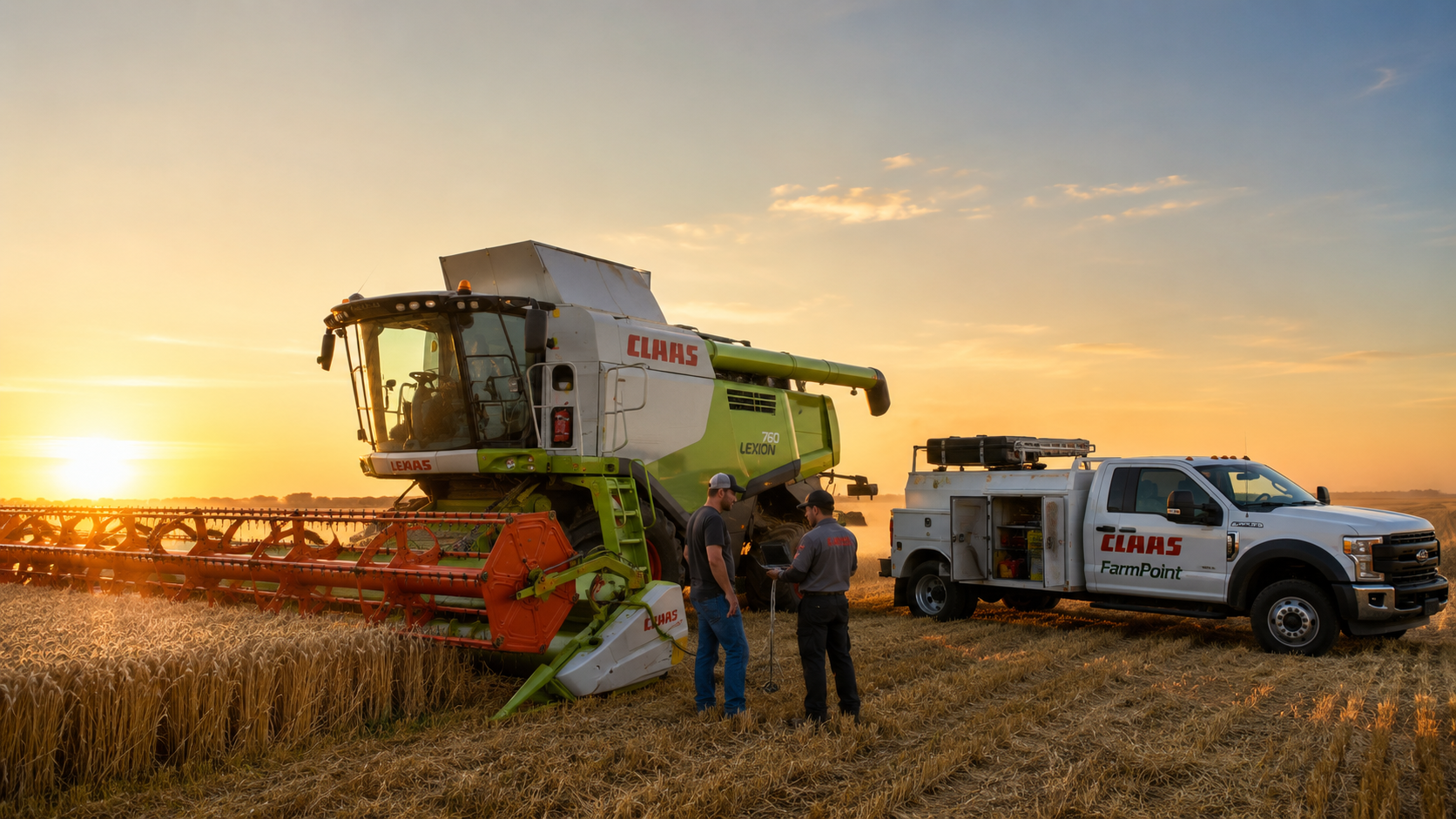
Rather than expecting every customer interaction to happen at a physical location, the CLAAS model is built around bringing more support directly to the farm. Mobile service technicians, strategically located regional parts hubs, remote diagnostics and connected machines all play a larger role in keeping equipment running. CLAAS summarizes the philosophy with the phrase “less brick & mortar, more farm & field,” emphasizing that customer support extends well beyond the walls of the dealership. That doesn’t mean buildings disappear entirely. The new Jamestown facility itself demonstrates that physical locations remain an important part of the network, but they increasingly serve as regional support centers rather than simply destinations for customers. (rrfn.com)
How It Differs From Deere
Comparisons to John Deere are almost unavoidable because Deere has spent generations building one of the strongest dealer networks in North American agriculture. Over the past two decades, many independent dealerships have consolidated into larger organizations operating dozens of locations across multiple states. Those larger groups have been able to invest heavily in inventory, precision agriculture specialists, technician training and customer support while still maintaining a strong local presence.
Even with those changes, the dealership itself remains at the center of the relationship. Farmers still rely on those locations for equipment purchases, parts, service, training and technical support. In many ways, Deere has spent years refining and strengthening the traditional dealership model rather than replacing it.
CLAAS is approaching the question from a different direction. Instead of asking how to build a better dealership, FarmPoint asks whether every interaction needs to begin at the dealership at all. As remote diagnostics improve and machines become increasingly connected, technicians can often identify problems before arriving at the farm. Service trucks can be dispatched with the right tools and parts, reducing unnecessary trips and, in some cases, avoiding the need to transport equipment back to the shop altogether.
Why This Matters
The timing of FarmPoint is no coincidence. Today’s farm equipment generates enormous amounts of diagnostic data, allowing many issues to be identified remotely before a technician ever leaves the shop. At the same time, skilled technicians remain difficult to recruit, construction costs continue to rise and farmers increasingly expect service to come directly to them whenever possible.
None of that eliminates the need for a fully equipped dealership. Major engine work, transmission repairs and extensive rebuilds will always require specialized tools, experienced technicians and shop facilities. However, those large repairs make up only part of a dealership’s daily workload. If routine maintenance, diagnostics and many service calls can be completed on the farm, manufacturers may begin to rethink how much investment belongs in large retail campuses versus mobile service capabilities.
That question extends beyond CLAAS. Every manufacturer is trying to maximize uptime while controlling costs, and every dealer faces the challenge of recruiting technicians and serving larger territories.
Where AGCO Fits Into the Picture
FarmPoint isn’t the only sign that manufacturers are rethinking how dealerships should operate. AGCO has spent the past several years developing its FarmerCore initiative, using its AgRevolution dealer network as a proving ground for many of the same ideas. Mobile service trucks, on-farm repairs, regional parts distribution and digital engagement all play central roles in both strategies. The common thread is a belief that farmers increasingly want the dealership to come to them, rather than making a trip to the dealership for every transaction.
That doesn’t mean the two models are identical. Each company has built its network differently and serves different customer bases. But both suggest the industry may be moving toward a future where dealerships function less as destinations and more as regional support hubs connected by mobile technicians, digital tools and strategically placed parts inventories.
Is This the Future?
It’s difficult to imagine manufacturers such as John Deere abandoning the dealer networks they’ve spent decades building. Those organizations remain one of their greatest competitive advantages and continue to provide tremendous value to customers.
At the same time, it’s equally difficult to ignore the direction the industry is heading. Equipment is becoming more connected, software plays a larger role in machine performance and service technicians increasingly arrive with laptops alongside their toolboxes. Farmers also expect faster service and less downtime than ever before, creating pressure to solve more problems where the equipment is actually working.
Perhaps the future won’t be defined by choosing between traditional dealerships and mobile service. Instead, dealerships may continue evolving into regional support hubs backed by connected technology, strategically located parts inventories and technicians who spend more time in the field than behind a service counter.
Whether FarmPoint becomes the industry standard remains to be seen. But by asking what a dealership should look like in the next generation of agriculture, CLAAS has started a conversation that every major equipment manufacturer will eventually have to answer.

Leave a Reply