For more than half a century, the farm equipment industry has been locked in a horsepower race. As farms expanded, labor became harder to find, and weather windows grew increasingly unpredictable, tractors steadily became larger and more powerful. Every new generation promised to pull wider implements, cover more acres per hour, and help farmers accomplish more work with fewer people.
That progression has shaped nearly every aspect of modern agriculture. Manufacturers invested billions developing larger machines, while farmers accepted ever-higher equipment costs in exchange for greater productivity. On many operations, the largest tractor in the shed became both the centerpiece of the fleet and a symbol of the farm’s growth. Yet a new generation of autonomous technology is raising a question that would have seemed almost unthinkable just a decade ago: what if the future of farming doesn’t require more horsepower at all?
The Logic Behind Bigger Tractors
The trend toward larger equipment wasn’t driven by marketing alone. It was rooted in practical economics. As farms added acres, operators needed to plant and harvest more ground in the same number of suitable field days. Larger implements paired with higher-horsepower tractors allowed producers to cover more acres without adding employees, helping offset persistent labor shortages and making better use of narrow planting and harvest windows.
Manufacturers responded by continually pushing the limits of tractor design. Models that once represented the top of the lineup gradually became mid-range offerings, while today’s largest row-crop tractors exceed 500 horsepower (and well beyond). For many producers, those investments made perfect sense because missing a planting window by even a day or two can have real consequences for yield and profitability.
The downside is equally obvious. Modern high-horsepower tractors often represent one of the largest capital investments on the farm, with purchase prices approaching or exceeding three-quarters of a million dollars before implements are even considered. Those machines deliver tremendous capability, but they also concentrate an enormous amount of money into equipment that may only see its heaviest use during a few critical weeks each year.
A Kentucky Farm Tests a Different Approach
A recent case study highlighted by Future Farming suggests there may be another way to think about machinery. Kentucky grain farmer Quint Pottinger has been experimenting with autonomous field operations using smaller equipment instead of relying solely on one massive tractor. His experience isn’t proof that every farm should abandon high-horsepower machines, but it does illustrate how autonomy changes the conversation.
Traditionally, farmers have measured productivity in acres per hour. The goal has always been to complete as much work as possible before the operator reaches the end of the day. Once the driver goes home, the tractor stops as well, regardless of how much work remains.
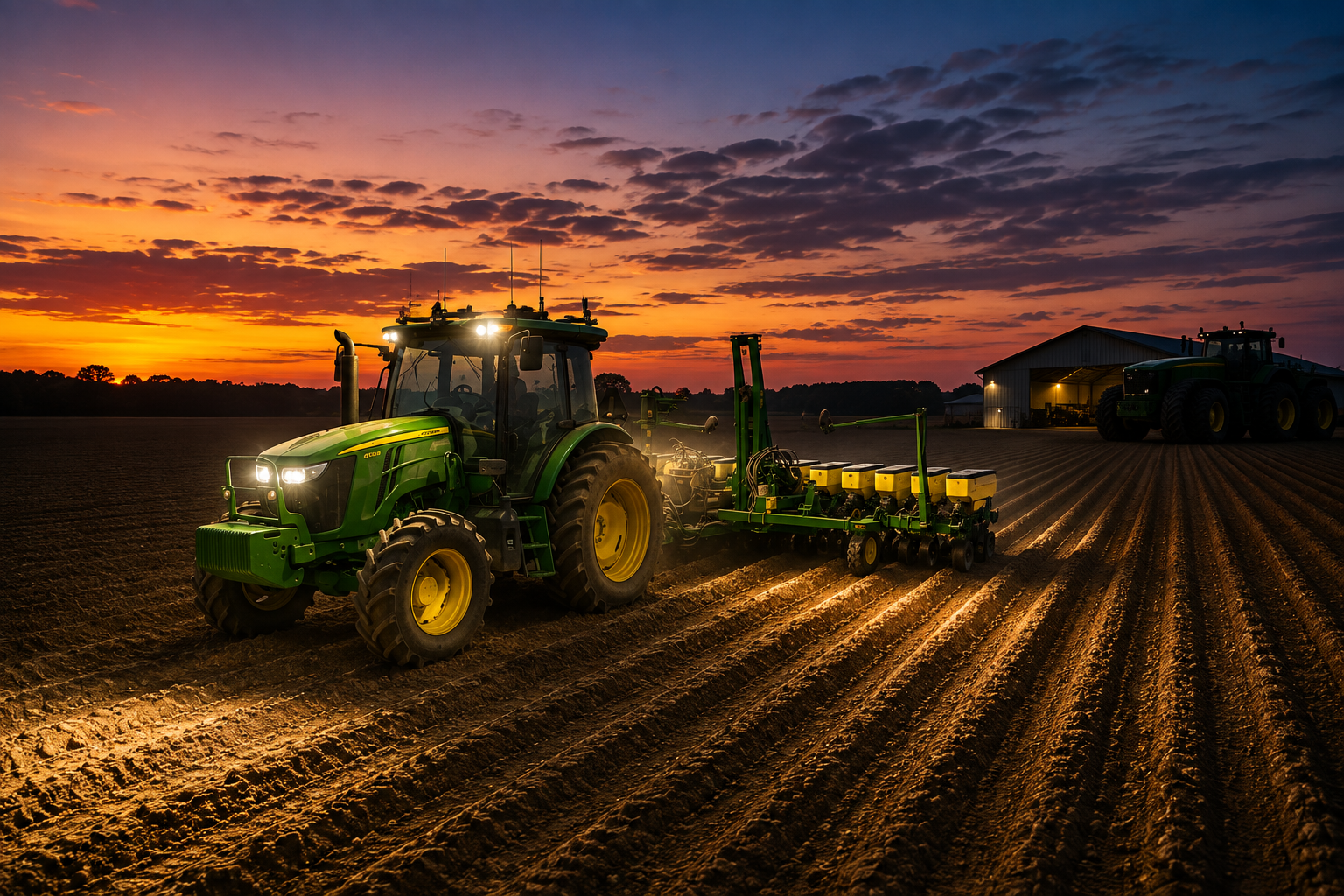
Autonomous equipment changes that equation. A machine that can safely continue operating through the night doesn’t need meal breaks, overtime pay, or a second shift. Even if it covers fewer acres each hour than a much larger tractor, it may accomplish similar work simply because it remains productive for far more hours each day.
From Acres Per Hour to Acres Per Day
That shift may ultimately prove more important than autonomy itself. For decades, the industry has optimized machines around peak hourly productivity because labor has been the limiting factor. The operator’s time determined how much work could be completed, so adding horsepower became the logical solution.
Once the operator is removed from the equation, time begins to look very different. If a smaller autonomous tractor can operate safely for twenty hours while a conventional tractor runs for ten or twelve, the advantage of sheer horsepower starts to narrow. Rather than maximizing acres per hour, farms begin maximizing acres per day.
That doesn’t mean large tractors are about to disappear. Heavy tillage, large air seeders, and other demanding applications will continue to require significant power. However, planting, spraying, mowing, and other repetitive field operations may eventually benefit more from continuous operation than from ever-larger engines.
Rethinking Farm Economics
The implications extend beyond simply buying a smaller tractor. Lighter equipment generally places less weight on the soil, reducing compaction that can affect crop development and water infiltration. Lower purchase prices may also reduce financial risk during periods of high interest rates or volatile commodity markets, giving producers greater flexibility in how they invest capital.
There is also the issue of resilience. When one high-horsepower tractor breaks down during planting season, a large portion of the farm’s capacity can disappear overnight. A fleet of smaller autonomous machines could spread that risk across multiple units, allowing work to continue while one machine is repaired. Whether that approach ultimately proves more economical will depend on each operation, but it represents a fundamentally different philosophy than concentrating nearly all field capacity into one machine.
Perhaps the biggest question is what this means for equipment manufacturers themselves. For decades, the industry’s answer to growing farms has been larger tractors with more horsepower. If autonomy allows producers to achieve similar productivity through longer operating hours instead of larger engines, manufacturers may eventually find themselves competing on software, reliability, and system integration as much as raw pulling power.
The Next Chapter
Autonomous farming remains in its early stages, and significant challenges remain before widespread adoption becomes reality. Producers will need confidence in the technology’s safety, reliability, service support, and regulatory framework before allowing expensive equipment to work unattended. Those hurdles should not be underestimated, and the largest tractors on the market are unlikely to disappear anytime soon.
Even so, the conversation has clearly begun to change. For generations, agriculture has assumed that the path to greater productivity always meant larger machines with more horsepower. Autonomous technology suggests another possibility, one where smarter equipment working longer hours may outperform bigger equipment working shorter ones. If that proves true, the next major chapter in farm machinery may not be another horsepower race at all. It could be the moment agriculture finally discovered that time, not horsepower, was the resource worth maximizing.

Leave a Reply