
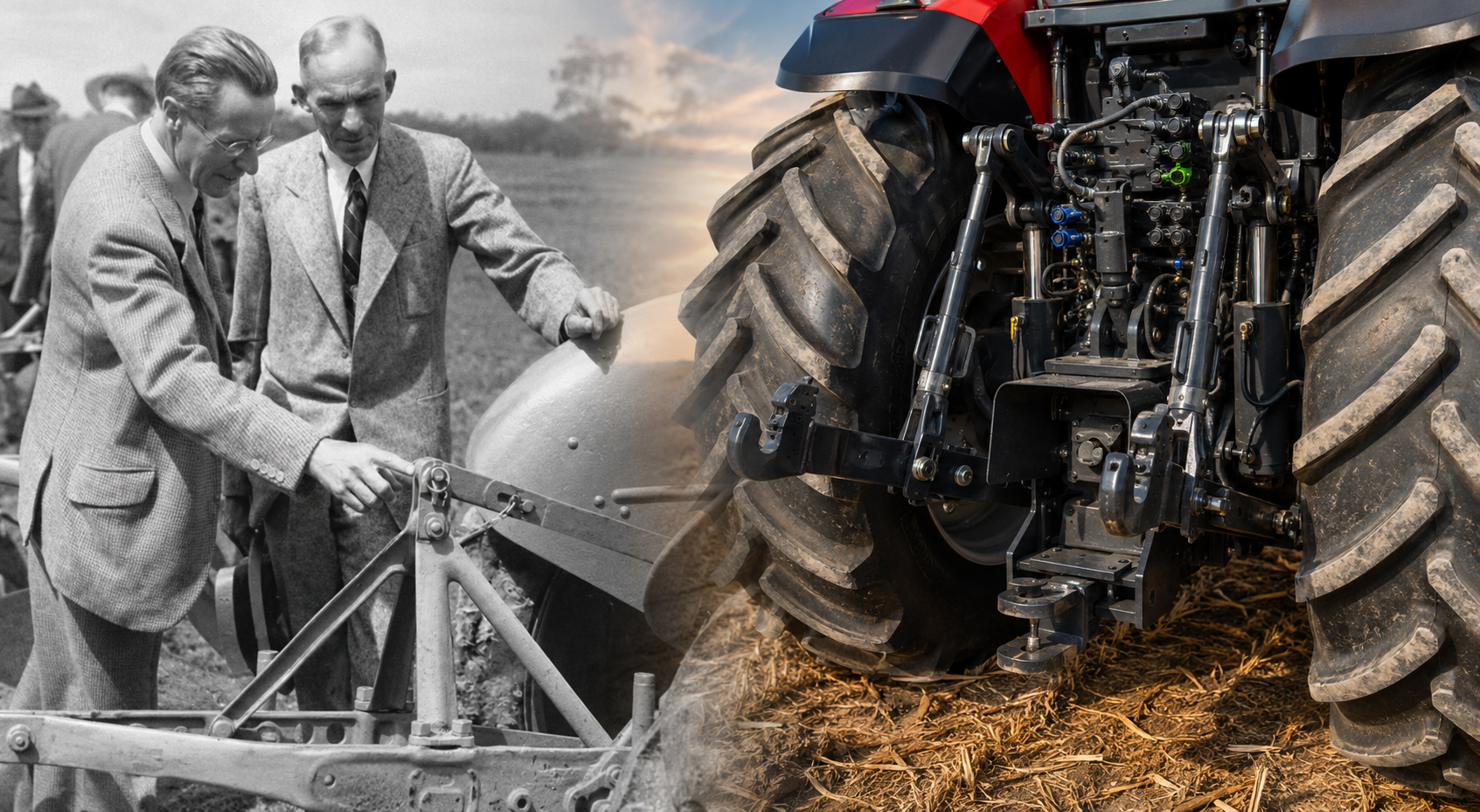
Every November, enthusiasts gather in Northern Ireland to celebrate Harry Ferguson at the Heritage Festival held near his birthplace. For many, it is a chance to admire beautifully restored Ferguson tractors and honor one of agriculture’s greatest inventors.
What some may not realize is that nearly every modern farm tractor, regardless of whether it is painted green, red, blue, orange, or yellow, still carries the DNA of Harry Ferguson’s ideas.
His name appears on vintage Massey Ferguson tractors around the world, yet his greatest contribution extends far beyond a single brand. More than ninety years after he developed what became known as the Ferguson System, the principles behind it continue to define how tractors connect to implements, transfer power to the ground, and work safely in the field.
Before Ferguson, Tractors Had Serious Problems
Early tractors were powerful, but they were often crude. Implements were commonly pulled from a simple drawbar, much like a wagon. When a plow encountered a buried rock or heavy patch of soil, all of that force transferred directly into the tractor. In some situations, the rear wheels could become the pivot point, causing the front end to rise dangerously. Tractor rollovers were a very real hazard, while traction and working depth were inconsistent.
Ferguson believed the tractor and the implement should not behave as two separate machines. Instead, they should function as one integrated system. That idea changed everything.
More Than Just Three Arms
Most people know Ferguson as the inventor of the three-point hitch, but the hitch itself was only part of the breakthrough.
His real innovation combined the hitch with hydraulic draft control. As the load on an implement increased, the hydraulic system automatically sensed the additional draft and slightly lifted the implement to maintain traction. When conditions became easier, it lowered the implement back to its working depth.
Today that sounds almost ordinary. In the 1920s, it was revolutionary. The benefits were immediate.
Farmers gained better traction without adding unnecessary weight. Implements maintained more consistent working depth. Tractors became more efficient, consumed less fuel for the same work, and were significantly safer when encountering hidden obstacles. The three-point linkage also made attaching and changing implements dramatically easier than many earlier systems.
The Famous Handshake
Ferguson spent years trying to convince manufacturers to adopt his system. After developing early production tractors with David Brown in England, he demonstrated his ideas to Henry Ford. In 1938, the two men reached what became one of the most famous agreements in agricultural history: a simple handshake.
The result was the Ford-Ferguson 9N, introduced for the 1939 model year. It brought the Ferguson System to a massive audience and helped establish the three-point hitch as the future of tractor design.
The partnership eventually ended in a lengthy legal dispute after Henry Ford’s death, but by then the concept had already proven itself. Manufacturers across the industry recognized the advantages, and the three-point hitch gradually became the worldwide standard.
The Most Successful Tractor Feature Ever?
Modern tractors are packed with sophisticated technology. GPS guidance keeps passes perfectly straight. AutoTurn completes headland turns without driver input. ISOBUS allows implements and tractors to communicate seamlessly. Cameras, sensors, telematics, and artificial intelligence continue to change how farming is done.
Yet almost every one of those innovations sits on top of a mechanical foundation Ferguson pioneered decades ago. Look behind nearly any utility, row-crop, or compact tractor today and you’ll still find the familiar triangular arrangement of two lower lift arms and a top link. The geometry has been refined, electronics have been added, and hydraulic capacity has increased enormously, but the basic concept remains remarkably unchanged.
That kind of longevity is rare in engineering.
An Innovation That Outlived Its Inventor
Harry Ferguson was more than a tractor designer. He built and flew his own airplane, experimented with automotive engineering, and even contributed to four-wheel-drive racing technology. Still, it is agriculture where his legacy is impossible to miss.
Every time a farmer backs up to a mower, planter, rotary cutter, box blade, sprayer, or cultivator and connects it in minutes, Ferguson’s influence is at work. Every time draft control helps maintain traction through changing soil conditions, his thinking is still solving problems.
The newest tractors may feature touchscreen displays, RTK guidance, and autonomous capabilities, but they continue to rely on ideas developed by an engineer from rural Ireland who believed tractors could be smarter, safer, and more efficient.
That is why, decades after his passing, Harry Ferguson remains one of the most influential figures in agricultural history. The festival celebrating his life is a reminder of an extraordinary inventor, but the real tribute is taking place every day in fields across the world, wherever a three-point hitch goes to work.


Leave a Reply