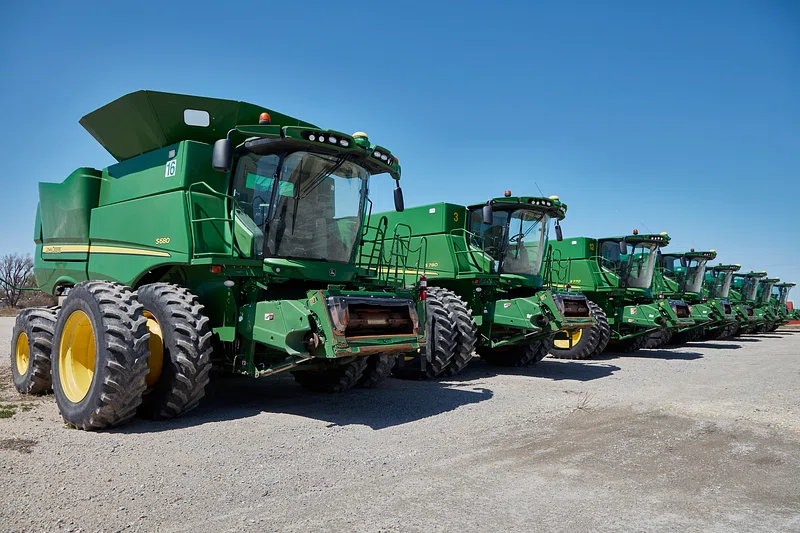
Buying a combine is one of the biggest equipment investments most grain farmers will make. After years of rapidly rising machinery prices, however, farmers willing to consider used equipment may finally have something that has been in short supply lately: leverage.
The used combine market has shifted considerably from the shortages and soaring prices of the early 2020s. Dealers accumulated more late-model machines as farmers traded during stronger commodity markets, while tighter farm margins have since cooled demand for expensive equipment. The result is more choice for buyers and more incentive for sellers to make a deal.
The Equipment Market Has Changed
The slowdown in farm equipment has been difficult to miss. According to the Association of Equipment Manufacturers, U.S. combine sales fell 56.1% year over year in May before rebounding slightly in June, when sales increased 3.9% compared with June 2025. (newsroom.aem.org)
That’s a major reversal from earlier in the decade, when supply-chain disruptions, strong commodity prices and elevated farm incomes helped push machinery demand and prices sharply higher. As farm margins tightened and borrowing and input costs increased, equipment demand cooled. (farmdocdaily.illinois.edu)
Jeff Madsen, remarketing manager for CLAAS, recently told RFD-TV that tighter margins and higher new-equipment prices are causing farmers to be more deliberate about capital purchases. Modern combines can also remain productive for a long time when properly maintained, strengthening the argument for buying used. (rfdtv.com)
Let Someone Else Pay the Biggest Depreciation
A late-model used combine offers a lower purchase price after its first owner has already absorbed some of the steepest depreciation.
Instead of putting a large amount of capital into a new combine, a farmer may be able to buy a machine only a few years older with much of the capacity, technology and comfort of the newer model. The savings can stay in the operation or go toward a better head, precision technology, grain handling, repairs or simply preserving working capital.
Finding the best value requires looking beyond the sticker price. Madsen recommends considering acreage, crop mix, annual utilization, fuel efficiency, harvest performance and total cost of ownership, along with warranty coverage, financing and dealer support. (rfdtv.com)
A $150,000 combine that immediately needs $50,000 worth of work can quickly become more expensive than the $180,000 machine sitting beside it.
A Buyer’s Market Means You Can Be Pickier
One of the biggest advantages of today’s market is choice. When inventories are tight, farmers may have to compromise on hours, configuration or condition simply to secure a machine before harvest. More inventory gives buyers the ability to compare machines, inspect their histories and walk away from one that doesn’t make sense.
There are also indications that the window may be starting to narrow. University of Illinois farmdoc reported used-combine inventory down 9.5% year over year earlier in 2026. Asking values were nearly flat, while auction values increased 7.47%. (farmdocdaily.illinois.edu)
Those numbers suggest the market may be gradually absorbing some of its excess inventory. Farmers who know they’ll need additional harvesting capacity in the next year or two may have reason to shop while selection remains relatively strong.
Condition Matters More Than Model Year
Hours naturally get plenty of attention when shopping for a combine, but they don’t tell the entire story. A higher-hour machine that was carefully maintained and repaired when needed can be a better investment than a lower-hour combine with an unknown history.
Buyers should inspect high-wear areas throughout the feederhouse, threshing and separating system, unloading system, grain tank and cleaning system, along with belts, chains, bearings and hydraulics. Service records are particularly valuable because they can show when major wear components were replaced and provide a clearer picture of what the machine may cost over the next several seasons.
Electronics deserve the same scrutiny. Displays, sensors, yield monitoring, guidance and automation systems can represent significant value on a late-model combine, but also significant repair costs if they aren’t working properly.
A thorough inspection helps buyers understand the repairs a machine is likely to need and account for those costs before making the deal.
Reliability Still Comes First
There is one reason farmers shouldn’t become overly focused on finding a bargain: harvest doesn’t wait.
A combine that saves tens of thousands of dollars at purchase but spends critical harvest days waiting for parts isn’t much of a bargain. Dealer support, parts availability and familiarity with the machine can be worth paying for, which is why total cost of ownership matters more than the number on the sales listing.
Ultimately, value comes down to finding a machine that can reliably harvest the required acres at a reasonable total cost.
A Window Worth Watching
Farmers have spent the past several years watching machinery prices climb while availability fluctuated dramatically. Today’s market looks considerably different, with weaker new-equipment demand, more used choices and farmers scrutinizing large capital purchases more carefully.
At the same time, used inventories have begun moving lower and auction values have shown signs of strengthening. That could make this an especially interesting moment for farmers who already know a combine purchase is on the horizon.
Today’s buyer-friendly market gives farmers an opportunity to be selective and find a well-maintained machine whose first owner has already absorbed a significant portion of the depreciation.
For the farmer who finds the right one, a good used combine could deliver many more harvests without carrying the price tag of brand-new iron.

Leave a Reply