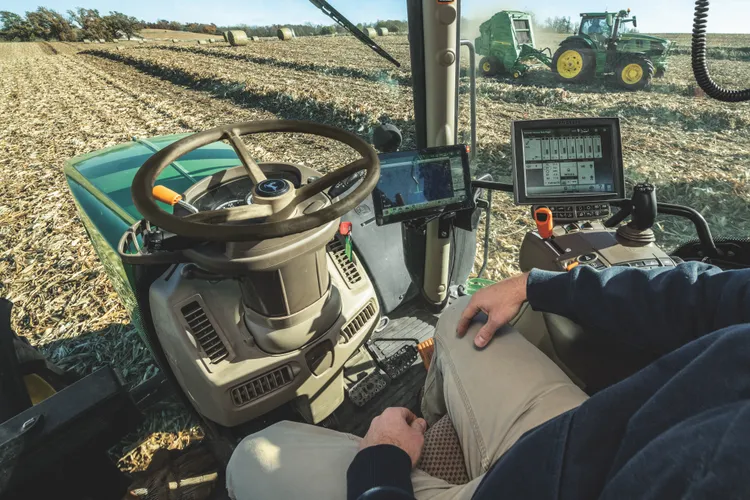
John Deere says its newest baling technology can reduce operator activity by as much as 76%. That doesn’t mean the tractor is ready to head to the field without anyone in the cab, but it may offer a more practical look at how automation is likely to change farm work in the near future.
Deere’s new Hands-Free Baling system brings together technologies the company has been developing for years, allowing the tractor and round baler to handle much of the steering, speed control, bale formation and bale-ejection process automatically. The result is a system designed to make an experienced operator’s day easier, and potentially to make experience itself less important when deciding who can run the baler.
That could be a significant benefit on farms where finding another capable operator is often harder than finding another tractor.
What Does Hands-Free Baling Actually Do?
Hands-Free Baling is designed specifically for cornstalks and straw. It combines AutoTrac guidance, AutoTrac Turn Automation, gate automation, speed automation and Weave Automation on Deere’s 1 Series round balers.
Together, those systems allow the tractor to follow windrows using guidance created during previous passes. The baler automatically moves from side to side to fill its chamber evenly, while speed and gate automation control tractor speed and manage stopping, wrapping and ejecting the finished bale. When the tractor reaches the end of the field, AutoTrac Turn Automation handles repeatable headland turns.
One particularly interesting part is that some of the information needed to make it work may already exist.
“Those guidance lines in the field are already out there from planting and combining,” Deere hay and forage marketing manager Kaylene Ballesteros told Successful Farming.
That means farmers may be able to get more value from precision technology already on their equipment, rather than investing in an entirely new system.
Deere Reports 76% Less Operator Activity
The headline number comes from a 2025 internal John Deere study using a 6R 175 tractor and 561R round baler in central Iowa cornstalks. Compared with baling manually with the automation disabled, Deere reported up to a 76% reduction in operator activity, including steering and control inputs. The company also reported up to 8.4% more bales per hour and a 4.4% improvement in fuel efficiency, measured in tons baled per gallon.
Those numbers should come with some context. This was Deere’s own testing with a specific tractor, baler, crop and set of field conditions, so individual results will vary. Still, they suggest that reducing operator involvement isn’t necessarily coming at the expense of productivity.
In fact, Deere argues that automation can make the process more consistent, particularly when the person in the tractor doesn’t have years of baling experience.
“We want to take the mental fatigue away so they can continue to focus on their operation,” Ballesteros told Successful Farming. “Many farmers and ranchers might want to put someone else in the seat.”
That last sentence may be the most important part of the entire announcement.
What If the Operator Doesn’t Have to Be an Expert?
Anyone who has spent years baling develops a feel for the job. An experienced operator knows how quickly to travel, how to follow an imperfect windrow and how to weave back and forth to keep the chamber filled properly. They recognize when something doesn’t look or feel right before a monitor necessarily tells them.
That’s valuable knowledge, but it also creates a problem when someone else needs to take over.
Hands-Free Baling essentially transfers some of that responsibility from the person to the equipment. Weave Automation monitors crop flow and chamber fill and moves the baler side to side without operator input. Guidance keeps the tractor where it belongs. Speed automation manages travel speed, while gate automation handles another repetitive part of the bale cycle.
The experienced operator doesn’t suddenly become unnecessary, but the gap between that person and a less experienced employee or family member can become smaller.
Deere puts the benefit in practical terms. Ballesteros said the combination of greater productivity, lower fuel use and fewer operator inputs could allow a farmer to put “a less experienced operator in the seat” while tackling other priorities elsewhere on the operation.
For farms struggling to find skilled labor, that may ultimately be more valuable than simply making baling easier.
Automation Doesn’t Have to Mean Driverless
Agricultural automation is often discussed in terms of fully autonomous tractors, machines operating around the clock and eventually removing the driver from the field altogether. Hands-Free Baling shows another way the transition could happen.
There isn’t one revolutionary technology here that suddenly makes the baling process autonomous. Deere is combining several technologies that have been arriving gradually.
AutoTrac handles guidance. AutoTrac Turn Automation handles the headlands. Speed and gate automation have already been on the market for more than a decade. Weave Automation, introduced more recently, fills another gap by controlling bale formation. Put them together and suddenly the operator is doing substantially less.
“Hands-free baling highlights how our gate and speed automation, that launched over 10 years ago, continues to build on itself, unlocking more and more value,” Ballesteros said.
That gradual progression may tell us more about the future of farm equipment than some of the more dramatic autonomous-machine concepts.
A tractor doesn’t have to go from completely manual to completely driverless. Instead, every new generation of equipment can take responsibility for another part of the job. Steering becomes automatic. Then turns. Then speed. Then implement control. Eventually, the person in the cab spends less time physically operating the machine and more time supervising what it is doing.
Getting More From Technology Farmers Already Bought
There’s another important part of Deere’s strategy here. Hands-Free Baling can use guidance lines established during earlier passes through the field, including planting and combining. Rather than treating baling as an entirely separate operation, Deere is finding ways to extend precision technology across more of the crop cycle.
For farmers who have already invested heavily in precision agriculture, that matters. The economics of a guidance system look different when the same investment can improve planting, harvesting and eventually baling.
Deere says Hands-Free Baling is available on select 1 Series round balers equipped with Weave Automation and paired with properly equipped 6R, 7R and 8R tractors. For now, the system is focused specifically on cornstalks and straw rather than every round-baling application.
But the bigger significance may have less to do with baling. Deere’s 76% figure comes from an internal study, and farmers will ultimately determine how well the system performs across different crops, fields and conditions. Even so, Hands-Free Baling offers an interesting glimpse of what agricultural automation may look like before fully autonomous equipment becomes commonplace.
The operator is still in the cab and still responsible for overseeing the job, but more of the repetitive work is being handed over to the equipment. That may ultimately be how automation reaches most farms: not by replacing the operator all at once, but by gradually asking less of the person in the seat as the machine learns to handle more on its own.
Leave a Reply