
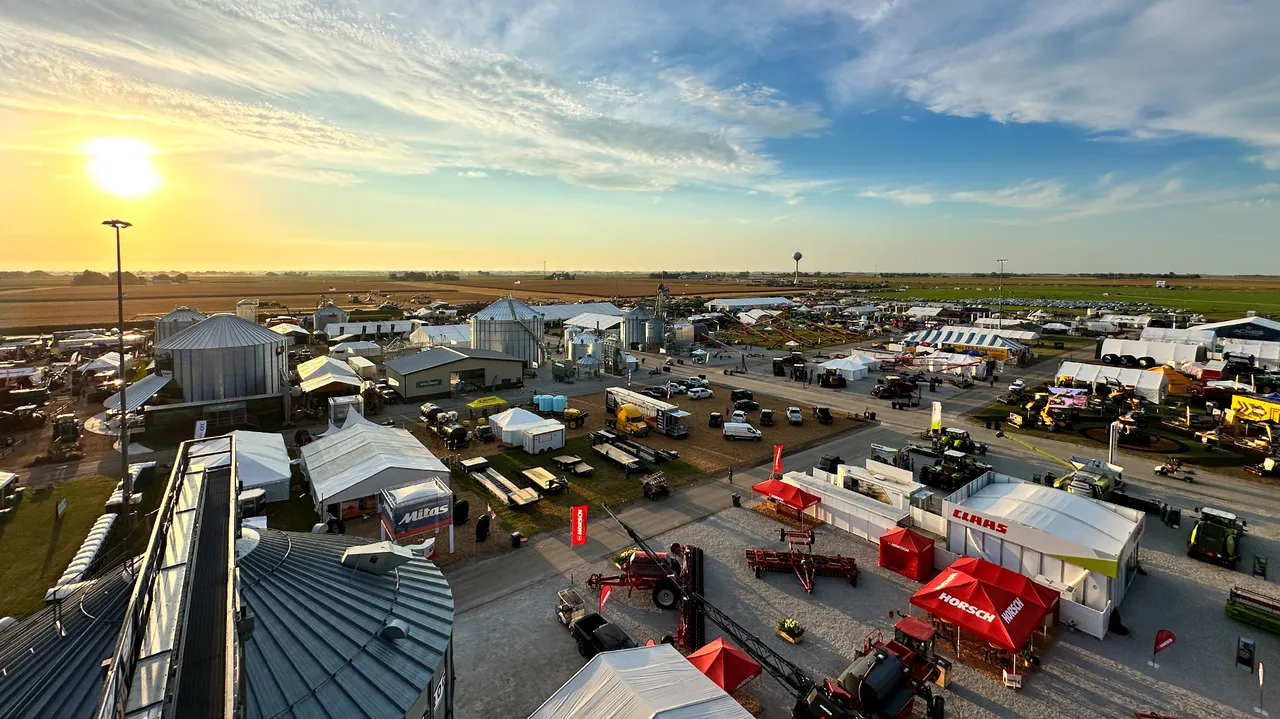
The Farm Progress Show has always been a place for manufacturers to show farmers what’s coming next, and the 2026 edition in Boone, Iowa, delivered everything from an 80-foot planter and 680-horsepower tractor to retrofit autonomy, targeted spraying and a new generation of CLAAS tractors.
Some introductions were enormous in the literal sense. Others showed how quickly precision technology is moving beyond factory-installed options and into equipment farmers already own.
Here are some of the machinery and technology reveals that stood out at this year’s show.
Fendt Goes Big With an 80-Foot Momentum Planter
It was difficult to overlook Fendt’s new Momentum planter.
The new flagship stretches 80 feet across and plants 32 rows at 30-inch spacing. Fendt equipped it with 130 bushels of onboard seed capacity, a 1,000-gallon fertilizer tank and a five-section vertical contouring toolbar designed to maintain consistent planting depth over rolling terrain and terraces.
It is the largest planter Fendt has produced and was part of a much broader statement from AGCO about its ambitions in North America.
Fendt also introduced the second-generation 1100 Vario MT track tractor, producing up to 680 horsepower and featuring an active, hydraulically driven steerable axle. The launch was particularly significant because it marked Fendt’s first global tractor introduction held in the United States.
At the other end of the lineup, the new 300 Vario Gen5 brings Fendt technology into the 113- to 152-horsepower range, with a redesigned cab and updated electronics.
JCB Brings the 41-MPH Fastrac 6300 to North America
JCB’s Fastrac has always been an unusual tractor by American standards, and the new 6300 Series continues that tradition.
The 335-horsepower tractor can travel as fast as 41 mph on the road while retaining JCB’s hydropneumatic suspension system for field operation. An optional integrated central tire inflation system allows operators to change tire pressure between road and field conditions.
The hydraulic system can provide up to 106 gallons per minute of flow, putting large planters and air seeders squarely within its intended workload.
While the 6300 had previously been revealed overseas, Farm Progress Show gave many North American farmers their first close look at the tractor ahead of its arrival at select dealers.
PTx Pushes Retrofit Technology Further
Some of the show’s most consequential introductions weren’t tractors at all.
PTx Trimble introduced Symphony Vision, a camera-based targeted spraying system designed to retrofit onto existing sprayers. Rather than requiring farmers to replace an entire machine to gain camera-based precision application, the system brings the technology to equipment already in the fleet.
PTx also showed expanded capabilities for OutRun, its retrofit autonomy platform. OutRun can currently automate compatible John Deere 8R and select Fendt tractors, with compatibility for Deere 9R tractors planned as well.
Another introduction, ArrowTube, takes precision planting down to the orientation of the individual seed, positioning corn seed as it enters the soil to encourage more consistent emergence and plant development.
Taken together, the products point toward an increasingly important trend in farm technology: some of the industry’s most advanced capabilities are becoming available without buying an entirely new machine.
Massey Ferguson Introduces a New Narrow-Row Planter
Massey Ferguson expanded its planting lineup with the new N-Series split/narrow-row planter.
Available in six configurations ranging from 15- to 22-inch row spacing, the planter comes with factory-installed Precision Planting technology and a modular architecture that allows additional components to be added later.
The company is targeting operations interested in narrower rows, including soybean growers looking for quicker canopy closure.
Massey Ferguson also displayed updates to its Hesston 1436 Double Baler, including a singulation chute that places its two streams of small square bales into a single row and an intelligent weighing system that provides bale data in real time.
Kubota Makes Autosteer a $6,000 Retrofit
Kubota’s Farm Progress Show announcement wasn’t the biggest machine on the grounds, but it may be one of the more accessible technology introductions.
The company launched WorkSmart, a broader precision technology initiative, beginning with WorkSmart Autosteer.
The retrofit guidance system carries a starting MSRP of $6,000 and can be installed on compatible new and used Kubota equipment. That brings technology normally associated with much larger row-crop equipment into compact and utility applications.
For smaller farms, livestock operations and specialty producers, that price point could make autosteer considerably easier to justify.
Case IH Adds More Intelligence to Hay Equipment
Case IH brought several equipment and precision updates to Boone, including the new WD6 Series windrower.
One of its more interesting features is the ability to map relative yield variation across a field while cutting hay. An active hydraulic flotation system also automatically adjusts pressure to maintain more consistent ground contact and cutting performance.
Case IH also highlighted updates to its Axial-Flow 160 Series combines, FieldOps platform, SenseApply targeted spraying and Active Implement Guidance.
And for sheer visual impact, the company’s Heartland and Providence Magnum tractors brought special red, white and blue treatments commemorating America’s 250th anniversary.
New Holland Mixes New Iron With AI
New Holland used Farm Progress Show to introduce three new Workmaster compact utility tractors, the 45C, 50C and 55C, ranging from 47 to 57 horsepower.
They were also among the first machines shown in New Holland’s updated “Dynamic Blue” paint, a slightly brighter shade that will gradually appear across additional product lines.
For hay producers, New Holland showed its 2027 Roll-Belt 1 Series round baler with reinforced components, electro-hydraulic belt tension control and optional factory-installed IntelliBale automation.
But one of New Holland’s more forward-looking demonstrations involved an AI-enabled camera system for forage harvesting. The system analyzes forage in real time, another example of machine vision moving from experimental technology toward practical field applications.
CLAAS Replaces Nearly Its Entire Tractor Lineup
As we recently covered, CLAAS didn’t arrive in Boone with one new tractor, but rather brought a new generation spanning three tractor families.
The new ARION 6, AXION 8 and AXION 9 cover approximately 165 to 450 horsepower, giving CLAAS a substantially updated offering for everything from livestock and mixed farms to large row-crop operations.
The machines share a greater emphasis on drivetrain intelligence, automation, connectivity and operator comfort. For CLAAS, which remains much better known for combines and forage harvesters among many North American farmers, the rollout is also another step toward becoming a bigger player in the U.S. tractor market.
Bigger Machines, Smarter Existing Machines
The 2026 Farm Progress Show offered plenty of traditional horsepower competition. An 80-foot planter paired with a 680-horsepower tractor still draws a crowd, and probably always will.
But the broader story coming out of Boone may be what was happening alongside the big iron.
Retrofit autosteer, retrofit targeted spraying, autonomous tractor conversions, implement guidance, machine vision and even individual seed orientation all received significant attention. Manufacturers aren’t only competing to build larger and more capable machines. They’re competing over how much more productive they can make equipment farmers already have.
That could ultimately prove to be the more important trend from Farm Progress Show 2026.


Leave a Reply