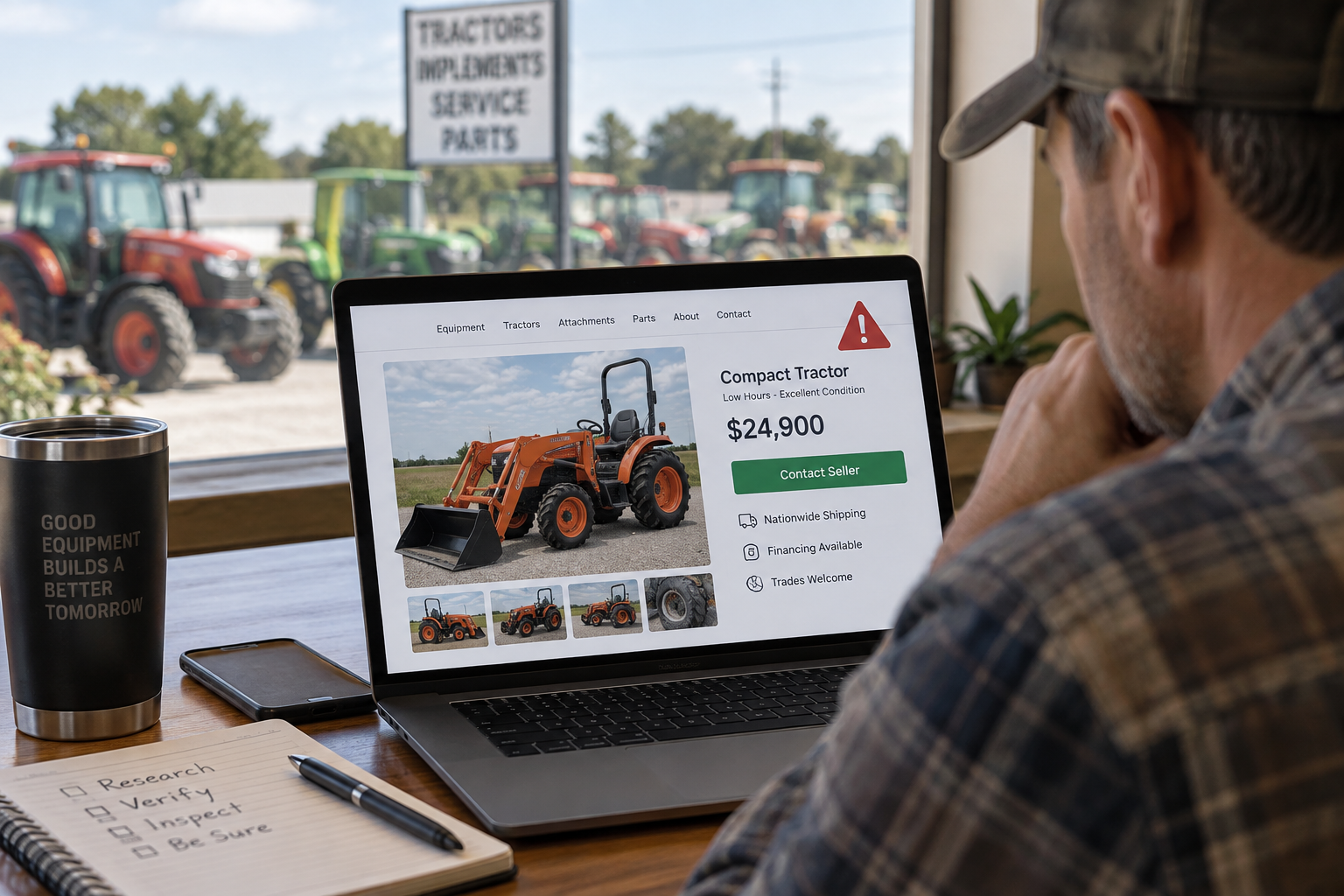
Buying farm equipment online has become commonplace. A farmer in Nebraska can find the tractor, combine or skid steer he needs at a dealership hundreds of miles away, compare it against similar machines and arrange transportation without ever setting foot on the dealer’s lot. That convenience has dramatically expanded the equipment available to buyers, but it has also created an opportunity for scammers.
A recent case in North Carolina shows how expensive the consequences can be. According to the Johnston County Report, a 49-year-old man searching online for a Kubota tractor found a social media advertisement offering one at an unusually attractive price. The seller claimed to be located in Florida, and the buyer ultimately wired $23,500 with the understanding that the tractor would arrive within a few days. It never did. When he tried to contact the seller again, the seller had disappeared, and authorities are now investigating the case as online fraud.
Unfortunately, scams like this are becoming increasingly difficult to spot.
A Nice Website Doesn’t Prove Much Anymore
One of the biggest changes in equipment fraud is the sophistication of the seller’s online presence. The Georgia Department of Agriculture warned farmers this summer about scams involving convincing websites and advertisements that appear to represent legitimate farm equipment dealerships. In some cases, criminals have impersonated real businesses, using AI and other technology to reproduce names, logos, addresses, advertisements and communications.
Farm Progress recently reported on a similar case in which a farmer believed he was purchasing a tractor for just under $50,000. The website appeared credible, but the dealership was an imposter. After the buyer received wiring instructions and the money was sent, the tractor never arrived and the funds could not be recovered.
That means buyers can no longer assume that a polished website, professional logo, inventory photos and salesperson who answers emails are enough to establish that a business is legitimate. If you’re dealing with a small or unfamiliar dealership, particularly one you’ve never heard of before, investigate it independently. How long has the business existed? Does it have a physical location? Does that location actually contain an equipment dealership when you look it up on Google Maps Street View? Are there independent reviews going back several years? Does the phone number listed elsewhere for the business match the person you’re talking to?
For major equipment brands, another useful step is checking the manufacturer’s official dealer directory. If someone claims to be an authorized Kubota, John Deere, Case IH or New Holland dealer, for example, see whether the manufacturer agrees.
Verify the Equipment, Not Just the Seller
Even a real business name doesn’t necessarily mean the person you’re talking to represents that business. Ask for the machine’s serial number and verify it independently when possible. Request additional photographs that aren’t included in the advertisement. Better yet, ask the seller to conduct a live video call and show you the actual machine.
Don’t just ask to see “the tractor.” Ask the seller to show specific things in real time: the serial plate, hour meter, engine compartment, tires, cab or a particular feature visible in the listing photos. Ask them to start it. A scammer who copied photographs from another listing may be able to send you more stolen pictures, but producing the actual machine live is considerably harder.
For a major purchase, an in-person inspection remains one of the best protections available. If the equipment is too far away for you to inspect yourself, consider paying a reputable local mechanic, dealer or other trusted third party to inspect it on your behalf. Buyers should also verify that the seller actually owns the machine by requesting appropriate documentation and investigating potential liens when necessary.
Be Extremely Careful With Wire Transfers
How a seller wants to be paid can be as important as what they’re selling. Wire transfers are attractive to criminals because they can be extraordinarily difficult to reverse once the money has moved.
That doesn’t mean every legitimate equipment transaction involving a wire is fraudulent. Large equipment purchases are routinely completed by wire. It does mean you should be absolutely certain about who is receiving the money before authorizing one.
Never rely solely on wiring instructions contained in an email. Independently call the dealership using a phone number you have verified from another source and confirm the recipient, bank and account information. Be especially suspicious if wiring instructions suddenly change, the recipient doesn’t match the business you’re buying from or you’re being pressured to send the money immediately.
The Price Is Still One of the Biggest Clues
Everybody wants to find the deal someone else missed, and scammers know it. An unusually low price encourages buyers to move quickly because they’re afraid someone else will get there first. That urgency can override the skepticism someone would normally have about sending tens of thousands of dollars to a stranger.
Before getting emotionally invested in a machine, compare it against similar equipment. Look at the same model, year, hours and configuration across multiple marketplaces. A legitimate seller might be somewhat below the market for any number of reasons. A machine priced dramatically below everything comparable deserves an explanation and additional scrutiny.
Don’t let the fear of missing a bargain become the reason you skip verification.
Tractor Tuesday’s Equipment Buyer Checklist
Before sending money for equipment you found online:
- Research the seller independently. Don’t rely exclusively on the website or social media profile where you found the machine.
- Check how long the seller has been operating. A brand-new website claiming decades of experience should immediately raise questions.
- Verify the physical location. Use independent sources to make sure an equipment business actually operates there.
- Call a verified phone number. Find the number independently rather than relying only on contact information supplied by the seller.
- Check the manufacturer’s dealer directory. If the seller claims to be an authorized dealer, confirm it with the manufacturer.
- Compare the price with the market. A price far below comparable equipment is a warning sign, not necessarily a windfall.
- Get the serial number. Verify that the machine and its identifying information match what is being advertised.
- Request fresh photos and live video. Have the seller show specific parts of the machine and start it during a live call.
- Verify ownership. Make sure the seller has the right to sell the equipment and investigate liens when appropriate.
- Inspect it whenever possible. If you can’t go yourself, hire someone trustworthy near the equipment to put eyes and hands on it.
- Be cautious with payment. Never send a large wire simply because a seller is pressuring you to close quickly.
- Verify wiring instructions independently. Call a known, independently verified number before sending funds, particularly if payment instructions have changed.
- Walk away if something doesn’t add up. There will always be another tractor.
Trust, but Verify, Even on Tractor Tuesday
At Tractor Tuesday, we work to keep fraudulent equipment off our marketplace and vet the dealerships whose inventory appears on the site. We want buyers to know who they’re dealing with and to have access to real equipment from real sellers. But no online marketplace should be a substitute for a buyer’s own due diligence, and that includes Tractor Tuesday.
If you’re considering a machine listed on our site, especially from a seller you don’t already know, verify the equipment and the seller before sending money. Call them. Ask questions. Request additional pictures or video. Inspect the machine or have someone inspect it for you. If something about a listing or seller doesn’t look right, contact us.
The internet has made it easier than ever for farmers to find the right equipment beyond their local area, but it has also made it easier for criminals to look legitimate from hundreds or thousands of miles away. A website can be copied, photos can be stolen, reviews can be fabricated, documents can be forged and even the identity of a real dealership can be impersonated.
The best defense is still fairly simple: slow the transaction down, independently verify what you’re being told and don’t send the money until you’re confident both the seller and the machine are real. If the deal disappears because you asked too many questions, it probably wasn’t a deal you wanted in the first place.
Leave a Reply