
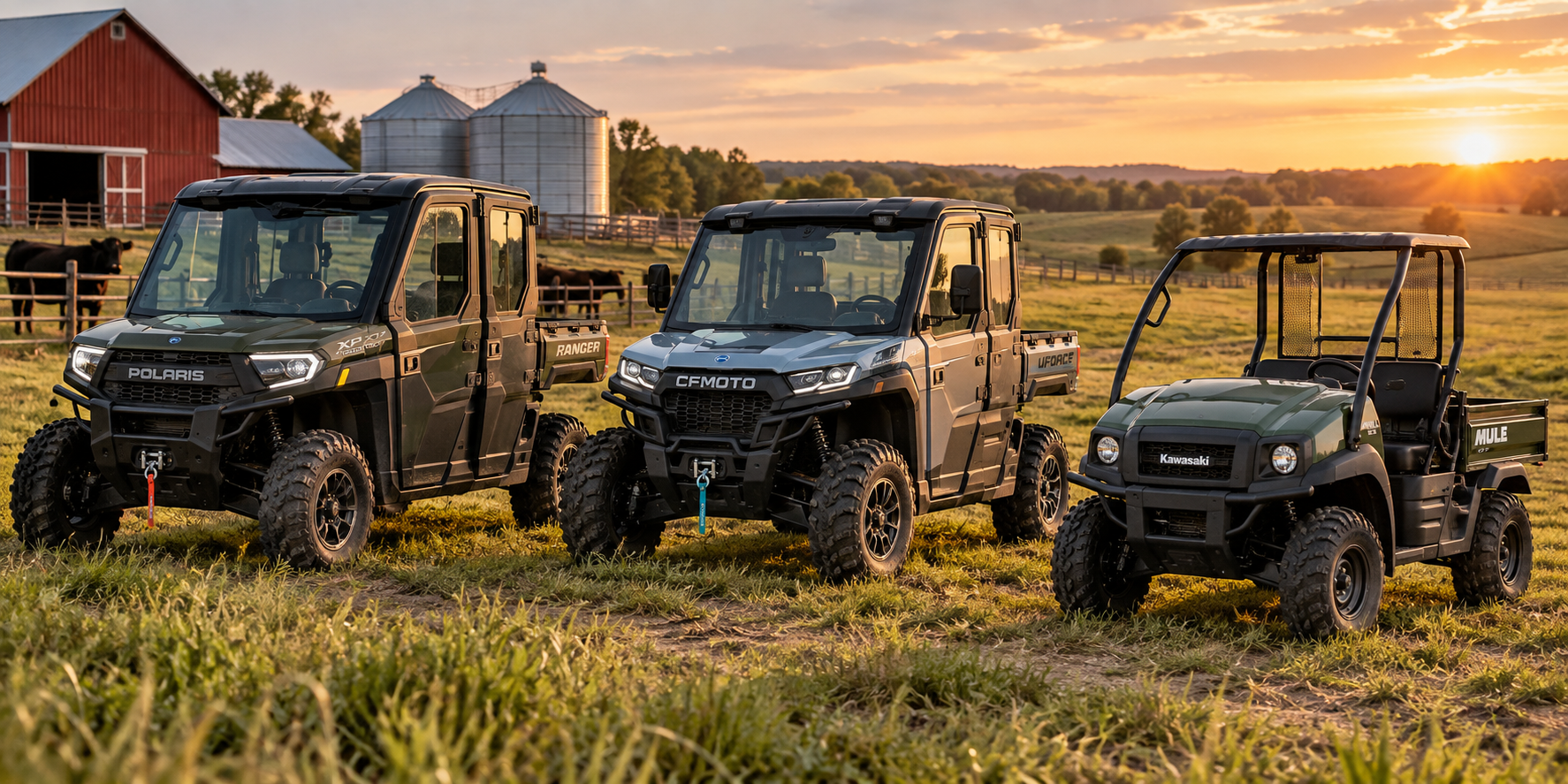
There was a time when a farm UTV was a pretty simple proposition. You got a small engine, a bench seat, a dump box and enough traction to get across a muddy field. It hauled fencing supplies, carried tools, checked cattle and saved a lot of unnecessary trips in the pickup.
Take a look at the 2027 UTV market and that description still fits some machines. Others have become something much closer to miniature pickup trucks, complete with enclosed cabs, heat and air conditioning, power windows, touchscreens, cameras and enough horsepower to make yesterday’s utility vehicles look downright primitive. The prices have followed.
A new 2027 Kawasaki Mule SX starts at $7,799. At the other end of the farm-oriented market, a Polaris Ranger XP 1000 NorthStar starts at $29,999. Between those two numbers is one of the widest ranges of choices farmers have ever had in a side-by-side, and some of the newest machines suggest manufacturers aren’t all betting on the same direction.
When a UTV starts looking like a truck
The 2027 Polaris Ranger XP 1000 Cab is a good example of just how far the category has come. Starting at $24,499, it gets a factory-enclosed cab, heat, air conditioning and powered front windows. Underneath all that comfort is an 82-horsepower engine, a 1,000-pound-capacity cargo box and a 2,500-pound towing rating.
These are actually important features on a farm. Air conditioning matters when you’re checking fields in July, while heat and a sealed cab matter when you’re feeding cattle in January. A 2,500-pound towing capacity and 1,000-pound bed also make a UTV capable of doing jobs that might otherwise require starting a pickup.
Polaris isn’t alone. CFMoto’s 2027 UForce U10 Pro Highland starts at $24,699 and comes with a fully enclosed cab, heat and air conditioning, hard doors and power windows. It also gets an 88-horsepower three-cylinder engine, touchscreen display and 1,000-pound cargo box. The six-seat Highland version climbs to $27,699.
Can-Am is moving in much the same direction. Its 2027 Defender HD10 and HD11 lineup starts at $19,799, with the HD11 producing up to 95 horsepower. Available equipment includes a sealed cab and HVAC system, while Can-Am continues to emphasize towing, cargo capacity and all-day work capability. Put those machines next to an older farm UTV and the family resemblance starts getting harder to see.
More power, more technology, more everything
The evolution isn’t limited to cabs. CFMoto’s new XForce X10 and four-seat X10-4 show just how far the broader side-by-side market is pushing performance and technology. The new machines use a turbocharged three-cylinder engine producing 154 horsepower. They also get electronically adjustable suspension, a 12.3-inch touchscreen, integrated backup camera and Apple CarPlay.
That’s admittedly more recreation than agriculture, but it illustrates what has happened to the category. More horsepower, more suspension, more electronics and more creature comforts have steadily changed buyers’ expectations of what a side-by-side should be.
Even utility machines are following that path. CFMoto’s new three-passenger UForce 10 EPS starts at $14,499 with an 8-inch touchscreen, push-button shifting, electronic throttle, multiple drive modes, downhill assist and auto hold. It still has the stuff farmers care about, including a 1,000-pound dump box and 2,500-pound towing capacity, but there’s considerably more technology between the steering wheel and the tires than there used to be.
For plenty of buyers, that’s progress. A UTV may rack up hundreds of hours a year and serve as one of the most-used vehicles on the farm. Spending more for comfort and capability can make sense when the machine is used every day, but manufacturers also seem to recognize that not everybody wants a $25,000 side-by-side.
The basic UTV isn’t dead
Perhaps the more interesting part of the 2027 market is what’s happening at the other end. Kawasaki still offers the Mule SX with a starting MSRP of $7,799. Its air-cooled 401cc single-cylinder engine makes just 12.3 horsepower, the cargo bed holds 399 pounds and towing capacity is 1,100 pounds. It even still uses drum brakes and, on the base model, two-wheel drive.
On paper, those specifications look almost comically modest beside a 95-horsepower Can-Am or an HVAC-equipped Polaris. On a farm, however, they might be perfectly adequate. If the job is driving from the shop to the grain bins, carrying a mineral bag to the pasture, checking irrigation or throwing a toolbox in the back, 95 horsepower isn’t necessarily what makes a UTV useful. Small dimensions, low operating cost, maneuverability and a price well below $10,000 may matter more.
Kawasaki offers plenty of more sophisticated Mules, but keeping the SX around gives buyers an increasingly unusual option: a new UTV that is still fundamentally a small utility vehicle. Arctic Cat appears to see an opportunity there, too.
For 2027, Arctic Cat introduced the midsize Prowler 500, positioning it as an affordable entry into the side-by-side market. It starts at $10,799, uses a 443cc engine and can tow up to 1,500 pounds. Rather than trying to turn it into a luxury off-road vehicle, Arctic Cat is emphasizing manageable size, utility and price.
Honda is sticking with a similar formula in parts of its lineup. The Pioneer 700 returns for 2027 starting at $12,899, while the smaller Pioneer 520 remains a compact alternative capable of hauling 450 pounds and towing 1,000 pounds. Those machines aren’t trying to compete with a pickup truck on features, and that’s arguably part of their appeal.
Farmers are a big part of this market
The distinction matters because agriculture isn’t a side business for UTV manufacturers. Research from Power Products Marketing cited by Successful Farming estimates farmers account for about 29% of UTV sales. The same research found North American new-UTV sales fell more than 7% in 2024 to approximately 520,000 units and have since stabilized in a relatively soft market.
That market environment could help explain some of what we’re seeing in 2027. Manufacturers still have buyers willing to spend pickup-truck money for a highly capable, climate-controlled machine, but affordability matters when equipment budgets are tight.
It also leaves manufacturers trying to serve two very different definitions of “utility.” For one farmer, utility means an enclosed cab, air conditioning, enough towing capacity for a loaded trailer and enough comfort to spend half a day behind the wheel. For another, it means something small enough to squeeze through a gate, simple enough to maintain and cheap enough that putting muddy boots on the floor doesn’t feel like a financial event. Neither definition is necessarily wrong.
How much UTV does a farm actually need?
That’s probably the more useful question for farmers shopping the 2027 models. A $25,000 machine can earn its keep if it replaces pickup miles, handles serious towing and hauling, and gets used year-round in weather that would otherwise keep an open UTV parked. For livestock operations in particular, a heated and air-conditioned cab can turn a side-by-side into an everyday work vehicle rather than a fair-weather convenience.
But there’s also something appealing about a $7,799 Mule SX or $10,799 Prowler 500. They represent an idea that can get lost as horsepower and feature lists grow: sometimes the best thing about a UTV is that it isn’t a pickup truck. It’s smaller, lighter and easier to get in and out of. It can cross ground where you don’t want a full-size truck, haul the tools you need and get back to the shop without turning every chore into a road trip.
The 2027 market isn’t moving entirely upscale or entirely back toward simplicity. It’s doing both at the same time, which may be good news for farmers. UTVs have become capable enough to replace a pickup for more jobs than ever before, but manufacturers haven’t completely forgotten the basic little workhorses that made them so useful on farms in the first place.


Leave a Reply