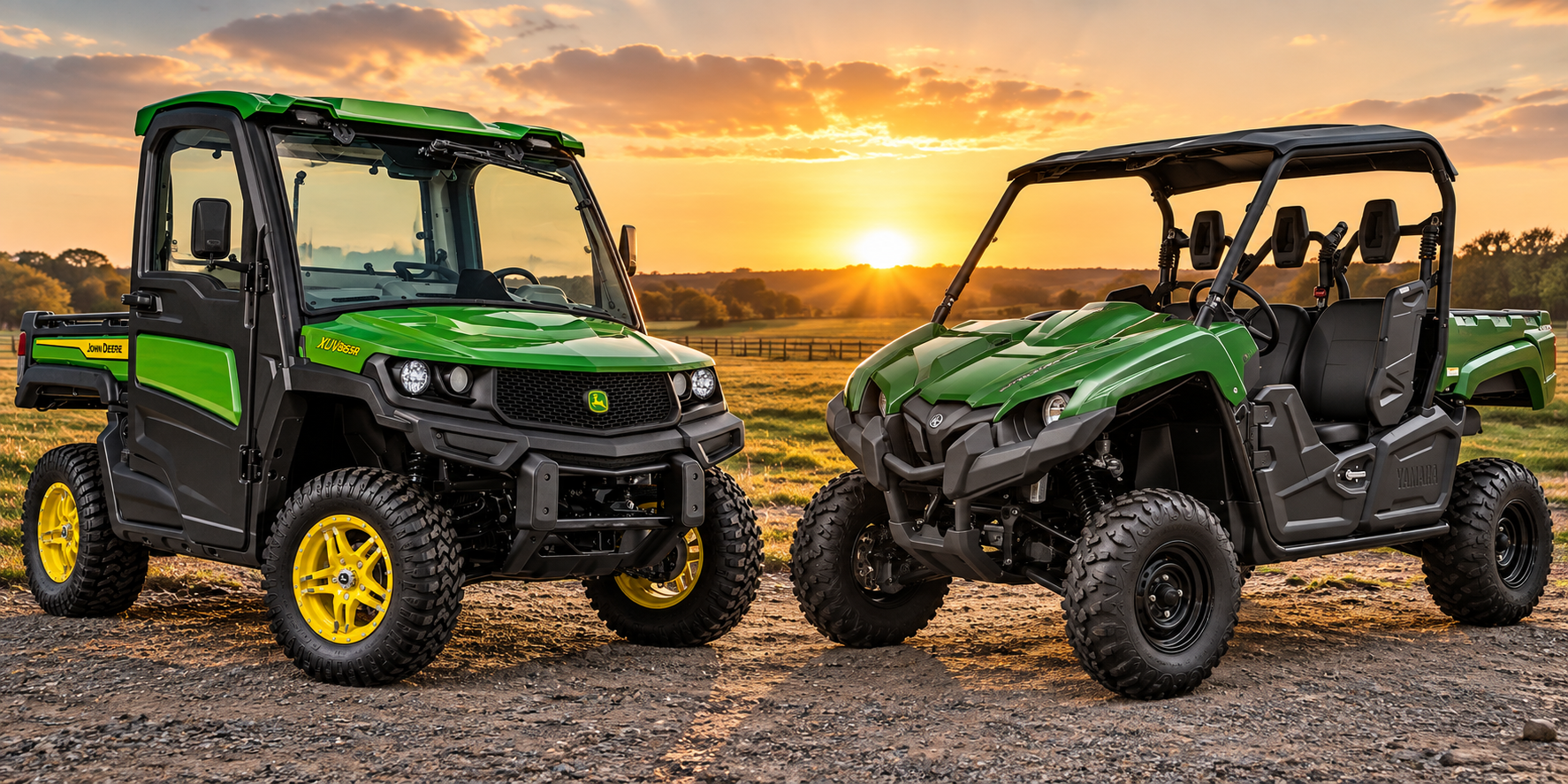
John Deere already knows how to build a successful side-by-side. The Gator has become a familiar sight on farms, ranches and jobsites, and Deere recently redesigned its full-size XUV lineup with machines offering features like factory-installed HVAC.
So why bring Yamaha into the picture? John Deere and Yamaha announced this week that they will collaborate on the development of future side-by-side vehicles, combining Yamaha’s powertrain and vehicle design expertise with Deere’s vehicle development, U.S. manufacturing capabilities and customer knowledge.
Neither company has announced a new model, specifications or a timeline. But the partnership comes at an interesting moment for the side-by-side industry, as traditional work UTVs become more powerful, comfortable and sophisticated.
Two Companies With Different Strengths
At first glance, Deere and Yamaha might seem like competitors. Both already sell side-by-sides and have decades of experience building vehicles designed to operate away from paved roads, but their strengths come from very different places.
Deere has built the Gator around work, closely connecting it to the company’s agricultural, commercial and property-owner customers. Yamaha comes from the powersports world, with experience across motorcycles, ATVs and recreational side-by-sides that gives it considerable expertise in engines, powertrains, suspension and vehicle dynamics.
That difference may be exactly what makes the partnership attractive. Deere specifically says Yamaha will contribute its powertrain and vehicle design expertise, while Deere brings vehicle development, U.S. manufacturing and customer insights. Together, the companies say they hope to accelerate innovation and develop “differentiated products.”
The Utility UTV Is Changing
We recently looked at how UTVs are increasingly being pulled in different directions. Some manufacturers are emphasizing simple, affordable machines that resemble the basic work vehicles that helped create the category, while premium side-by-sides are increasingly becoming miniature pickup trucks.
The 2026 Can-Am Defender HD11, for example, offers a 95-horsepower engine, available HVAC, a 10.25-inch touchscreen and front and rear cameras. Polaris continues expanding its Ranger lineup with factory cab systems, heat and HVAC.
Deere isn’t ignoring that trend. Its current full-size Gator XUV family includes the 845 and diesel-powered 875, including an HVAC-equipped 875 for customers who want an enclosed, climate-controlled work machine. But buyers who once compared primarily payload, towing capacity and price are increasingly being offered more horsepower, better suspension, quieter cabs, electronics and automotive-style comfort.
That’s where Yamaha’s expertise could become particularly valuable.
Could the Gator Get More Yamaha DNA?
Neither company has said Yamaha will simply supply engines for future Gators. In fact, the agreement appears to be considerably broader.
Yamaha describes the arrangement as involving “joint development and mutual supply” of recreational off-highway vehicles. It also says the companies intend to address a broader range of customers in the growing utility segment, where work capability and comfort are becoming increasingly important.
That leaves plenty of possibilities open. A future Gator could potentially benefit from Yamaha’s experience developing compact, high-output powertrains as well as its expertise in suspension, handling, noise and vibration reduction or other areas traditionally emphasized by recreational side-by-sides.
That doesn’t mean Deere wants to turn the Gator into a sport machine. Yamaha could instead help Deere further blur the line between work and recreation without abandoning the Gator’s work-first identity. A farmer may primarily need a machine to haul tools, check fields or tow equipment, but that doesn’t mean the same customer won’t appreciate more power, a smoother ride and a more comfortable cab.
Deere Has Something Yamaha Needs, Too
This isn’t a one-way relationship. Yamaha says the companies will retain their own brands, dealers, sales channels and customer relationships, while the reference to “mutual supply” suggests the collaboration could eventually produce vehicles or components that flow in both directions.
Deere brings an established U.S. manufacturing base at Horicon Works in Wisconsin and direct access to a huge population of farmers, ranchers, contractors and property owners who already use its equipment. That could be especially valuable to Yamaha, which has acknowledged challenges within its own side-by-side business. In reporting its first-half 2026 results, Yamaha said its ATV business performed well but that it continued to struggle with ROV sales.
A closer relationship with Deere could give Yamaha another route into the utility side-by-side market while allowing both companies to share development resources.
Shared Development, Different Machines
There is no indication Deere intends to replace the Gator or dramatically change what the brand represents. Both companies have emphasized that they will maintain separate brands, dealer networks and customer relationships, suggesting any shared engineering could still produce distinctly different machines.
Think less badge engineering and more shared development. A common powertrain, vehicle architecture or collection of components could potentially underpin products tailored differently for Deere and Yamaha customers. Deere could emphasize agricultural utility, attachments and durability, while Yamaha could take some of the same underlying technology in another direction.
Exactly how far the companies intend to take that approach remains unknown, but the partnership is notable precisely because Deere didn’t need Yamaha simply to keep building Gators. Deere already has the brand, factories, dealers and customer base, while its newest full-size XUVs are relatively recent additions.
Bringing Yamaha into future development suggests Deere sees an opportunity to make a bigger leap. Yamaha, meanwhile, gains a partner with deep roots among the farmers, ranchers and professional users increasingly being targeted by the UTV industry.
We don’t know what their first jointly developed machine will look like, or whether it will even wear a Gator badge. But if the utility UTV continues evolving into part work vehicle, part recreational machine and part miniature pickup truck, Deere and Yamaha may have found plenty of reasons to build the next generation together.

Leave a Reply