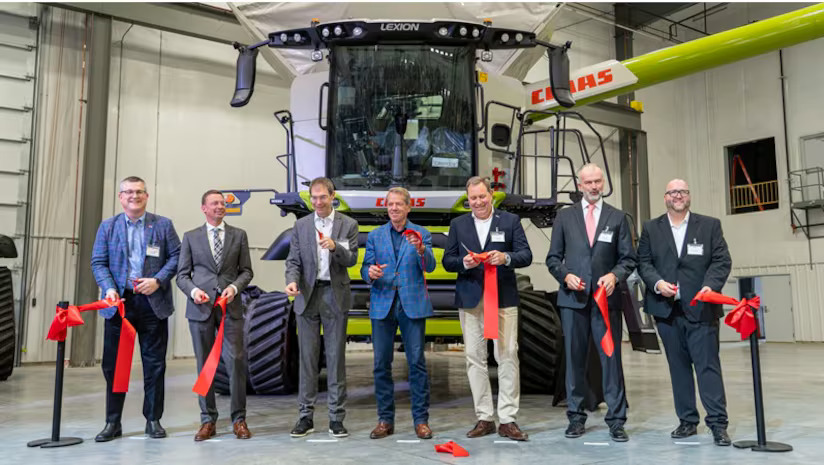
German agricultural equipment manufacturer CLAAS is putting serious money behind its North American ambitions. The company officially opened a new research and development center in Omaha, Nebraska, on October 8, another milestone in a multiyear, $100 million investment and growth strategy for the United States and Canada.
The new facility represents a $10 million investment, but the bigger story is what CLAAS intends to accomplish with it. The company wants to develop and refine equipment specifically for North American farming conditions, bringing more engineering and testing capabilities closer to the farmers who will ultimately operate its machines. For a manufacturer competing against established brands like John Deere, Case IH, and New Holland, that commitment could prove increasingly important.
More Than Just Another Building
The new research and development center sits on CLAAS’s existing Omaha campus, which has been the company’s North American home for more than 25 years. The property already houses its regional headquarters, LEXION combine assembly plant, and CLAAS Training Academy.
The new facility has a 44,800-square-foot footprint, including approximately 12,000 square feet of enclosed space. It provides 25% more capacity than CLAAS’s previous off-site research location and includes expanded instrumentation areas, engineering offices, equipment storage, and a heated indoor wash bay.
More importantly, it will serve as the central hub for CLAAS’s North American equipment testing operations. Engineers will continue testing machinery on farms throughout the United States and Canada, but the data collected from those machines can be brought back to Omaha for analysis. The campus currently employs more than 250 people across manufacturing, engineering, training, and customer support operations.
Why North American Testing Matters
Agricultural equipment designed for European farms doesn’t necessarily face the same demands when it arrives in North America. Field sizes, crop varieties, operating speeds, weather conditions, and farming practices can differ considerably. A combine harvesting wheat in Germany may face very different challenges when cutting soybeans in Nebraska or rice in Arkansas.
CLAAS has long recognized those differences, particularly through its LEXION combine and JAGUAR forage harvester businesses. But developing equipment specifically around North American conditions requires more than adapting an existing machine.
The Omaha center will allow engineers to gather information directly from farms and incorporate those findings into future equipment development. Claudius Knierbein, Head of Engineering for CLAAS Omaha, noted in the company’s announcement that its customers farm in some of the world’s most diverse agricultural conditions. Testing across different crops, soils, and climates can expose problems and opportunities that may never appear during development in Europe.
CLAAS Wants a Bigger Piece of the North American Market
CLAAS is already a familiar name to many North American farmers, particularly those operating large combines and forage harvesters. Its LEXION and JAGUAR machines have established reputations, but the company’s ambitions extend beyond those traditional strengths.
CLAAS has been expanding its North American dealer network while investing in facilities, training, and customer support. In 2025, the company announced additional dealer appointments and plans for a Customer Experience Center at its Omaha headquarters. Together, those investments are designed to strengthen its presence throughout the equipment ownership experience, from product development and sales to service and technical support.
That’s particularly important in a market where established manufacturers have extensive dealer networks and generations of customer relationships. Farmers considering another equipment brand aren’t simply comparing horsepower, capacity, or technology. They’re also evaluating parts availability, dealer support, resale value, and whether the manufacturer will remain committed to their market.
A $100 million investment doesn’t eliminate those concerns, but it provides a tangible indication that CLAAS intends to compete for North American customers over the long term.
The Next Generation of Equipment
The Omaha expansion also comes as agricultural equipment manufacturers face pressure to improve efficiency while adding more advanced technology. Fuel consumption, automation, artificial intelligence, and precision farming capabilities are becoming increasingly important areas of development.
Speaking with Brownfield Ag News following the opening, CLAAS Group CEO Jan-Hendrik Mohr highlighted fuel efficiency and data availability as priorities for future equipment. Reducing fuel consumption by even 5% to 15% compared with previous machine generations could offer substantial benefits to farmers operating high-horsepower equipment for hundreds of hours each season.
Mohr also discussed the potential for artificial intelligence and machine learning to help farmers identify opportunities to improve efficiency. The new Omaha center gives CLAAS another resource for developing and evaluating those technologies under actual North American operating conditions.
A Long-Term Bet on American Agriculture
CLAAS has been assembling LEXION combines in Omaha for decades, and the company says approximately 40% of the components used in those machines are made in America. The addition of a dedicated research and development center strengthens that manufacturing presence while expanding the role Nebraska plays in the company’s global operations.
For farmers, the immediate impact may be difficult to see. An engineering facility doesn’t necessarily translate into a new tractor or combine arriving at a dealership next month, but the equipment being tested and refined through Omaha today could influence what CLAAS brings to the North American market several years from now.
With $100 million committed to its broader growth strategy, CLAAS is making it clear that it sees considerable opportunity in a market long dominated by some of the world’s largest agricultural equipment manufacturers. The question now is how effectively it can turn that investment into better machines, stronger dealer relationships, and ultimately, a larger share of North American equipment sales.


Leave a Reply