
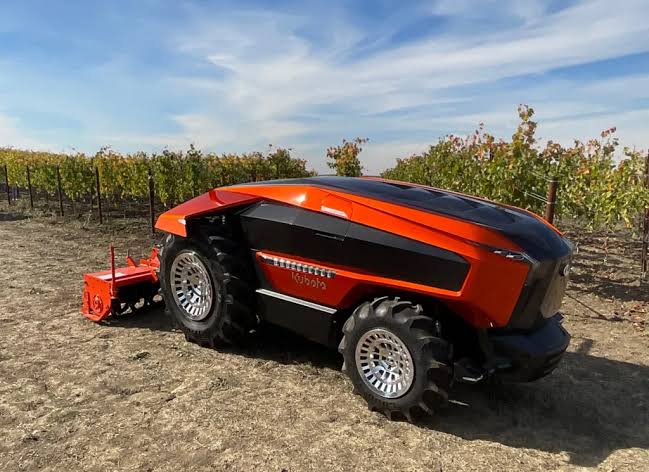
Agricultural equipment manufacturers have spent decades developing bigger tractors, more powerful combines, and increasingly sophisticated technology for large farming operations. Kubota sees another opportunity: bringing more capability and technology to smaller machines.
Recent announcements include precision guidance for compact equipment, a redesigned BX subcompact tractor lineup, and an expanded European partnership involving autonomous weed-control robots. They are very different products, but together they fit a strategy Kubota calls “Big Work with Smaller Machines.”
Precision Agriculture Moves Downmarket
Kubota recently introduced WorkSmart Autosteer, a guidance system for select compact and utility tractors, mowers, and RTVs.
Automated steering is common on larger farm equipment, but smaller operators haven’t always had access to the same technology. WorkSmart Autosteer automatically maintains a selected guidance line for jobs such as mowing, spraying, spreading, grading, and planting.
The system starts at $6,000, excluding installation and subscriptions. Kubota offers a subscription-free version with approximately 6- to 8-inch pass-to-pass accuracy and a higher-precision option capable of accuracy down to one inch.
That’s still a meaningful investment for a small tractor, but it could make guidance practical for livestock producers, hay growers, specialty crop operations, and other customers who don’t need a 400-horsepower tractor to benefit from precision technology.
From Small Tractors to Autonomous Robots
Kubota is taking the same idea considerably further in Europe through an expanded partnership with Norwegian robotics company Kilter.
The Kilter AX-1 is an autonomous spot-spraying robot that uses cameras and artificial intelligence to identify individual weeds and apply small droplets of herbicide directly to them. Kilter says 66 machines have already been delivered, with the expanded Kubota agreement opening additional European markets.
For Kubota, the partnership provides access to specialized robotics without developing everything internally. Kilter gets something equally important: Kubota’s established dealer, parts, and service network.
The AX-1 isn’t coming to North America through this agreement, but it shows where the smaller-machine concept could eventually lead. Instead of simply making a conventional machine larger and more powerful, manufacturers can use automation to make a smaller, specialized machine more productive.
Kubota Isn’t Forgetting the Tractor
At the same time, Kubota has completely redesigned its BX subcompact tractor series, a lineup with roots dating back to 2000.
The new BX90 series includes five models with improvements to loader performance, mowing capabilities, operator comfort, and versatility. There’s nothing revolutionary about the concept. These are still compact tractors built for property owners and smaller agricultural operations that need one machine to perform a variety of jobs.
But that’s also the point. Kubota’s strategy isn’t dependent entirely on autonomous robots or artificial intelligence. The company is continuing to invest in the conventional small tractors that built its reputation while gradually bringing more sophisticated technology into the same end of the equipment market.
Big Work Doesn’t Always Require a Bigger Machine
Kubota formally identified “Big Work with Smaller Machines” as part of its machinery strategy. The idea is to increase productivity through technology rather than relying exclusively on more size and horsepower.
There’s a sizable market for that approach. Smaller farms, livestock producers, orchards, vineyards, and specialty crop operations face many of the same labor and operating-cost pressures as large row-crop farms, but the equipment developed for the biggest operations often isn’t practical for them.
That doesn’t mean every small tractor needs autosteer or every farm needs a robot. A $6,000 guidance system still has to produce enough savings to justify the investment, and autonomous equipment has to prove it can deliver a return outside controlled demonstrations.
Still, Kubota’s recent announcements point in a consistent direction. The company is improving conventional subcompact tractors, bringing precision guidance to smaller machines, and helping put autonomous agricultural robots into commercial use.
For an industry accustomed to measuring progress in horsepower, Kubota is making a different bet: the next jump in productivity might come from making smaller machines smarter, not simply making them bigger.


Leave a Reply