
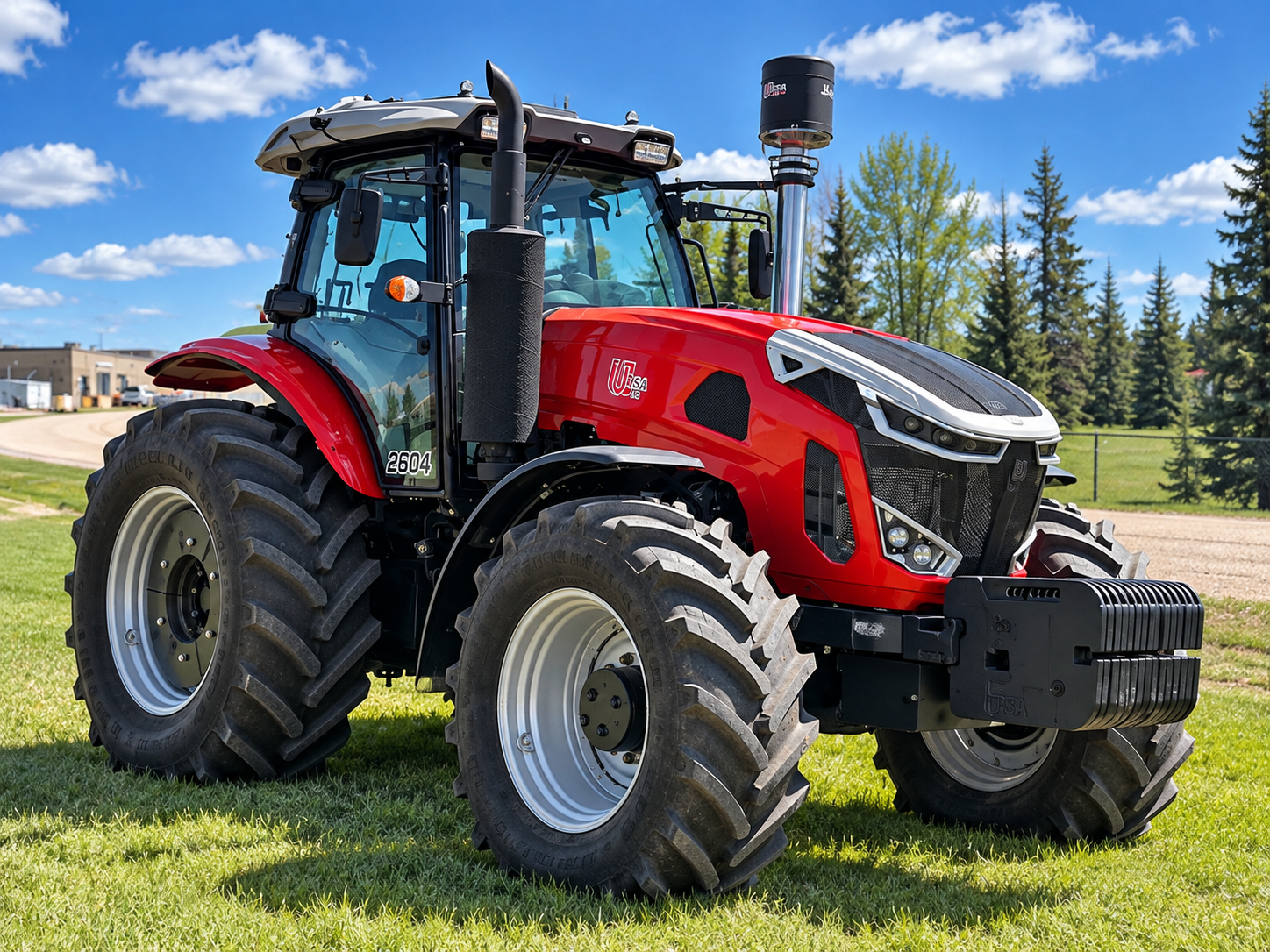
For decades, tractor development has moved in a predictable direction: more electronics, automation, sensors, software and increasingly sophisticated controls.
URSA Ag is going the other way. The small Alberta manufacturer is building tractors around remanufactured mechanical diesel engines, manual transmissions and remarkably little electronic technology. Rather than competing with the latest machines on displays and automation, URSA is betting there are farmers who want a new tractor that behaves a little more like an old one.
Early demand suggests the idea may have found an audience.
A New Tractor Built Around an Old Idea
URSA Ag owner Doug Wilson told The Western Producer that the idea grew partly from a conversation with a customer trying to transfer a farm to his son. The price of newer equipment was making that difficult, which led to a more basic question: What does a farmer actually need in a tractor?
URSA now offers three front-wheel-assist tractors: the approximately 150-horsepower AG 150, 180-horsepower AG 180 and 260-horsepower AG 260. But one of the most unusual parts of the tractors is under the hood.
Rather than using newly manufactured engines with the electronic controls and emissions systems common on today’s higher-horsepower tractors, URSA uses remanufactured older-generation Cummins diesels. The AG 150 and AG 180 use 5.9-liter 12-valve engines, while the AG 260 uses an 8.3-liter Cummins. They use mechanical fuel injection rather than modern electronic engine management.
That means no engine computer and none of the complicated electronic emissions architecture found on most new tractors in this horsepower range. The result is something unusual in 2026: a newly assembled tractor built around an engine many independent mechanics already understand.
The philosophy extends through the rest of the machine. All three tractors use manual transmissions, and the cab isn’t dominated by a giant touchscreen managing dozens of functions. Wilson told The Western Producer that even the backup camera is essentially the tractor’s only significant electronic feature.
The goal is to build a machine its owner can understand, diagnose and repair without specialized software.
Simplicity Has a Price Advantage
URSA’s current Canadian sample pricing starts at C$129,900 for the AG 150, C$149,900 for the AG 180 and C$199,900 for the AG 260, excluding taxes, freight, duties and options.
Those aren’t inexpensive machines, but URSA is trying to avoid charging buyers for complexity they may not need. There are plenty of jobs where autosteer, implement communication, variable-rate application and sophisticated tractor management systems provide real value. A high-hour row-crop tractor pulling precision equipment is very different from one primarily pulling a grain cart, baler, manure spreader or mower.
For those jobs, simplicity can have value well beyond the initial purchase price. Modern tractors are extraordinarily capable, but greater electronic integration also creates more potential failure points. A sensor, software problem or emissions-related fault can sometimes sideline a machine that is otherwise mechanically capable of working. Wilson says one complaint he repeatedly hears from farmers is limp mode.
Downtime rarely happens at a convenient time in agriculture, and losing a tractor during planting, haying or harvest can cost considerably more than the repair itself. URSA’s use of familiar mechanical engines and conventional controls is intended to make more problems something a farmer or local mechanic can address without waiting for specialized diagnostic equipment or dealer support.
That gives URSA an interesting place in the right-to-repair discussion. Instead of asking how to make an increasingly computerized tractor easier for its owner to diagnose, the company is asking how much of that computerization needs to be there in the first place.
There Are Trade-Offs
That formula won’t work for every farm. Removing electronics also removes capabilities, and a farmer relying heavily on ISOBUS, integrated guidance, automation or other precision-ag systems isn’t going to replace a modern high-tech tractor with a basic mechanical machine without giving something up.
The remanufactured engines also introduce an important consideration, particularly for prospective U.S. buyers. Emissions and import regulations differ between markets, and using an older-generation remanufactured engine does not automatically mean a tractor can be imported and operated everywhere. URSA advises international customers to verify applicable import and emissions requirements before purchasing.
URSA also faces a challenge common to any small equipment manufacturer: support. Buyers accustomed to established dealer networks will reasonably want to know about parts availability, warranty coverage and long-term service.
The tractors aren’t entirely Canadian-made, either. URSA assembles them in Bowden, Alberta, using components sourced from multiple countries. Wilson has said cabs, hoods and tires have come from China, other components come from Italy, and some parts, including hydraulic lines and fabricated components, are sourced locally. For a small manufacturer trying to keep prices down, global sourcing isn’t surprising, but it is worth distinguishing a tractor assembled in Alberta from one manufactured entirely there.
How Big Is the Market for a Simple Tractor?
URSA has been building tractors for about four years, and Wilson told The Western Producer that approximately 50 have been sold so far. He expects the company to build another 50 over the next 12 months. Earlier this year, he also reported receiving more than 1,000 inquiries from farmers in roughly 30 countries as attention surrounding the tractors spread online.
Those numbers are tiny compared with the major manufacturers, but they’re significant for a small operation testing a very different tractor philosophy. URSA is already considering where the concept could go next, with Wilson discussing 75- and 100-horsepower tractors, a bale shredder and even the possibility of applying the same low-tech approach to a combine.
If demand continues to grow, URSA may be demonstrating that simplicity can be a product category of its own.
Could Simple Become Its Own Equipment Category?
URSA doesn’t need farmers to reject modern technology for its idea to work. Precision agriculture, automation and increasingly intelligent machinery can deliver real value, and those technologies aren’t going away.
But there may be room at the other end of the market. The continued popularity and strong resale values of certain older tractors suggest plenty of farmers still value equipment that is durable, familiar and relatively straightforward to repair. URSA is essentially trying to package some of those characteristics into a new machine rather than asking farmers to keep tractors built decades ago running indefinitely.
That could appeal to smaller operations, livestock producers, farmers looking for a secondary tractor and buyers who simply don’t need every machine on the farm connected to a software ecosystem. The remanufactured Cummins engines are central to that proposition: familiar mechanical technology, widely understood by independent mechanics, installed in a newly assembled tractor.
The bigger question is whether a small manufacturer can provide the parts, service and long-term support farmers expect from a tractor they may own for decades. Regulatory questions could also limit where URSA can sell its current designs. If the company can navigate those challenges, however, its deliberately low-tech approach could become more than a niche curiosity.
The equipment industry has spent years figuring out what else it can put into a tractor. URSA is testing whether there’s also a market for leaving some of it out.


Leave a Reply