
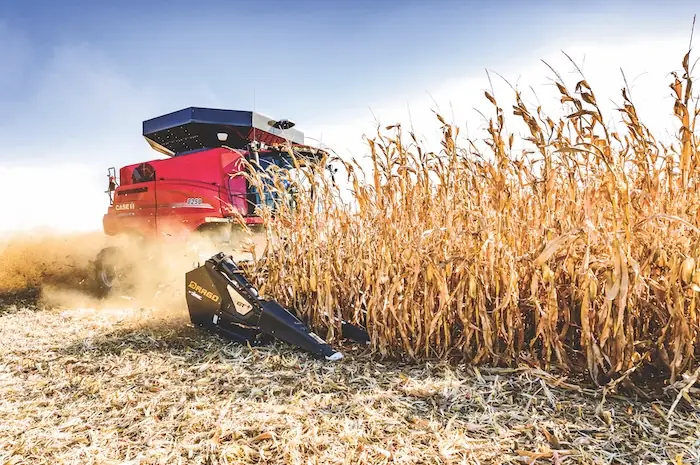
Farmers spend an entire growing season trying to maximize yields, but some of that investment can disappear in the final few seconds before the crop reaches the combine. Ears bouncing off the header, kernels shelling at the deck plates, and stalks slipping past gathering chains can all leave valuable grain on the ground.
With tight margins making every bushel count, reducing harvest loss is becoming an increasingly important part of equipment performance. Dragotec USA is addressing that problem with the new Drago GT+ corn head, introduced for the 2027 model year with improvements designed to capture more grain, handle difficult field conditions, and reduce maintenance.
What Does One Bushel of Harvest Loss Cost?
A single bushel per acre might not sound particularly significant when harvesting a field yielding 200 bushels or more. Across an entire farming operation, however, those losses add up quickly.
At a hypothetical corn price of $4 per bushel, recovering just one additional bushel per acre would represent $4,000 across 1,000 acres. On a 2,500-acre corn operation, that same improvement would be worth $10,000 annually.
| Corn acres | Value of 1 bu./acre recovered |
|---|---|
| 500 | $2,000 |
| 1,000 | $4,000 |
| 2,500 | $10,000 |
| 5,000 | $20,000 |
Those figures illustrate why corn head design matters, although actual savings depend on field conditions, existing equipment performance, and how much grain can realistically be recovered.
How the New Drago GT+ Works to Reduce Loss
The GT+ replaces the existing Drago GT beginning with the 2027 model year. Rather than relying on a single major change, manufacturer Olimac has revised several components involved in separating ears from stalks and delivering grain into the combine.
One of the most important features is Drago’s automatic self-adjusting deck plates. Each row unit independently responds to changing stalk sizes, helping maintain proper spacing without constant operator intervention. The GT+ upgrades the QuadSuspension system with faster response and reduced maintenance requirements, aiming to limit the kernel loss that occurs when ears strike the plates.
The head also retains Drago’s 22.5-inch knife rollers, which pull stalks downward over a longer distance. This allows the rollers to operate with lower tip speeds, reducing the violent impacts that can cause ears to bounce or kernels to shell prematurely.
Other improvements include a redesigned rear pan and kernel barrier to retain loose grain, smoother poly surfaces to improve crop flow, and a higher-capacity cross auger with deeper flighting and a smaller center tube.
Built for Down Corn and Heavy Residue
Harvest conditions rarely remain ideal throughout the season. Higher plant populations, dry stalks, heavy residue, and lodged corn can all make it harder to maintain consistent harvesting speeds without increasing losses.
The GT+ retains a low 17- to 23-degree operating profile, helping the snouts travel beneath leaning stalks. Short down-corn augers are now standard, while revised ear sweeps are designed to keep material moving toward the auger instead of dragging underneath the head.
Durability has also received attention. Drago’s Endura Drive system uses gear-driven components rather than conventional chain drives, and the updated design includes improved driveline protection. Sealed gathering-chain idlers eliminate certain grease points, potentially reducing daily maintenance demands during harvest.
Is a New Corn Head Worth the Investment?
The financial argument for reducing header loss is straightforward, but determining whether a new corn head will pay for itself requires more than calculating the value of a recovered bushel.
A farmer already operating a well-maintained head with minimal losses might see a relatively small improvement. Someone dealing with persistent butt shelling, uneven stalk sizes, or difficult down-corn conditions could have considerably more to gain.
The GT+ also carries the potential benefits of reduced maintenance and improved crop flow, although independent field comparisons will be needed to establish how much better it performs than the previous GT or competing corn heads.
Dragotec is offering the new GT+ in rigid and folding configurations ranging from four to 24 rows, with row spacing from 20 to 40 inches. Orders are open for the 2027 harvest season, with promotional discounts available through December 31, 2026.
For growers evaluating their next equipment purchase, the more important question may be how much grain their current corn head is already leaving behind. Measuring those losses under actual field conditions could be the first step toward determining whether an upgrade makes economic sense.
Sources: Successful Farming, Dragotec USA.


Leave a Reply