
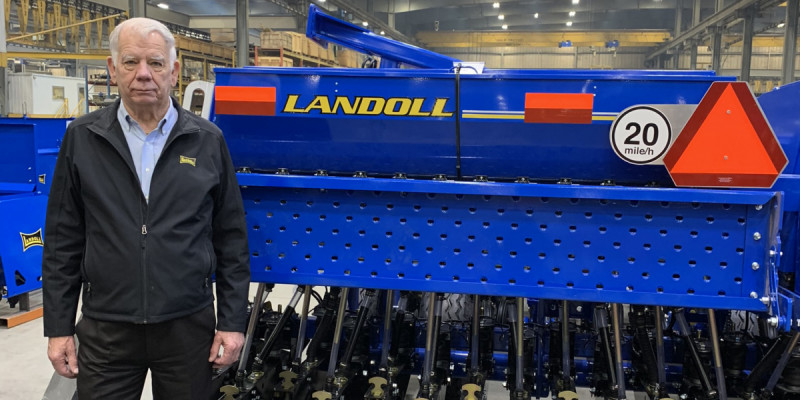
Don Landoll turned a three-man Kansas welding shop into a manufacturing powerhouse by solving practical problems, refusing to compromise on quality, and finding opportunity where other manufacturers saw obstacles. Following his passing at age 83, we look back at the inventions, business decisions and philosophy that made Landoll a lasting American success story.
In 1963, a 20-year-old welder named Don Landoll went into business in Marysville, Kansas, with a partner and one employee. Their operation handled welding jobs, radiator repairs and blacksmith work. It was a modest beginning, but Landoll already had bigger ambitions. He wanted to design and manufacture products of his own.
Six decades later, the Landoll name had become one of the most recognizable in specialized equipment manufacturing. The company built agricultural tillage tools, heavy-haul trailers, forklifts, construction equipment and machinery for the U.S. military. Along the way, it developed products that changed how equipment was transported and established a reputation for craftsmanship that extended well beyond agriculture.
Landoll died on October 31, 2026, at age 83. His passing marks the loss of one of the independent equipment industry’s most accomplished entrepreneurs, a man who proved that innovation, manufacturing expertise and a willingness to diversify could build a world-class business in a small Kansas community.
His story is particularly remarkable because Landoll did not start with a revolutionary invention or a large financial backer. He started with a welder, an understanding of machinery and a determination to find better ways of doing things.
A Farm Kid Who Learned to Build What People Needed
Born near Hanover, Kansas, in 1943, Don Landoll developed his mechanical abilities early. By high school, he was welding and repairing equipment on the family farm and helping neighbors keep their machinery operating.
After graduation, he hoped to join the Air Force but failed the physical examination. Instead, he went to work at a local implement dealership, gaining practical experience with the equipment farmers depended on.
In December 1963, Landoll and his business partner, Jesse Moffit, purchased Quick Service Welding in Marysville. The operation employed just three people, including its owners, and initially survived on the repair and fabrication work that came through the door.
When Moffit returned to the railroad in 1967, Landoll bought out his interest and became sole owner. By then, he had begun to recognize the limitations of relying entirely on custom repair jobs. Developing repeatable products offered a better opportunity to grow.
His first branded products included a slide-in livestock rack for pickup trucks and a chisel plow designed for local farmers. He also developed livestock feeding equipment and began producing agricultural toolbars as tractors grew larger and more powerful.
These early products established a pattern that would define Landoll’s career. He listened to what customers needed, designed something practical, and looked for ways to manufacture it at a scale that made business sense.
The Traveling Axle Trailer That Changed Everything
Perhaps Landoll’s most influential invention came from a problem that agricultural equipment dealers knew well.
As tractors and implements became larger, moving them between dealerships, farms and demonstration sites grew increasingly difficult. Conventional trailers often required steep loading ramps, additional equipment or complicated loading procedures. Landoll saw an opportunity to improve the process.
In 1969, he developed the traveling axle trailer concept, which entered production around 1970 and became the foundation of the company’s transportation equipment business. The design used a movable undercarriage and tilting trailer bed to create a low loading angle. Instead of relying on steep ramps, the trailer could lower its rear toward the ground, allowing equipment to be loaded and unloaded more easily.
For dealers moving tractors and implements, it was a practical breakthrough. For towing and recovery operators, equipment rental companies and heavy machinery haulers, the same design offered an entirely new level of versatility. The invention became so successful that the Landoll name eventually became shorthand for a traveling axle trailer, regardless of who manufactured it.
Landoll continued refining the concept, developing numerous patented improvements and expanding the trailer line to serve increasingly specialized applications. Modern Landoll traveling axle trailers offer capacities across a broad range, from relatively light equipment transportation to heavy-duty loads.
The important innovation was not simply a different trailer mechanism. Landoll had identified a problem shared by several industries and developed a solution that could be adapted to serve all of them.
Why Landoll’s Farm Equipment Earned Its Reputation
Although its trailers became famous, agriculture remained central to Landoll Company’s identity.
One of Don’s early breaks came when Case began purchasing tillage implements from his growing manufacturing operation. Initially, Case wanted equipment for its dealerships without its own branding. The relationship expanded as the company became confident in Landoll’s products.
Eventually, Landoll manufactured multiple tillage products carrying the Case name, including subsoilers, V-plows and coulter chisels. It was an important validation for a small independent manufacturer competing in an industry dominated by much larger companies.
But Landoll’s reputation wasn’t built solely on winning manufacturing contracts. His approach emphasized several qualities that mattered to farmers: strong construction, consistent manufacturing, dependable field performance and long-term product support.
Quality Was a Manufacturing Strategy
Don Landoll operated under a straightforward principle: “Quality is Always a Bargain.”
He recognized that less expensive equipment had a place in the market, but he wanted machinery carrying his name to be among the best in its class. That meant investing in manufacturing capabilities rather than competing primarily on price.
The company expanded its machining, fabrication, welding and finishing operations over the years. It invested in robotic welding, laser cutting, powder coating and other technologies intended to improve precision and consistency.
At one point, Landoll couldn’t find a robotic welding system that met his requirements. Rather than compromise, his team developed its own. The company subsequently expanded its robotic welding operations, incorporating automation into a manufacturing process that still depended heavily on skilled employees.
This investment mattered because farm equipment operates under enormous stress. Tillage tools encounter rocks, compacted soil and changing field conditions. Heavy trailers endure concentrated loads, vibration and repeated loading cycles. Strong welds, accurate fabrication and durable materials are essential to keeping that machinery working.
Landoll’s commitment to quality also influenced its resale value and customer loyalty. In a 2018 interview with Farm Equipment, he explained that the company’s parts operation aimed to support equipment as old as 40 years.
That philosophy addressed a concern familiar to anyone who owns older farm machinery. A well-built implement has limited value if replacement parts become impossible to obtain. Landoll understood that supporting equipment long after the original sale could help secure the next sale as well.
The Business Decision That Helped Landoll Survive the Farm Crisis
One of the most revealing chapters in Landoll’s history came during the agricultural downturn of the 1980s, when low commodity prices, high interest rates and collapsing equipment demand devastated manufacturers across the Midwest.
Landoll survived in part because Don had already embraced diversification. His company could fabricate steel and manufacture complex equipment, and those capabilities were valuable beyond the agricultural market.
An opportunity emerged when an FMC Corporation representative saw Landoll equipment at a dealership and was impressed by its welding quality. FMC needed a manufacturer capable of producing equipment for aviation and military applications. The relationship eventually led Landoll into aircraft de-icers and other government contracts.
In 1984, Landoll received a military order worth approximately $43.8 million, a remarkable opportunity during one of the most difficult periods in American agricultural manufacturing.
The benefits extended beyond revenue. Military contracts required documented materials, strict quality controls and sophisticated manufacturing capabilities. Landoll used those opportunities to invest in better equipment and production processes, which also improved the agricultural machinery coming out of the same facilities.
The company later manufactured military transport trailers and heavy-duty wreckers, including equipment supporting U.S. military operations during Desert Storm.
It was a strategy that would help define the business for decades. Instead of depending entirely on agricultural equipment sales, Landoll built manufacturing expertise that could serve multiple industries. When one market slowed, another could help sustain the company and its workforce.
Growing Through Partnerships, Acquisitions and Innovation
Landoll’s willingness to pursue new opportunities continued well beyond the 1980s.
In 2000, the company entered an agreement with AGCO involving tillage equipment, giving Landoll access to a broader dealer network. Around that period, the company also recruited experienced former Sunflower salespeople, strengthening its agricultural distribution capabilities.
That relationship influenced one of Landoll’s most recognizable characteristics: the distinctive blue paint on its agricultural equipment. Previously, Landoll equipment had been yellow. The color change helped distinguish its expanding agricultural lineup in a competitive market.
The company also grew through acquisitions. In 2003, Landoll acquired the Drexel forklift product line, expanding its material-handling business. In 2007, it purchased ICON Industries, adding construction equipment such as scrapers and compactors.
Then, in 2010, Landoll acquired Brillion Farm Equipment, bringing an established agricultural name and additional tillage, seedbed preparation and seeding products into its portfolio.
Each expansion built on capabilities the company already possessed. Landoll understood steel fabrication, hydraulics, machining and heavy equipment manufacturing. Applying those capabilities to additional products allowed the company to reach new customers while making better use of its production investments.
By 2019, the Kansas Historical Society reported that Landoll employed more than 800 people and operated manufacturing facilities covering more than 960,000 square feet. Those figures illustrate how far the company had grown from its original three-person welding shop.
The Man Behind the Machinery
For all his accomplishments, Don Landoll remained closely connected to the company, its employees and the community of Marysville.
He received numerous honors during his career, including the Ernst & Young Master Entrepreneur of the Year award for the Midwest in 1998 and induction into the Association of Equipment Manufacturers Hall of Fame in 2011. He also served as president of the Farm Equipment Manufacturers Association from 1990 to 1991.
His contributions to Marysville included support for educational facilities, public spaces, healthcare and community development. Landoll Company became an important source of employment and economic stability for the surrounding region.
But the personal stories shared following his passing reveal another measure of his influence.
In a recent episode of the Germinate Podcast, host Joe Sampson recalled visiting Landoll Company just weeks before Don’s death. What began as a business meeting turned into lunch in Marysville and an unforgettable tour of the company’s manufacturing facilities.
Don drove Sampson and several company representatives around in his Lincoln Navigator, even taking the vehicle directly through the factory. Along the way, he explained the equipment, greeted employees and enthusiastically showed visitors what his company was building.
Sampson remembered Don’s generosity with his time and the pride he took in the people around him. It was a fitting final memory of a manufacturer who had spent his life building machinery and relationships.
Joe Sampson remembers Don Landoll on the Germinate Podcast, sharing stories of his final visit and the lessons Don passed along to others in the equipment industry.
An American Manufacturing Legacy That Will Keep Working
Don Landoll’s career offers a reminder of how much independent equipment manufacturers have contributed to American agriculture.
He started by fixing machinery for neighbors and developed products that solved problems he understood firsthand. He built relationships with major equipment manufacturers without losing the independence that allowed his company to pursue new ideas. And when agricultural markets turned against him, he found opportunities in other industries that helped sustain and improve the business.
His success came from a combination of practical invention, manufacturing discipline, diversification and a commitment to supporting customers long after their equipment was purchased. Those principles helped turn a small Kansas welding shop into a company whose products are recognized across agriculture, transportation, construction and material handling.
Today, Landoll’s name continues to travel on highways, work in fields and appear on equipment built by the people and company he helped develop. For a man who began his career with a welding torch and an ambition to build something of his own, that is an extraordinary legacy.
Don Landoll, April 17, 1943 – October 31, 2026.

Leave a Reply