
Farmers who previously purchased additional prevented-planting crop insurance protection will have an opportunity to restore that coverage following new instructions issued by USDA’s Risk Management Agency (RMA) on November 20.
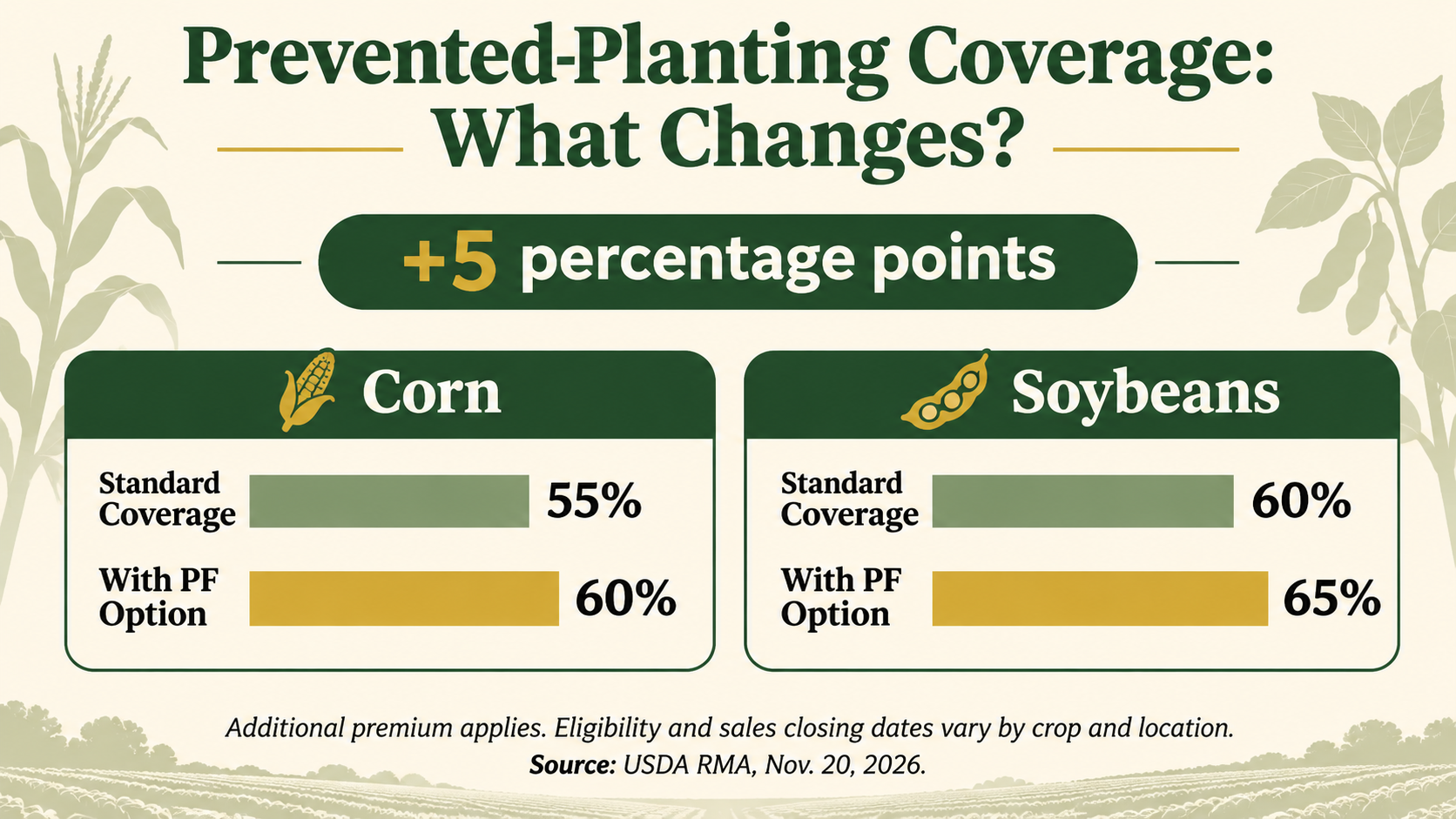
The change reinstates an optional five-percentage-point increase in prevented-planting coverage, commonly called the PF option. The additional protection can provide a larger insurance payment when an insured cause, such as excessive moisture or flooding, prevents a farmer from planting an eligible crop.
However, the coverage will not be restored automatically. Producers must elect the option again by their applicable sales closing date, even if they previously carried it.
What Is Changing for 2027?
USDA removed the additional prevented-planting option for certain crops under its Expanding Access to Risk Protection rule. After announcing plans in August to restore the coverage, RMA has now provided insurance companies with specific reinstatement procedures.
Under the November 20 bulletin, the option returns for the 2027 crop year for eligible crops with a November 30, 2026 contract change date. Other crops generally become eligible beginning with the 2028 crop year.
Farmers who carried the option when it was last available can request reinstatement, subject to verification of their previous coverage. Producers who did not previously carry it may submit a new request, which insurance companies must review under existing procedures.
The distinction matters because a new request can be denied if an insured cause of loss that could prevent planting has already occurred.
How Much Additional Protection Does It Provide?
Prevented-planting insurance pays a percentage of a crop’s insured production guarantee when qualifying conditions prevent planting. For corn, the standard prevented-planting coverage percentage is generally 55%, while soybeans typically carry 60%.
The optional buy-up adds five percentage points, increasing those percentages to 60% for corn and 65% for soybeans. It does not increase the entire crop insurance guarantee by 5%, and farmers must pay an additional premium for the protection.
Consider a hypothetical corn operation with a 200-bushel approved yield, a $4.50 projected price and an 80% coverage level. Its insured production guarantee would be $720 per acre. Standard prevented-planting coverage at 55% would provide $396 per acre, while the additional option would increase that amount to $432.
That’s an additional $36 per acre, or $36,000 across 1,000 qualifying acres, before considering premiums and any adjustments affecting the final payment. Actual guarantees depend on each farm’s approved yield, policy terms and projected price.
For producers in areas prone to spring flooding or prolonged wet conditions, that additional protection could help offset expenses incurred before planting, including land rent, equipment payments and other operating costs.
Farmers Must Request Coverage Again
RMA’s instructions make clear that previous enrollment does not automatically restore the option. Farmers must submit an application or policy change form by the applicable sales closing date.
Insurance providers can verify previous coverage through policy records, a producer’s Summary of Coverage or USDA reporting systems. For crops with a November 30, 2026 contract change date, insurers generally examine 2025 policy records to establish whether the farmer previously carried the option.
Farmers who have changed insurance providers or reorganized their operations should pay particular attention to how their coverage history is documented. Eligibility for reinstatement may differ from eligibility for a new request.
The November 30 contract change date is not necessarily the farmer’s enrollment deadline. Sales closing dates vary by crop and location, making it important to confirm the correct deadline with a crop insurance agent.
Is the Extra Coverage Worth the Cost?
The value of additional prevented-planting coverage depends largely on a farm’s exposure to weather-related planting delays and the premium required.
Operations with poorly drained ground or a history of prevented-planting claims may find the added protection especially valuable. Farmers with lower exposure should compare the additional premium against the potential increase in payments before making a decision.
The option also does not guarantee payment whenever planting is delayed. Producers must satisfy prevented-planting eligibility requirements, including applicable acreage, timing and insured-cause-of-loss provisions.
With 2027 operating budgets already under pressure, the reinstatement gives eligible farmers another tool for managing planting risk. The immediate priority is to review existing coverage, confirm eligibility and request the option before the applicable sales closing date.


Leave a Reply