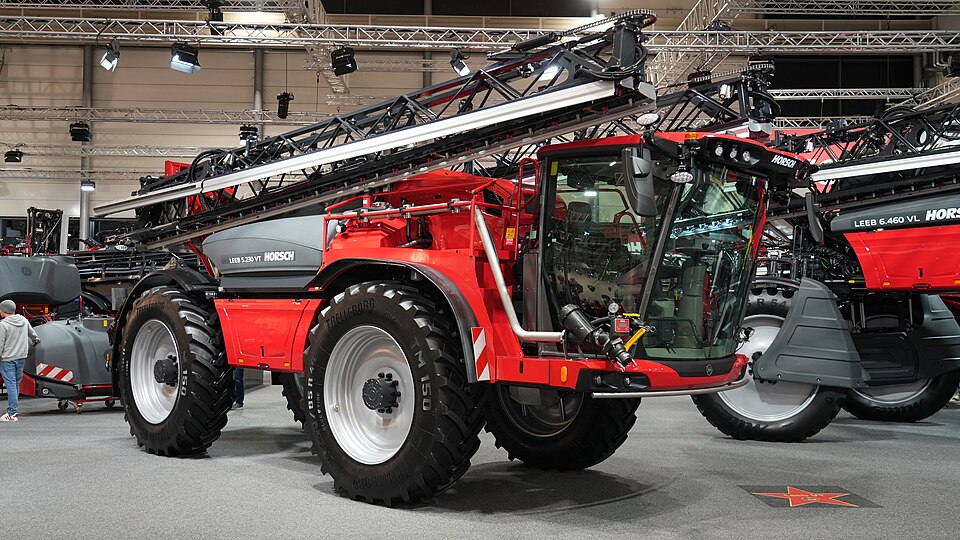
Farm shows across the country have been highlighting rapid advancements in precision spraying, and the recent Farm Progress article on this topic offered a clear look at where the industry is headed. The Horsch LEEB 8460, one of the featured machines, stood out for its boom design with elbow joints that automatically adjust to changes in terrain and crop height. Its auto-select nozzle system manages six nozzle options to maintain ideal pressure and droplet size no matter how the boom moves.
Other exhibitors brought solutions for farms of every size. Large operations saw new, heavy-duty sprayers with extremely wide booms designed for speed and coverage. Mid-size farms were represented by models such as the Apache HS1150, which pairs a compact 1,100-gallon tank with individual nozzle control and automated boom-height adjustment. Even smaller farms and specialized applications were included with accessible equipment such as the Altoz 25-gallon sprayer attachment that can be configured with different boom widths.
The shift is clear. Precision spraying is becoming practical and affordable across the full range of farming operations, driven by sensors, automation, and real-time adjustments that greatly improve accuracy.
Why Precision Spraying Matters
Precision spraying is delivering real economic, agronomic, and environmental benefits. For many growers, the most immediate impact shows up in reduced chemical cost. Trials using targeted spraying systems such as Greeneye have recorded dramatic reductions in herbicide use, sometimes saving tens of thousands of dollars per season on row-crop farms. One operation in North Dakota reported nearly forty thousand dollars in savings after retrofitting its sprayer with a precision kit.
A large, multi-farm demonstration on soybeans showed an average herbicide reduction of more than seventy percent compared to broadcast applications, with some fields reaching ninety percent reduction. Crucially, weed control remained effective and yields held steady.
The environmental benefits are equally important. Precision systems cut drift by keeping droplets on the target plant and off surrounding soil or nearby crops. They also reduce runoff and lower the overall load of chemicals entering the soil system, which helps preserve soil biology and reduces selection pressure that drives herbicide resistance. In several studies, precision spraying has cut drift by more than eighty percent and reduced ground loss by up to ninety percent compared with traditional sprayers.
Operational efficiency also improves. GPS-guided systems and automatic section control help eliminate overlap, reduce fuel use, and shorten the time required to complete a field. Many growers appreciate that precision spraying can be added to existing machines through retrofit kits, allowing them to gain these advantages without the cost of buying an entirely new sprayer.
What the New Models Contribute
The latest machines take spraying far beyond traditional broadcast application. The Horsch LEEB 8460 uses boom-contouring technology and real-time nozzle selection to ensure droplets reach their intended target regardless of field undulation or canopy variation. This helps improve coverage while limiting waste.
Mid-range models are making precision spraying accessible to farms with fewer acres. Machines with moderate tank sizes, user-friendly controls, and fully integrated nozzle management systems offer efficiency and accuracy without the price tag of the largest sprayers.
Precision spraying is also expanding into applications beyond herbicides. New software platforms are beginning to support targeted fungicide spraying, micronutrient delivery, and variable-rate fertility applications. These advances move crop management toward site-specific treatment where every pass is optimized for plant health and profitability.
Underlying all of this is the broader trend of precision agriculture. Soil mapping, GPS guidance, real-time sensors, and yield analytics work together to ensure every field is managed at a granular level rather than as a uniform block.
What Farmers Should Consider
For operations thinking about making the shift, precision spraying is best viewed as a long-term investment. Retrofitting an existing sprayer may provide the quickest return for farms spending heavily on herbicides. Larger farms may find that upgrading to a new terrain-adaptive sprayer produces better efficiency over time, especially when covering wide acres.
Successful precision spraying depends on timing and accurate weed mapping. Since these systems target only emerged weeds, scouting becomes more important. Fields with uneven weed pressure often see the greatest benefit, since the sprayer avoids wasting chemical on clean acres.
There is a learning curve with calibration and upkeep, but many growers report that the savings on chemical inputs and the improved efficiency offset the added complexity within the first one or two seasons.
Looking Ahead
Precision spraying fits into the larger future of precision agriculture. As the industry moves toward automation, autonomy, and data-driven decision-making, sprayers are becoming smarter, more selective, and more efficient. Spray drones, robotic spot sprayers, and fully autonomous machines are already being tested and, in some areas, adopted.
As these systems become more affordable and more widely available, precision spraying is poised to become standard practice. Farmers who adopt early can gain an edge in cost savings, sustainability, and field efficiency, while positioning their operations to take full advantage of future technologies.


Leave a Reply