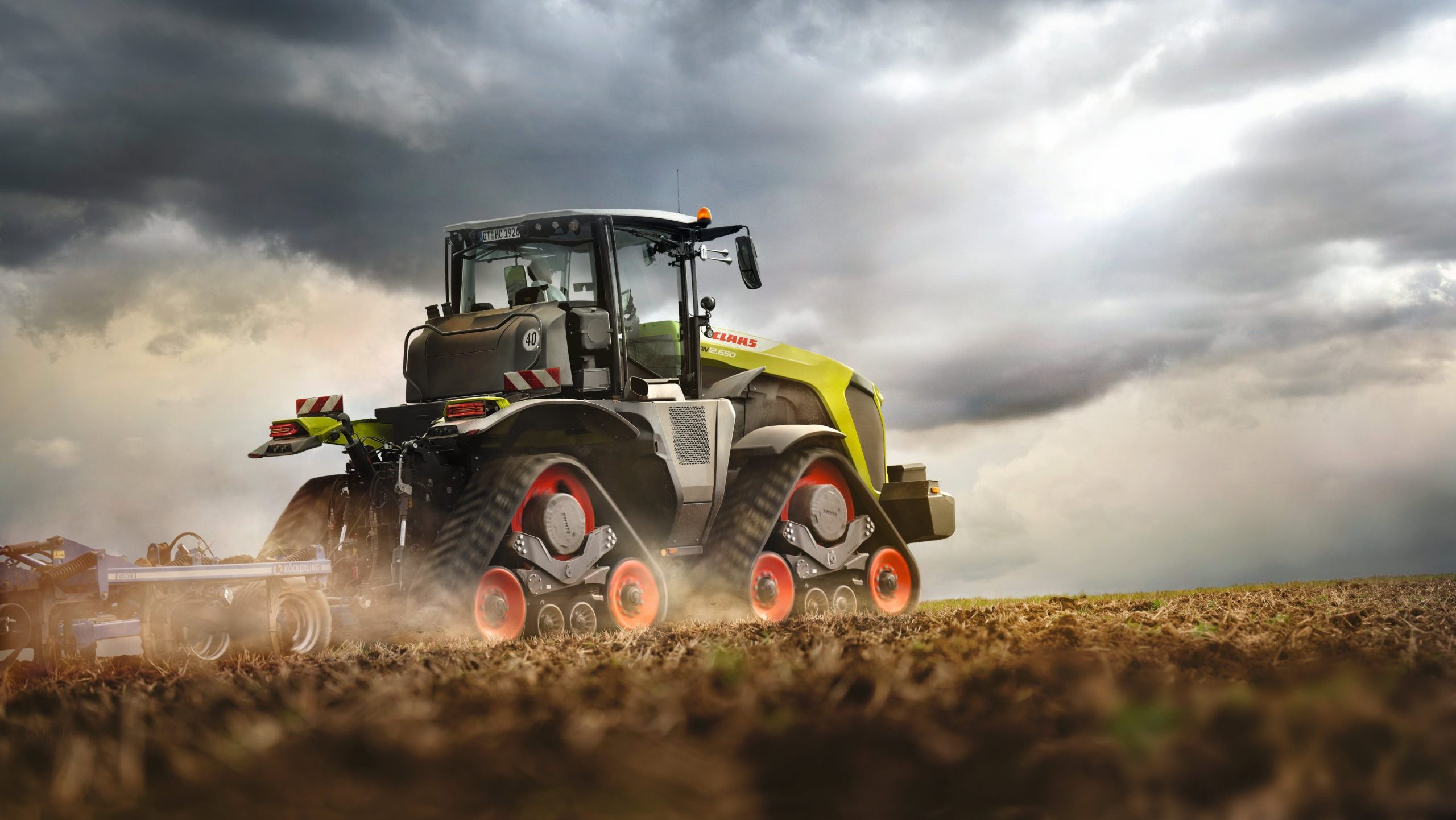
In the global tractor market, most high-horsepower machines follow a familiar formula. Articulated frames, large tires, and a focus on pulling power define the category. The CLAAS Xerion has never fit neatly into that mold.
From its earliest versions, the Xerion platform was designed around a different set of priorities. Balance over brute weight. Versatility over single-purpose use. Operator control as a central feature rather than an afterthought. That approach has allowed it to stand apart in Europe for years, and it is now becoming more relevant in North America as farms grow, labor tightens, and efficiency matters more than ever.
What Makes a Xerion Different
The Xerion is built on a full-frame chassis with near-even weight distribution across both axles. Instead of relying heavily on ballast to create traction, the design allows the tractor to apply power more naturally to the ground. That becomes increasingly important in high-draft applications where consistency and soil preservation both matter.
A defining feature of the platform is its use of a continuously variable transmission in a horsepower class where many competitors still rely on powershift designs. This allows the tractor to deliver steady torque at low speeds while maintaining efficiency across a wide working range. The result is smoother operation and more precise control in demanding field conditions.
The cab design also sets the Xerion apart. On many models, the operator station can rotate, allowing the driver to face the implement when needed. This is particularly useful in applications like slurry handling or grain cart work, where visibility and control over the rear attachment are critical. It reduces fatigue over long days and changes how certain jobs are performed.
The platform has also proven to be highly adaptable. Xerion tractors are used for heavy tillage, large-scale planting, manure application, and transport work. In some configurations, such as saddle trac setups, the machine carries tanks or implements directly on the frame, further improving weight distribution and efficiency.
The Xerion 12 Signals Where Things Are Headed
The newest generation, the Xerion 12 series, builds on that foundation while pushing into a new level of capability. With up to 653 horsepower, it competes directly at the top end of the global tractor market.
The introduction of the TERRA TRAC system brings four independently mounted tracks into the equation, improving traction and reducing slip while spreading weight more evenly across the soil surface. Combined with the full-frame design, it allows the tractor to carry its power without relying on extreme tire configurations.
Cab improvements continue to focus on operator endurance, with more space, better suspension, and a refined control layout that integrates machine functions and data systems into a single interface.
The most notable step forward is in automation. The Xerion 12 introduces driver-monitored autonomy, allowing the tractor to execute pre-planned field operations with minimal input once underway. Steering, pass management, and headland functions can be handled automatically, while the operator remains in the cab to oversee performance. This reflects a practical shift toward automation that fits current farm operations rather than a fully unmanned model.
A Platform Built for Connected Farming
Across the Xerion lineup, CLAAS has continued to invest in integrated technology. Systems like CEMOS analyze performance in real time and adjust machine settings to improve efficiency. Connectivity platforms link the tractor to planning tools and farm management systems, allowing work to be defined ahead of time and reviewed afterward.
This level of integration positions the Xerion as part of a broader workflow rather than a standalone machine. Planning, execution, and analysis are increasingly connected, and the tractor becomes a central piece of that system.
Where CLAAS Fits in the U.S.
In the United States, CLAAS is still most widely recognized for its combines. The Xerion represents part of a longer-term effort to expand beyond harvesting equipment and establish a stronger presence in high-horsepower tractors.
Adoption has been steady among large-scale operations that can take full advantage of the platform’s capabilities. For these users, the Xerion offers a distinct alternative to more traditional tractor designs, particularly in applications where traction, visibility, and versatility are critical.
A Different Direction, Not Just a Bigger Tractor
The Xerion represents a different way of approaching how power is delivered, how operators interact with equipment, and how automation fits into daily work.
With the Xerion 12, CLAAS is extending that philosophy into the next phase. More power, more automation, and deeper integration with digital systems all point in the same direction. For American producers evaluating where large equipment is headed, the Xerion platform offers a clear view of that future.

Leave a Reply