
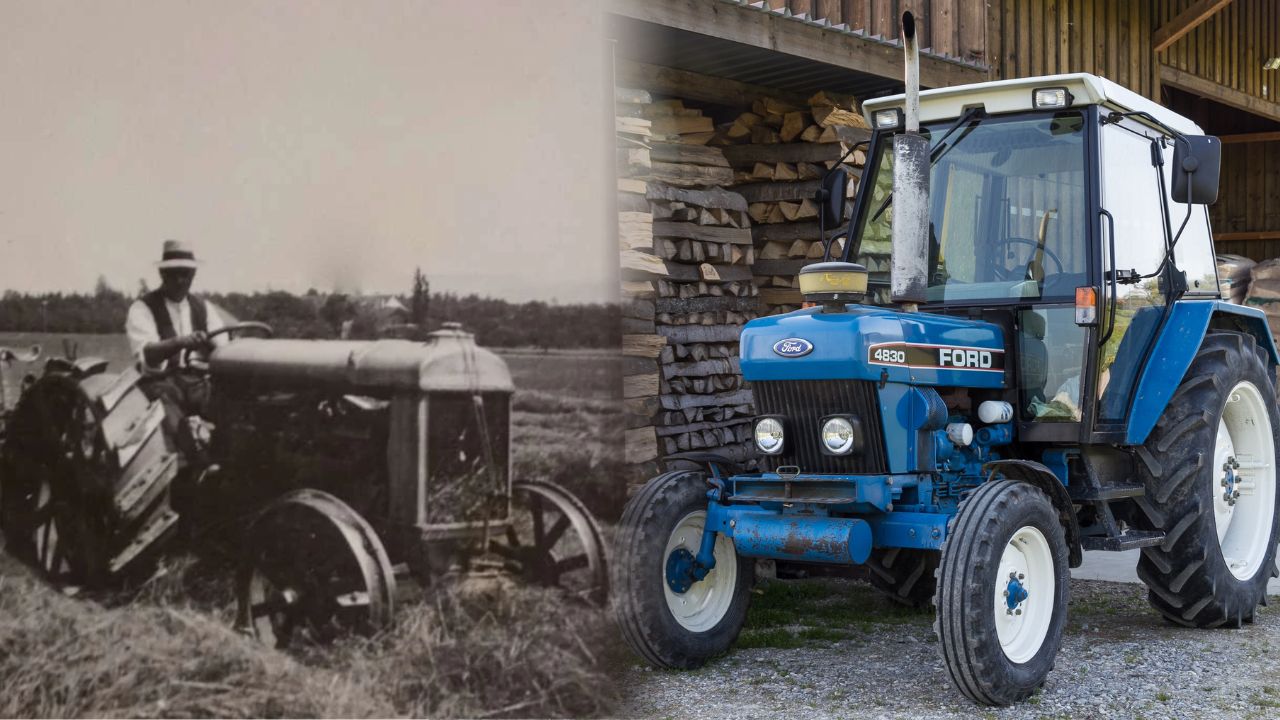
For generations of farmers, the sight of a blue Ford tractor sitting in a shed or parked beside a barn meant reliability. Long before touchscreens, automated guidance systems, and high horsepower wars became central to agriculture, Ford tractors helped introduce mechanization to farms that otherwise may never have afforded it.
The company’s agricultural legacy stretches far beyond paint color or model numbers. Ford helped reshape how tractors connected to implements, how smaller farms approached fieldwork, and how machinery became accessible to ordinary producers. Even today, decades after Ford exited the tractor business, Ford tractors still hold a respected place in farm sheds, auction lots, and rural communities across North America.
Farming Before Ford Tractors
Before tractors became common, many farms still depended heavily on horses and labor-intensive fieldwork. Large steam engines and early gas tractors existed, but they were often expensive, heavy, and difficult for smaller operations to justify. Large prairie farms could justify the investment more easily than family farms with limited acreage.
Henry Ford believed machinery could be mass-produced affordably enough to transform everyday farming. Ford had already changed transportation with the automobile, and he saw agriculture as another industry that could benefit from standardization and efficiency.
The Fordson Arrives
Ford’s involvement in agriculture began well before the famous 9N and 8N tractors. In 1917, the company introduced the Fordson Model F, often simply called the Fordson.
The name “Fordson” combined “Ford” and “son,” reflecting the involvement of Henry Ford and his son, Edsel Ford, in the agricultural side of the business. The branding helped distinguish Ford’s tractor operations from its automotive division while still carrying the recognition of the Ford name.
The Fordson quickly became one of the first widely successful mass-produced tractors in the world. It was smaller, lighter, and less expensive than many competitors of the era, helping introduce mechanized farming to thousands of producers who had previously relied heavily on horses.
Demand surged during and after World War I as farms sought greater efficiency and labor savings. By the 1920s, Fordson tractors had become a familiar sight across American agriculture and international markets alike.
While the Fordson helped make tractors more accessible, Ford engineers and innovators continued searching for ways to improve how tractors actually worked in the field. Early tractors could pull equipment effectively, but many implements remained cumbersome to attach and difficult to control. Farmers still faced challenges with traction, safety, and consistency in the field.
That pursuit eventually led Ford into partnership with Harry Ferguson, whose engineering ideas would help reshape modern farming equipment forever.
The Revolution of the Three-Point Hitch
Prior to Ferguson’s innovations, attaching implements to tractors could be awkward, dangerous, and inefficient. Equipment often pulled from fixed drawbars with limited control over depth or weight transfer.
The three-point hitch changed that entirely. By mounting implements directly to the tractor with hydraulic control, farmers gained better traction, improved implement control, and safer operation. The system also made tractors dramatically more versatile.
That innovation debuted on the Ford-Ferguson 9N tractor in 1939.
The 9N was compact, relatively affordable, and simple enough for many farmers to maintain themselves. It quickly became popular because it fit the realities of smaller and mid-sized farms. It could plow, cultivate, mow, and handle countless daily chores without requiring massive acreage to justify ownership.
The later 2N and especially the 8N expanded on that success. The 8N, introduced in 1947, became one of the best-selling tractors in American history. Even now, many remain operational nearly 80 years later.
Part of the appeal was simplicity. Farmers could repair them with basic tools, find replacement parts without much trouble, and trust them to start when needed.
The Shift to Blue
By the 1960s, Ford tractors entered a new era. The familiar gray and red styling gave way to the blue paint scheme that many farmers still instantly recognize today.
This period marked Ford’s transition from smaller utility-focused machines into a broader agricultural lineup capable of handling heavier tillage, larger hay operations, and expanding row crop demands.
Models like the Ford 5000 gained strong reputations for durability and practical horsepower. Later tractors such as the 7000 and TW Series pushed Ford deeper into the high horsepower market during an era when farms were rapidly increasing in scale.
These tractors often earned reputations as dependable working machines rather than flashy status symbols. Many producers appreciated that Ford tractors were straightforward to operate and relatively easy to maintain compared to increasingly complex competitors.
In livestock country and hay regions especially, Ford blue became deeply familiar.
Why Utility Farmers Loved Ford
Ford developed a particularly loyal following among livestock producers, hay operators, and diversified farms. Utility tractors became the backbone of many daily operations, handling loader work, feeding cattle, mowing, baling, and transport duties.
Their size and versatility made them practical for farms that needed one tractor to perform many different jobs throughout the year.
That versatility remains part of their appeal today. Older Ford utility tractors continue to attract acreage owners, smaller operators, and producers looking for dependable horsepower without modern emissions systems or expensive electronics.
As repair costs continue climbing across the equipment industry, many farmers have rediscovered appreciation for mechanical simplicity.
The Genesis Era
In the 1990s, Ford introduced what many enthusiasts still consider some of the company’s finest tractors: the Genesis Series.
These machines blended modern comfort and higher horsepower with a reputation for strong drivetrains and operator-friendly performance. Features like the SuperSteer front axle improved maneuverability, while upgraded cabs and transmissions helped Ford compete more directly with other major manufacturers.
The Genesis tractors arrived during a transitional period for the company. Ford’s agricultural division eventually evolved into what became New Holland Agriculture, but many farmers still refer to those machines simply as “Ford tractors.”
That loyalty says a great deal about the strength of the brand identity Ford established over decades in agriculture.
Ford Tractors at Auction Today
Ford tractors continue to hold a unique place in the used equipment market. Smaller classics like the 8N remain popular entry points for collectors and hobby farmers, while larger blue Ford tractors still attract buyers looking for affordable horsepower.
Well-kept TW Series tractors, Genesis models, and older utility tractors routinely generate interest because they occupy an appealing middle ground between vintage simplicity and modern capability.
For many buyers, the appeal is practical. Parts availability remains relatively strong, mechanical systems are familiar to experienced operators, and ownership costs can be far lower than newer equipment.
There is also an emotional connection that drives demand. Many farmers learned to operate equipment on a Ford tractor driven by a parent or grandparent. Those memories carry value that extends beyond horsepower ratings or auction prices.
A Legacy Still Working
Few tractor brands shaped everyday farming as deeply as Ford. The company helped bring mechanization to smaller farms, introduced innovations that became industry standards, and built machines that earned trust through decades of work.
Many of those tractors were never treated as collectibles. They were used hard, repaired repeatedly, and depended upon season after season. In many ways, that durability became the brand’s greatest legacy.
Even now, it is common to see an old blue Ford tractor still running augers, mowing roadsides, feeding livestock, or pulling wagons across rural America.
That kind of staying power is difficult to manufacture. It has to be earned.

Leave a Reply