
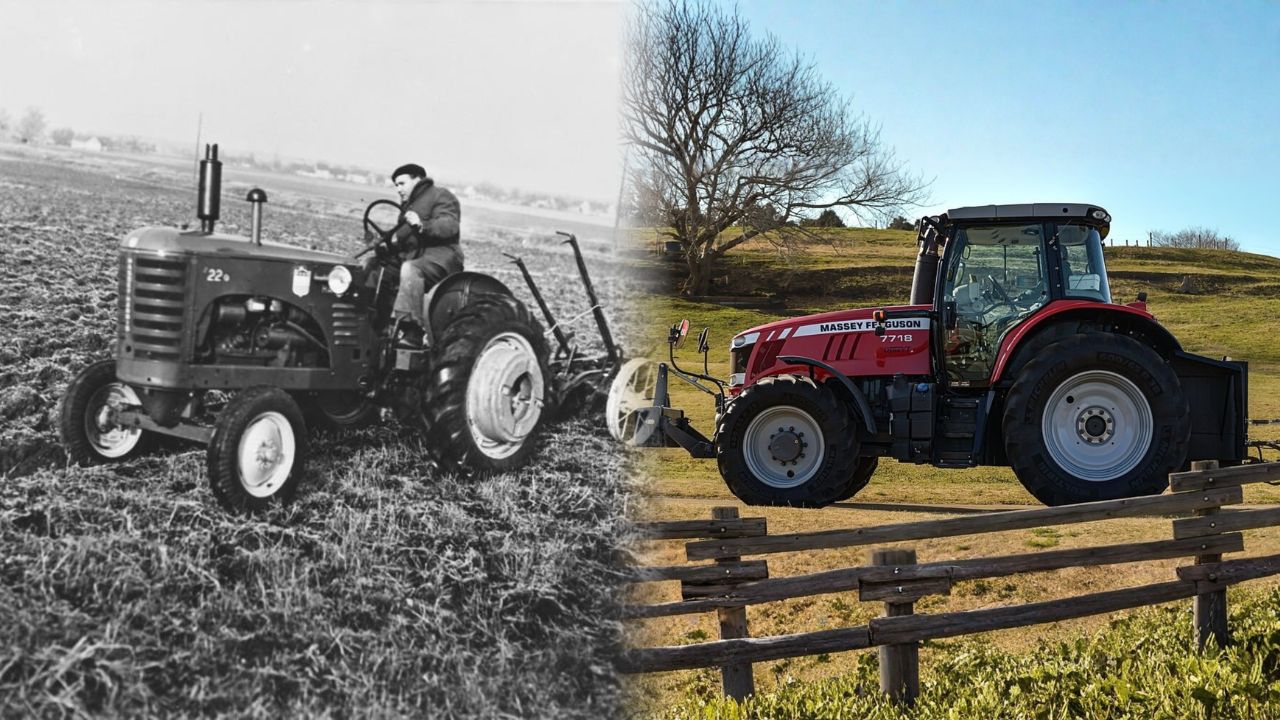
For generations of farmers, the red paint of Massey Ferguson was as recognizable as green, red, or yellow equipment rolling across North American fields. From small livestock operations to massive grain farms, Massey tractors and combines became trusted workhorses across the world.
Yet despite its global success, the brand went through decades of financial struggles, corporate restructuring, and fading visibility in the American market. For a time, many wondered whether Massey Ferguson would ever reclaim its place among agriculture’s top machinery brands.
Now, after years of rebuilding under AGCO, Massey Ferguson appears to be gaining momentum again in the United States. New tractor platforms, modern styling, expanding technology, and renewed dealer investment have helped put the brand back into conversations it once dominated.
Daniel Massey and the Beginning
The roots of Massey Ferguson trace back to 1847, when Daniel Massey opened a small workshop in Newcastle, Ontario, Canada. At the time, farming was still heavily dependent on manual labor and horse-drawn equipment, but mechanization was beginning to transform agriculture across North America.
Massey’s company focused on producing some of the era’s most important farm tools, including mechanical threshers designed to reduce labor and improve harvesting efficiency. As demand for mechanized farming equipment grew, Massey Manufacturing quickly expanded.
In 1891, Massey Manufacturing merged with A. Harris, Son and Company to form Massey-Harris. The new company became one of the largest agricultural machinery manufacturers in the British Empire and eventually one of the biggest farm equipment companies in the world.
By the early 1900s, Massey-Harris equipment could be found on farms across Canada, the United States, Europe, and beyond.
Massey-Harris Helps Modernize Harvesting
As agriculture industrialized during the early twentieth century, Massey-Harris became known for helping push harvesting technology forward.
One of the company’s most important achievements came with the development of self-propelled combines. Prior to that shift, combines were often large pull-type machines powered by separate engines or tractors. Massey-Harris helped simplify the harvesting process by integrating power and harvesting functions into one machine.
The company’s Model No. 21 self-propelled combine became especially influential during the 1940s. It helped prove that self-propelled combines could become the future of grain harvesting, particularly on large wheat operations throughout North America.
This era helped establish Massey-Harris as a serious global competitor during a time when farm equipment manufacturers were racing to modernize agriculture.
Harry Ferguson and the Three-Point Hitch Revolution
While Massey-Harris was building harvesting equipment, another inventor was quietly changing tractors forever.
Harry Ferguson believed tractors could be safer, more efficient, and easier to use. His solution was the hydraulic three-point hitch system, one of the most important agricultural innovations ever developed.
Before Ferguson’s system, implements were often pulled behind tractors using fixed drawbars. The setup could be difficult to control, inefficient in transferring weight, and dangerous under heavy load conditions.
Ferguson’s three-point hitch changed all of that. By allowing mounted implements to become integrated with the tractor itself, operators gained better traction, improved depth control, safer operation, and easier implement management.
The system transformed modern farming and eventually became the industry standard still used today.
In 1953, Massey-Harris merged with Ferguson Company to form Massey-Harris-Ferguson. A few years later, the company shortened the name to Massey Ferguson.
The merger combined Massey’s manufacturing scale with Ferguson’s revolutionary tractor technology, creating one of the most influential farm equipment brands in history.
The Golden Years of Massey Ferguson
During the 1960s and 1970s, Massey Ferguson grew into a global agricultural powerhouse.
The company expanded aggressively across Europe, North America, South America, and other international markets. Its tractors became especially popular among livestock producers, mixed farming operations, and grain farmers looking for reliable, practical equipment.
Many farmers still remember classic Massey Ferguson models from this era with deep loyalty. The brand earned a reputation for straightforward mechanics, dependable drivetrains, and strong pulling power.
Massey Ferguson also became one of the largest tractor manufacturers in the world during this period. In some global markets, the company achieved dominance that rivaled or exceeded competitors.
The familiar silver-striped red tractors became icons on farms across multiple continents.
Financial Struggles and Decline
Like much of the agricultural equipment industry, Massey Ferguson eventually ran into difficult economic realities.
The farm crisis of the late 1970s and 1980s created major financial pressure across agriculture. High interest rates, falling commodity prices, and reduced machinery demand hurt manufacturers throughout the industry.
Massey Ferguson also struggled with the costs of global expansion, manufacturing complexity, and growing competition from companies like John Deere, Case IH, and emerging international brands.
Corporate restructuring followed. Plant closures, layoffs, and financial instability created uncertainty around the company’s future. Ownership changes and the transition into Varity further complicated the brand’s identity during the 1980s.
While Massey Ferguson remained respected globally, the brand slowly lost momentum in parts of the American market. In the United States especially, competitors increasingly dominated dealer networks, advertising, and large-scale row crop operations.
For many American farmers, Massey Ferguson began fading from the spotlight.
AGCO and the Rebirth of the Brand
The turning point came in 1994 when AGCO acquired Massey Ferguson.
At the time, AGCO itself was still a relatively young company, but it had ambitious plans to build a global agricultural equipment business. Massey Ferguson became one of the centerpieces of that strategy.
Over the next several decades, AGCO invested heavily into rebuilding and modernizing the brand. Manufacturing facilities were upgraded, new tractor platforms were developed, and the company expanded its technology offerings.
The Beauvais factory in France became one of the most advanced tractor manufacturing plants in the world and helped serve as a symbol of the brand’s modernization.
Massey Ferguson tractors also began evolving stylistically. Older models had long been viewed as practical but conservative machines. Newer generations introduced more modern cab designs, improved operator comfort, advanced transmissions, precision farming technology, and far more aggressive styling.
At the same time, AGCO carefully positioned Massey Ferguson differently from premium-focused Fendt. Rather than directly chasing the highest-end luxury tractor market, Massey often emphasized practicality, value, reliability, and farmer-focused simplicity.
That positioning helped the brand reconnect with many producers.
Why Massey Ferguson Is Rising Again in America
Today, Massey Ferguson appears to be experiencing renewed momentum in the American market.
Newer tractor series like the 5S, 6S, 7S, and 8S have helped modernize the brand’s image considerably. Improved cabs, better visibility, updated electronics, and cleaner styling have made many farmers take a second look at the red tractors.
The company has also found strength in segments where practicality matters most, including livestock operations, hay producers, mixed farms, and utility tractor buyers.
In an era where machinery prices continue climbing rapidly, many farmers are also becoming more willing to consider alternatives outside the traditional dominant brands. Massey Ferguson has increasingly positioned itself as a high-value option that still offers modern technology and capability.
Social media and online farm content have also helped expose younger farmers to the brand again. A new generation of operators who may have grown up primarily around Deere or Case IH equipment are now seeing modern Massey Ferguson tractors in the field, online, and at farm shows.
The resurgence may still be developing, but Massey Ferguson no longer feels like a forgotten legacy brand in America.
The Red Tractors Keep Rolling
For many farmers around the world, Massey Ferguson never truly disappeared.
Older Massey tractors still run augers, feed livestock, bale hay, and work fields decades after they left the factory. The brand maintained loyal followings across Canada, Europe, South America, and many smaller American farming operations even during its most difficult years.
But today, the company feels different than it did a decade ago.
After generations of innovation, financial struggles, reinvention, and rebuilding, Massey Ferguson appears to be entering a new chapter under AGCO. The company that began with Daniel Massey’s small Canadian workshop nearly 180 years ago is once again becoming a growing force in modern agriculture.
And across farm country, more farmers are noticing the red tractors again.


Leave a Reply