
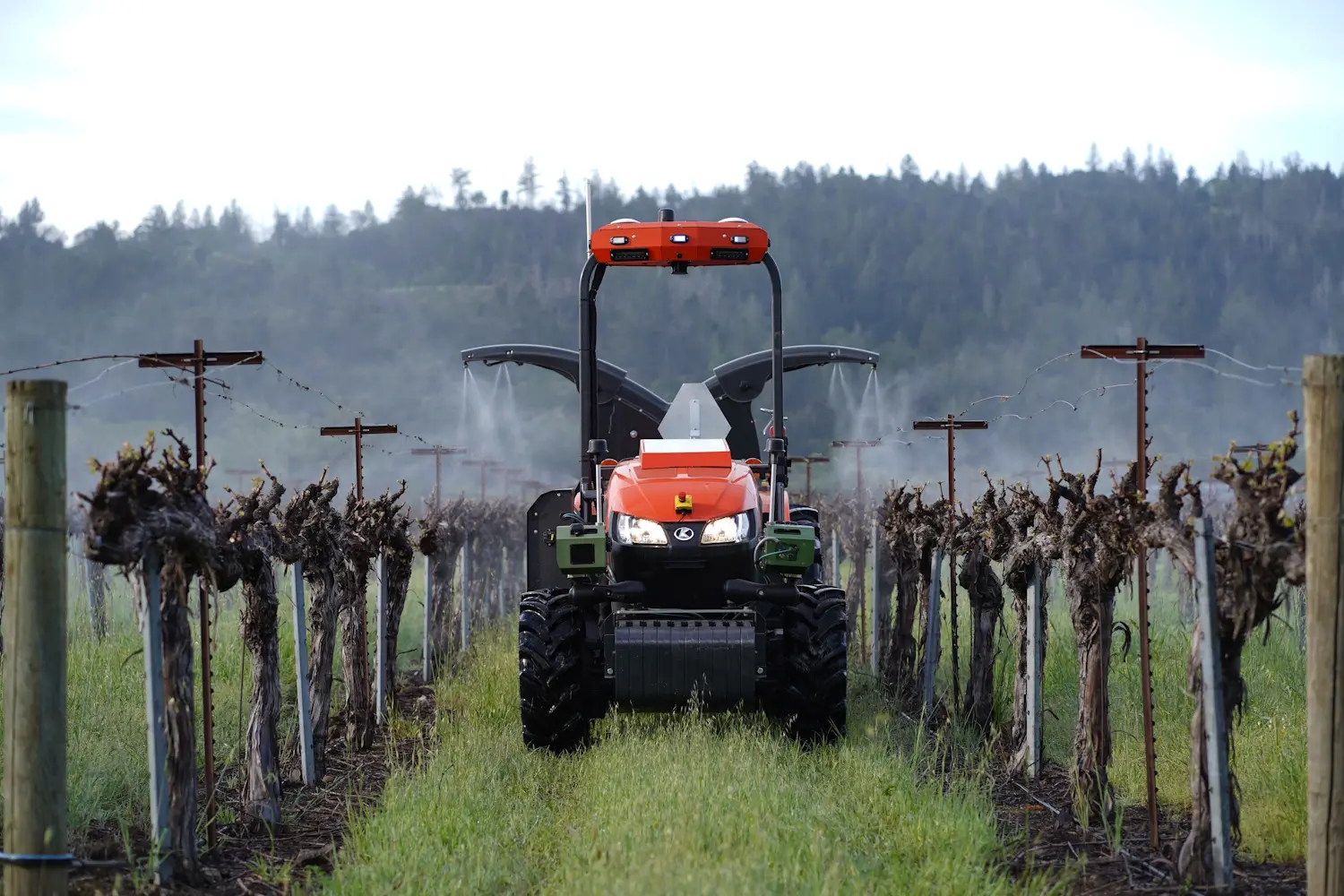
Kubota has made a strategic investment in Agtonomy, a California-based company developing autonomous operating systems for agricultural equipment. While the announcement may sound like another routine ag-tech investment, it offers a glimpse into where Kubota believes some of agriculture’s biggest challenges will be addressed over the next decade.
The investment builds on a partnership that began in 2024. Since then, Kubota and Agtonomy have been working together to commercialize autonomous solutions for specialty crop growers, particularly those operating in orchards, vineyards, and other high-value crop segments.
Unlike many autonomy projects that remain stuck in the prototype stage, the two companies have already begun deploying systems through Kubota’s dealer network in parts of the western United States. At CES 2026, Kubota showcased an autonomous M5 Narrow tractor equipped with Agtonomy’s autonomous driving technology, signaling that the partnership is moving beyond concepts and toward real-world adoption.
Why Specialty Crops Are Leading the Push
The partnership is focused on specialty crops such as grapes, nuts, fruits, and vegetables. These operations often face some of the most severe labor challenges in agriculture while also requiring highly repetitive field tasks such as mowing, spraying, and hauling.
For growers, the appeal of automation is not necessarily eliminating workers. Instead, it is finding ways to complete routine tasks more consistently while reducing labor pressure and allowing existing employees to focus on higher-value work. Rising labor costs and workforce shortages have become major concerns across specialty crop regions in states such as California, Oregon, and Washington.
That is where Agtonomy believes its technology can help. The company develops what it describes as physical AI systems that allow agricultural machines to perform field operations with increasing levels of autonomy while still giving growers oversight and control.
A Different Approach to Farm Autonomy
What makes this partnership notable is that Kubota is not trying to build an entirely new autonomous machine from scratch. Instead, the strategy centers on integrating Agtonomy’s software and automation platform into equipment that growers already recognize and trust.
That approach may prove important for adoption. Farmers have seen plenty of futuristic autonomous concepts over the years, but many have struggled to move beyond demonstrations. By embedding automation into familiar equipment platforms, Kubota appears to be betting that growers will be more willing to experiment with autonomy when it feels like an extension of the machines already sitting in their sheds.
What It Means for the Industry
The announcement is also another sign that autonomy is increasingly becoming a practical business strategy rather than a distant vision.
Major manufacturers across agriculture have spent years discussing autonomous equipment. What is changing now is the shift toward commercial deployments targeted at specific jobs and specific customer groups.
Kubota’s investment suggests the company sees automation as a meaningful part of its future, particularly in specialty crops where labor challenges remain acute and the economics of autonomy may be easier to justify than in broad-acre farming.
Whether widespread adoption happens quickly or gradually remains to be seen. But by investing directly in Agtonomy after two years of collaboration, Kubota is making it clear that it expects autonomous technology to move from demonstrations to daily farm operations much sooner than many growers may have expected.


Leave a Reply