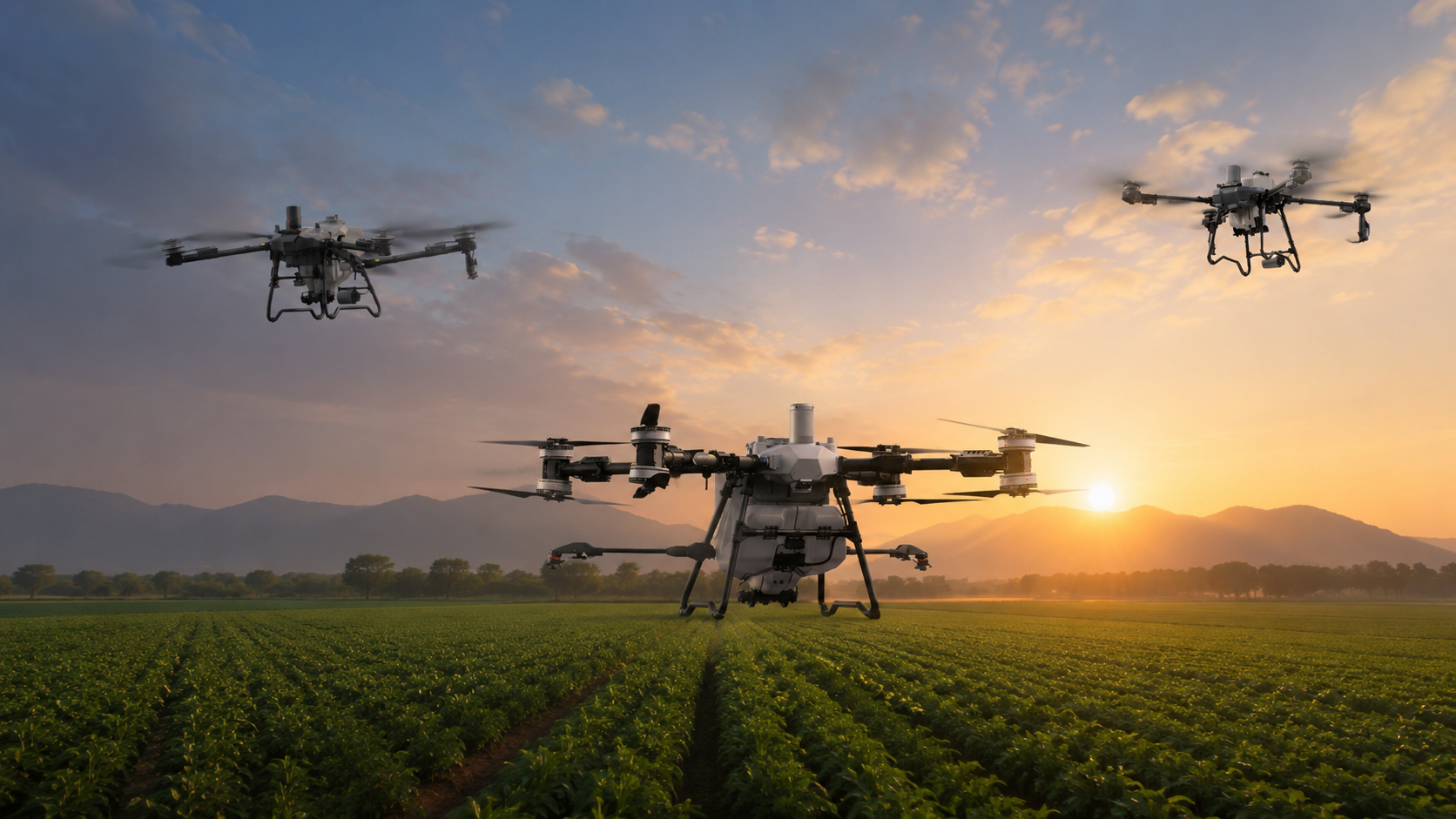
DJI has taken the wraps off two new agricultural drones, the Agras T55 and flagship Agras T100, and the company’s latest release makes one thing clear: agricultural drones are evolving into much more than aerial sprayers.
While larger payloads and faster application rates grab the headlines, DJI’s newest platforms also expand what a single drone can accomplish throughout the growing season. From spraying and spreading to seeding and even lifting materials, the company is positioning its newest models as multi-purpose machines for professional agricultural operators.
What’s New?
The Agras T55 is designed as an all-around workhorse for commercial operations. It supports spraying, spreading, seeding, and lifting while adding upgraded vision systems, improved obstacle avoidance, and more intelligent flight planning.
The larger Agras T100 pushes capacity even further. It features a larger spray tank, higher flow rates, improved battery efficiency, and lifting capabilities approaching 220 pounds in certain applications. DJI says the dual-battery design also allows the drone to remain airborne longer while carrying comparable payloads, reducing downtime spent swapping batteries and refilling tanks.
For operators covering hundreds or even thousands of acres, those efficiency improvements may prove just as valuable as increases in payload capacity.
Beyond Bigger Tanks
Perhaps the most interesting part of this release isn’t simply that the drones are larger. DJI appears to be designing platforms that remain useful well beyond the spray season.
Both models can switch between spraying, spreading, and seeding, allowing operators to tackle multiple jobs with the same aircraft. The addition of lifting capability also opens the door to transporting tools, seed, irrigation supplies, or other materials into locations where ground equipment may struggle to reach.
That flexibility could be particularly attractive for custom drone service providers, who need equipment capable of generating revenue across multiple seasons rather than only during crop protection windows.
Smarter Technology Is Becoming Standard
The newest Agras drones also continue another industry trend: making the software just as important as the hardware.
LiDAR, millimeter-wave radar, multiple vision cameras, and increasingly sophisticated automation allow the drones to better detect obstacles, follow terrain, and maintain more consistent application rates. Route planning has also become more automated, reducing operator workload while helping improve coverage efficiency.
Rather than asking operators to fly every pass manually, manufacturers are increasingly building aircraft that can plan, adjust, and execute missions with minimal intervention.
A Growing Role on the Farm
The new drones arrive as agricultural drone adoption continues to expand across North America.
While aerial spraying remains their primary use, many operators are also using drones to spread dry fertilizer, seed cover crops, scout crop health, inspect drainage issues, and evaluate emergence. For many farms, drones are becoming another precision tool alongside planters, sprayers, and combines rather than replacing existing equipment outright.
That doesn’t mean they’re ready to replace high-clearance sprayers across every broadacre operation. Battery logistics, refill times, FAA regulations, and application economics still limit where drones make the most sense. But improvements like those introduced on the T55 and T100 continue to push that line forward.
The Regulatory Cloud
As impressive as the technology has become, one question continues to follow nearly every DJI product announcement.
DJI remains the dominant manufacturer of agricultural drones worldwide, but it also faces continued scrutiny from U.S. lawmakers over concerns related to Chinese-made drone technology and data security. While existing restrictions have largely focused on government use, lawmakers have continued to debate broader measures that could affect future imports, approvals, or federal support for Chinese drone manufacturers.
For farmers and commercial applicators considering a significant investment, that uncertainty has become part of the buying decision. Performance, service support, software updates, and long-term availability are now weighed alongside payload capacity and application rates.
Looking Ahead
While the T55 and T100 don’t represent a dramatic reinvention of agricultural drones, they do show how quickly the technology is maturing.
Each generation is becoming more capable, more automated, and more versatile. Rather than building machines that excel at a single task, DJI is developing platforms that can spray, spread, seed, scout, and handle a growing list of jobs throughout the year.
Whether that strategy reshapes agricultural aviation will depend on how quickly farmers, custom applicators, and regulators embrace the technology. But if DJI’s latest release is any indication, the next chapter for agricultural drones will be defined as much by versatility and automation as by payload size alone.


Leave a Reply