
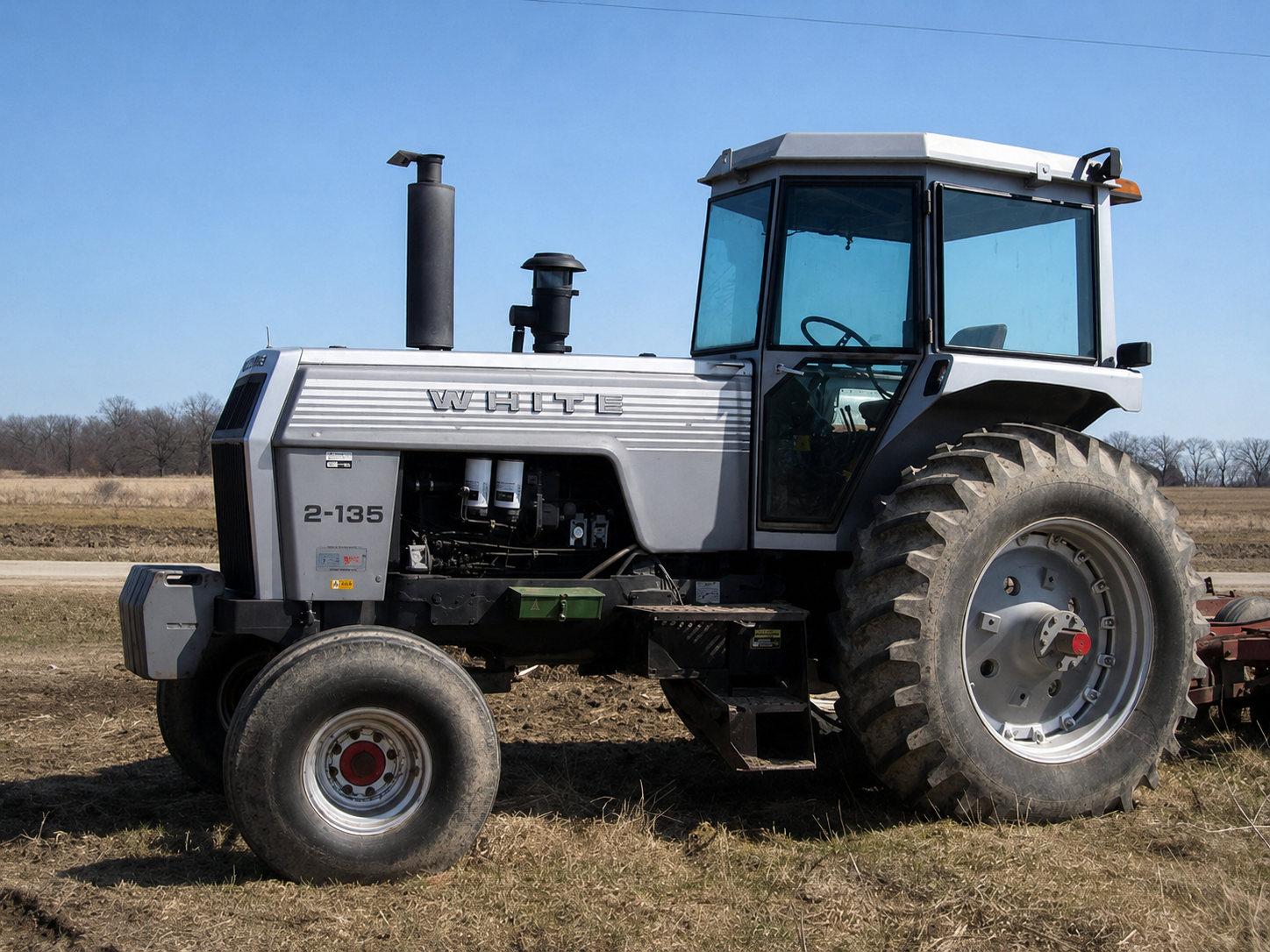
Walk through a farm auction today and you’ll still find plenty of White tractors attracting attention. Some are headed for restoration, while others are being purchased for exactly what they were built to do: go back to work.
That enduring popularity is remarkable for a brand that disappeared from new equipment dealerships decades ago. White tractors haven’t been produced under the White name since the late 1990s, yet models like the 2-105, 2-135, and 2-155 continue to earn a reputation for dependable performance and straightforward maintenance.
So what makes these silver tractors special, and why do so many farmers still seek them out?
A Brand Built From Farm Equipment Legends
The White story didn’t begin with White tractors at all. It began with the White Motor Company, a manufacturer better known for trucks than agricultural machinery. During the 1960s, White entered the farm equipment business by acquiring several well-known manufacturers, including Oliver, Minneapolis-Moline, and Cockshutt.
Each of those companies brought decades of engineering experience, loyal customers, and proven tractor designs. Rather than continuing to operate as separate brands forever, White gradually combined their product lines under the White Farm Equipment name during the 1970s.
The result wasn’t a completely new tractor from scratch. Instead, White blended many of the strongest ideas from its predecessor companies into a single lineup that emphasized reliability, operator comfort, and practical performance.
The Silver Paint Became an Identity
Most manufacturers have long been associated with a signature color. Green belongs to John Deere. Red is closely tied to International Harvester and Case IH. Blue is synonymous with Ford and later New Holland.
White took a different approach.
The bright silver paint wasn’t simply a styling choice. It gave the tractors an appearance unlike anything else in the field. Whether farmers loved it or hated it, there was never any confusion about what brand they were looking at.
Over time, that distinctive color became one of the brand’s greatest assets. Even today, a well-kept White tractor stands out immediately at an auction or tractor show.
Built to Work, Not Impress
Many owners describe White tractors with the same phrase: honest machines.
They weren’t overloaded with complicated electronics, and they generally prioritized function over flashy styling. The controls were straightforward, the drivetrains were robust, and many repairs could be performed without specialized diagnostic equipment.
Depending on the model, buyers could find dependable power from manufacturers such as Perkins, Hercules, Cummins, and Caterpillar. Those engines developed a reputation for longevity when properly maintained, helping many White tractors accumulate thousands of hours of productive work.
One feature that also earned praise was White’s Over/Under Hydraul-Shift transmission on earlier models, which allowed operators to change speed ranges under load without stopping. At a time when productivity mattered just as much as horsepower, that flexibility made a noticeable difference in the field.
Models That Continue to Draw Interest
Certain White tractors have become especially popular with both collectors and working farmers.
The White 2-105 is often viewed as one of the brand’s best all-around tractors. Producing roughly 105 horsepower, it found a home on livestock operations, hay farms, and mixed-crop operations where versatility mattered more than maximum power.
The 2-135 and 2-155 stepped into larger row-crop roles, offering more horsepower while maintaining the straightforward mechanical design that many owners appreciated. Even today, these tractors are capable of handling tillage, planting, mowing, and grain cart duties on many operations.
For those needing even more muscle, articulated models like the White 4-180 demonstrated that the company could compete in the growing high-horsepower market of the late 1970s and early 1980s.
While values vary depending on condition, well-maintained examples often attract competitive bidding because buyers know exactly what they’re getting, which is proven machines with decades of real-world experience.
Keeping White Tractors Running
One surprise for new buyers is how practical it can still be to own a White tractor.
Although the brand itself is gone, replacement parts remain available through a combination of aftermarket manufacturers, salvage yards, specialty suppliers, and AGCO dealers that continue to support legacy equipment. Owners also benefit from active online communities where technical advice, manuals, and restoration knowledge are shared every day.
Because these tractors rely heavily on mechanical systems instead of complex electronics, many repairs can be completed by experienced owners or independent repair shops without specialized software.
That simplicity has become even more appealing as newer agricultural equipment has grown increasingly sophisticated and expensive to maintain.
A Legacy That Lives On
White Farm Equipment eventually became part of a series of mergers and acquisitions that helped shape today’s agricultural equipment industry. In 1991, White became part of AGCO, which also brought together brands such as Allis-Chalmers, Massey Ferguson, Challenger, Fendt, and Valtra over the years.
While the White name eventually disappeared from new tractor hoods, its engineering, dealer relationships, and customer base played an important role in AGCO’s growth during its early years.
Many of the farmers who bought White tractors decades ago remained loyal to AGCO products long after the silver paint was gone.
More Than Just Nostalgia
It’s easy to assume that White tractors are appreciated only because they remind people of another era. Nostalgia certainly plays a role, especially among collectors who remember seeing them on family farms.
Their continued popularity goes beyond memories, though. Farmers still buy White tractors because they are durable, relatively easy to repair, comfortable to operate, and capable of handling real work without requiring a six-figure investment.
In an age when agricultural technology evolves at a rapid pace, there’s still something appealing about a tractor that starts, goes to work, and keeps doing its job year after year. That may be the biggest reason White tractors continue to have such a loyal following long after production came to an end.

Leave a Reply