For years, the conversation around autonomous farming has largely focused on brand-new machines. Manufacturers have showcased tractors capable of operating without a driver, startups have introduced purpose-built autonomous platforms, and equipment companies have invested heavily in technologies designed to reduce labor demands. While the innovation has been impressive, one challenge has remained constant: convincing farmers to replace expensive equipment they already own.
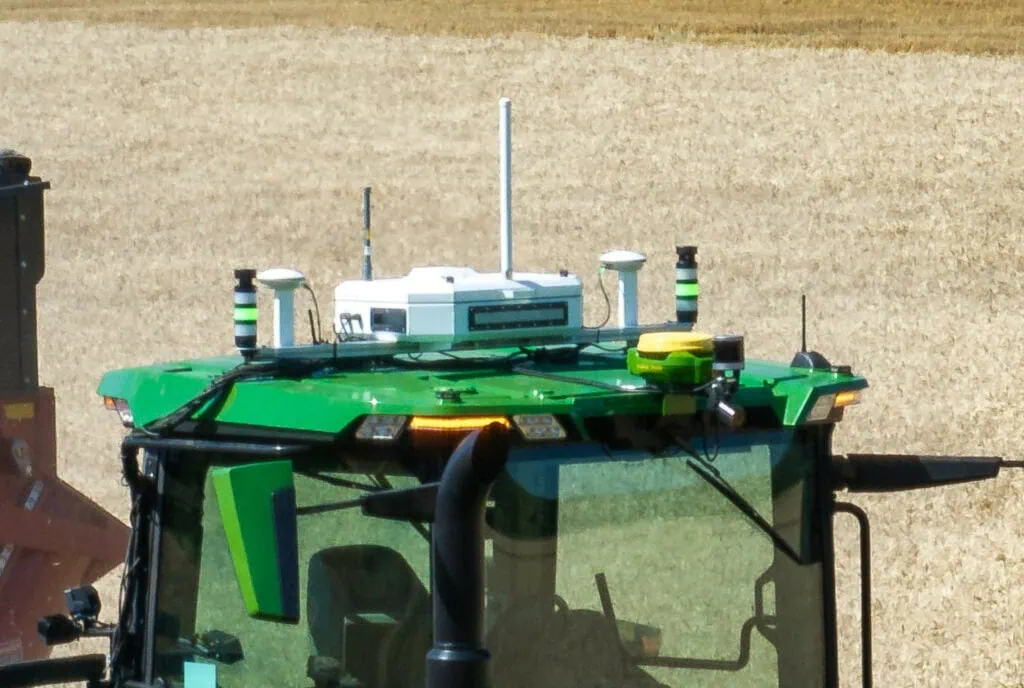
That may be why retrofit autonomy is beginning to attract so much attention. Instead of asking producers to purchase an entirely new autonomous tractor, companies are developing systems that can add autonomous capabilities to compatible equipment already in the field. The approach lowers the financial barrier to entry, allows operators to continue using machines they know and trust, and could make autonomy accessible to a much larger number of farms.
PTx Trimble’s recently announced OutRun retrofit kit is one of the latest examples of this shift. Designed to automate tasks such as grain cart operation and tillage on compatible equipment, the system reflects a growing belief that the fastest path to autonomous farming may not be replacing today’s tractors, but upgrading them.
Making Autonomy More Accessible
The average row-crop tractor represents a significant investment, and many machines remain productive for decades. Even farms that embrace new technology aren’t necessarily looking to replace equipment simply because autonomous options have become available.
Retrofit systems offer a different path. By building on existing machines, they allow producers to modernize their fleets without starting from scratch. That makes autonomy less of an all-or-nothing decision and more of an incremental upgrade, similar to how many farms adopted GPS guidance, auto-steer, section control, and precision application technologies over the past two decades.
Just as importantly, retrofit systems reduce the learning curve. Operators continue working with familiar tractors while adding new capabilities, making the transition feel like an evolution rather than a complete change in how the farm operates.
Labor Continues to Drive Innovation
The growing interest in autonomy is about solving a practical problem. Finding experienced equipment operators continues to be a challenge across much of agriculture. During planting and harvest, farms often have more work than qualified people available to perform it. Autonomous support equipment offers one way to help existing employees accomplish more without sacrificing productivity.
Applications such as autonomous grain cart operation or tillage allow workers to focus on jobs that require direct attention while repetitive field tasks become increasingly automated. Rather than replacing people, these systems are designed to help farms make better use of the labor they already have.
It’s Part of a Bigger Industry Trend
PTx Trimble isn’t the only company betting on autonomy, although its retrofit approach highlights an important shift in strategy.
Companies such as John Deere have continued developing fully autonomous solutions for tillage and other field operations, while manufacturers including CNH Industrial have invested in autonomous and precision technologies across their equipment portfolios. Companies like Agtonomy have focused on specialty crops with retrofit autonomy systems, and earlier pioneers such as Sabanto demonstrated that existing tractors could be converted into autonomous machines years before the concept began attracting widespread industry attention.
Although these companies differ in their approaches, they share a common goal: making autonomy practical enough to solve real problems on real farms.
Challenges Still Remain
Retrofitting equipment doesn’t eliminate every obstacle. Compatibility between different tractor models, safety systems, regulatory considerations, dealer support, subscription costs, and real-world reliability will all influence how quickly producers adopt these technologies.
Perhaps the biggest hurdle is trust. Farmers depend on equipment that performs consistently during narrow planting and harvest windows, and any autonomous system will have to prove it can deliver that same level of dependability before it earns widespread acceptance.
The good news for manufacturers is that today’s producers are already comfortable with technologies that once seemed revolutionary. GPS guidance, automated steering, variable-rate application, telematics, and precision planting all followed similar adoption curves. They gained acceptance because they solved practical problems while fitting naturally into existing farming operations.
Looking Ahead
Whether retrofit kits ultimately become the dominant path to autonomous farming remains to be seen. What is becoming increasingly clear, however, is that lowering the barriers to adoption may be just as important as advancing the technology itself.
If companies like PTx Trimble continue demonstrating that existing tractors can safely and reliably perform autonomous tasks, retrofit systems could become one of the industry’s most effective tools for bringing autonomy into everyday farming. The future of autonomous agriculture may not begin with replacing the tractor in your shed. It may begin by upgrading it.


Leave a Reply