Agricultural drones have been hovering on the edge of mainstream farming for years, but that may finally be changing.
A recent article by the StarPhoenix highlighted how newly approved drone technology is opening new opportunities for farmers in Saskatchewan, where larger agricultural drones are beginning to move beyond crop scouting into commercial field applications. While the regulatory changes are taking place north of the border, they reflect a much broader trend. Across North America, drones are rapidly evolving from niche tools into practical pieces of farm equipment.
That transformation isn’t being driven by one breakthrough alone. Better aircraft, improved batteries, smarter software, evolving regulations, and growing demand for precision applications are all pushing the technology forward at the same time.
From Eyes in the Sky to Working Machines
Not long ago, most agricultural drones were used primarily for aerial photography, crop scouting, and mapping. Those jobs remain important, but today’s commercial platforms are increasingly designed to work in the field rather than simply observe it.
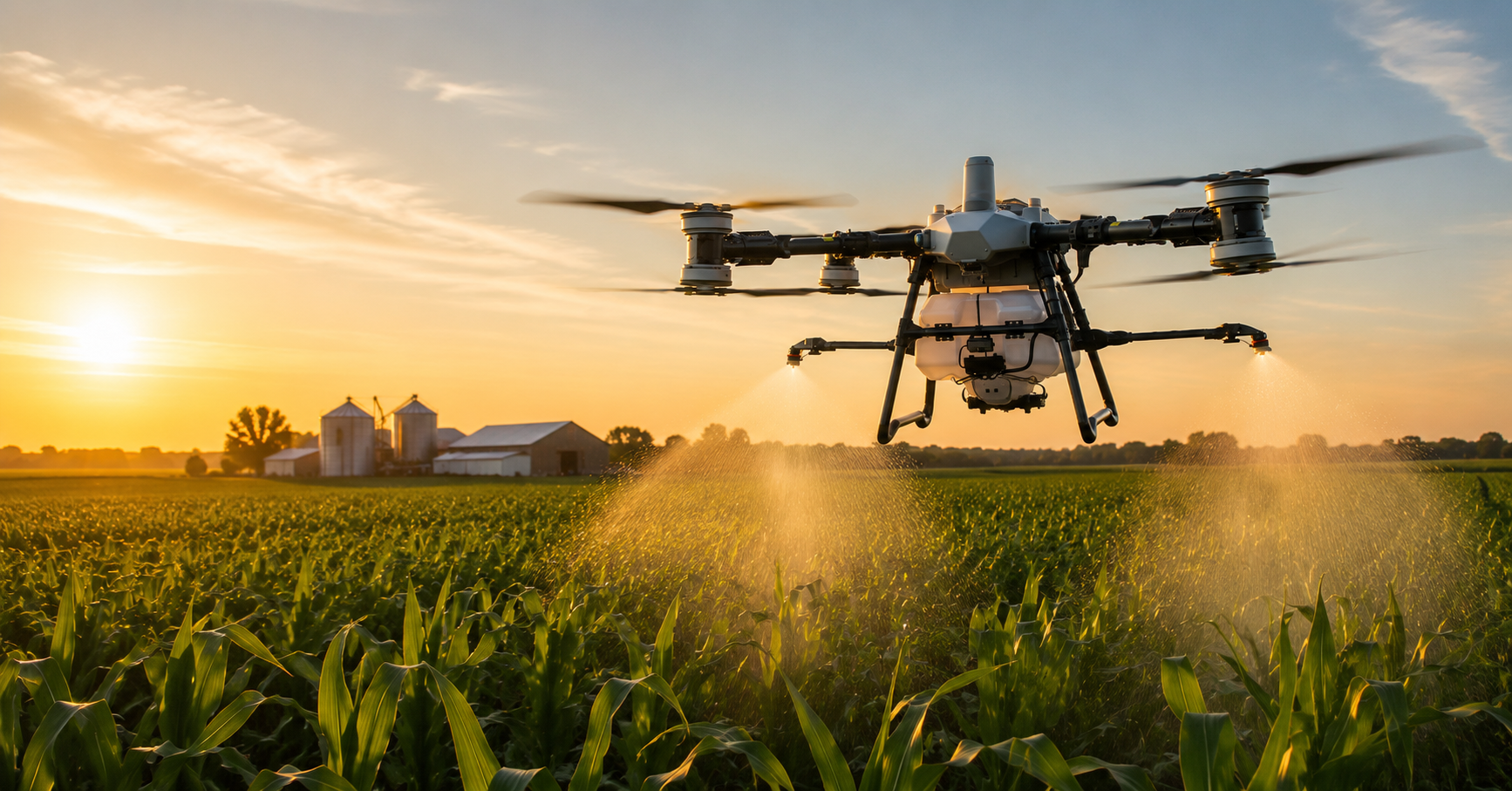
Modern agricultural drones can apply herbicides, fungicides, and insecticides with remarkable precision, seed cover crops in selected situations, scout fields using multispectral and thermal imaging, monitor crop emergence, inspect drainage issues, and even check livestock, fences, and waterways.
Rather than replacing traditional equipment, drones are becoming another specialized tool that helps farmers complete jobs more efficiently when conditions call for it.
Filling the Gaps Traditional Equipment Can’t
One of the greatest advantages of drones is that they can work where conventional machinery struggles.
After heavy rains, a self-propelled sprayer may sit idle while fields dry enough to support its weight. A drone, meanwhile, can be airborne within minutes, treating problem areas without leaving a single tire track.
That flexibility can be especially valuable during narrow application windows, when insects, disease, or rapidly growing weeds can’t wait several days for field conditions to improve.
The same precision also makes drones well suited for localized treatments. Rather than applying products across an entire field, operators can target specific areas, reducing both input costs and unnecessary applications.
Better Information Leads to Better Decisions
Spraying is only part of the story.
Even when they aren’t carrying a payload, drones are becoming powerful agronomic tools. High-resolution cameras, multispectral sensors, and thermal imaging can reveal crop stress, nutrient deficiencies, disease pressure, drainage problems, and water stress long before many of those issues become obvious from the ground.
Combined with yield maps, soil sampling, and satellite imagery, drone data gives farmers another layer of information to help guide management decisions throughout the growing season.
An Industry Growing Up
The aircraft themselves have changed dramatically over the past several years.
Larger payload capacities, RTK guidance, automated flight planning, obstacle avoidance, improved batteries, and increasingly intuitive software have made commercial drone operations far more practical than they were just a few years ago. Those improvements are lowering the barrier for both farmers and custom application businesses looking to add aerial services.
The growth extends well beyond the drones themselves.
As adoption accelerates, manufacturers are beginning to invest in the domestic supply chain needed to support the industry. AgFunderNews recently reported that California-based USA Drone Motors has emerged from stealth with plans to manufacture electric motors, actuators, and electronic speed controllers for heavy-lift drones in the United States. The company was founded in response to growing demand for American-made alternatives to components that have traditionally been sourced overseas.
That investment sends an important signal. Companies aren’t simply betting that farmers will buy more drones. They’re investing in the manufacturing ecosystem they believe will support a much larger agricultural drone industry in the years ahead.
Challenges Still Remain
Despite the momentum, drones are unlikely to replace self-propelled sprayers or aerial applicators across broad-acre farming anytime soon.
Payload capacity and battery life still limit daily productivity compared to conventional equipment. Operators must also navigate aviation regulations, pesticide application requirements, and pilot certification rules that vary by jurisdiction. For many producers, hiring a custom drone application service will remain the most practical option.
Like many emerging technologies, agricultural drones are likely to complement existing equipment rather than replace it.
Looking Ahead
Agriculture has always adopted new technology one practical improvement at a time. GPS guidance, autosteer, yield monitors, and precision planting all began as specialized tools before becoming standard equipment on many farms.
Agricultural drones appear to be following that same path.
They won’t replace every tractor, sprayer, or crop duster. Instead, they’ll fill the gaps those machines leave behind by reaching fields that are too wet to enter, treating problems before they spread, and providing information that’s difficult to gather from the ground.
The biggest sign that drones are becoming a permanent part of modern agriculture may not be found in the fields themselves. It’s that regulators, manufacturers, software developers, and component suppliers are all investing in the technology at the same time. When every part of an industry begins moving in the same direction, it’s usually a sign that the future has already started.


Leave a Reply