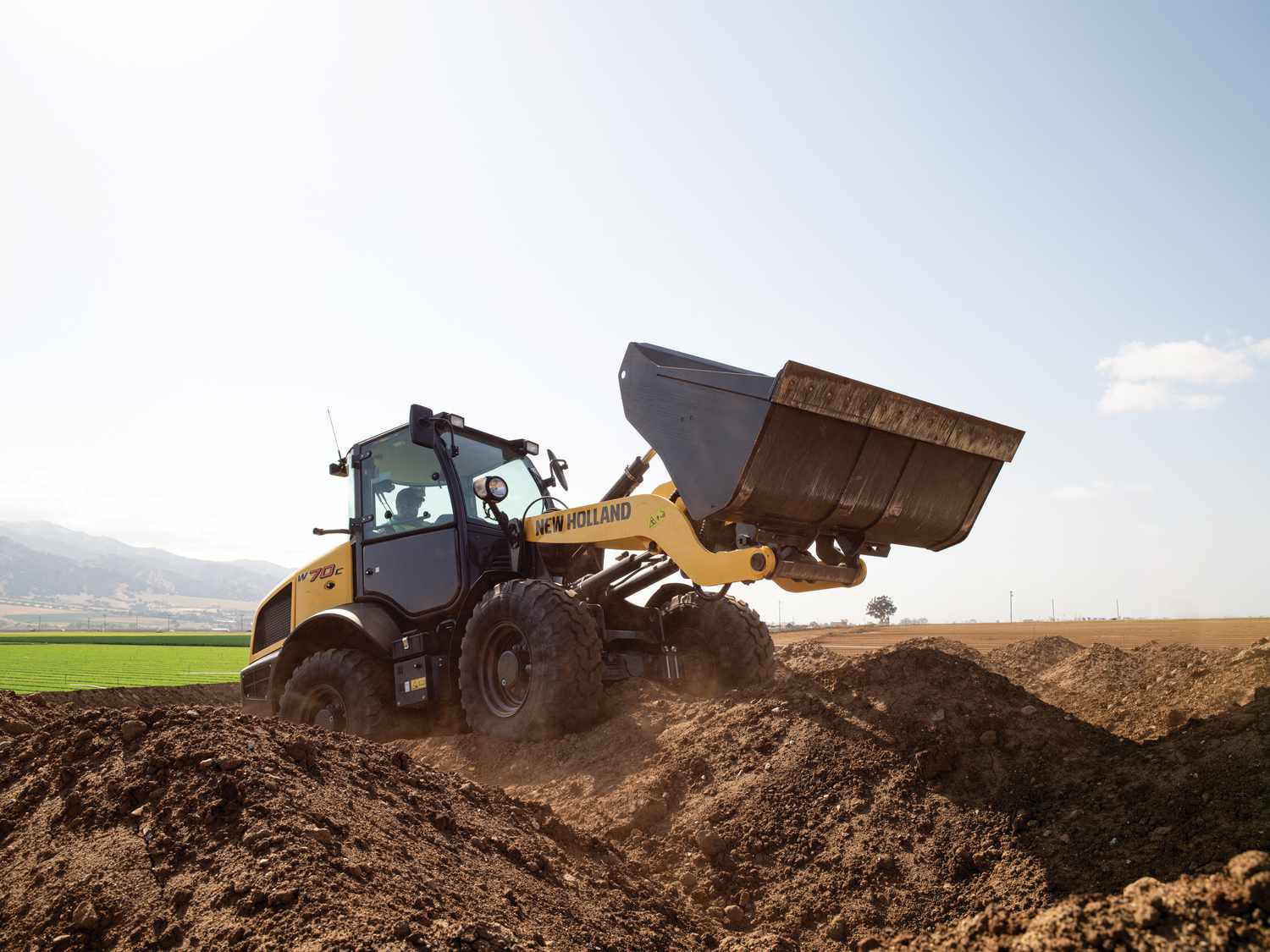
Compact wheel loaders aren’t new, but North American farmers are beginning to look at them differently. The machines have long been common on European farms, where articulated loaders frequently perform jobs Americans traditionally hand to skid steers.
“If you go to Europe you won’t see a skidsteer,” Neil Messick, one of the owners of Messicks Farm Equipment in Pennsylvania, recently told Lancaster Farming. “Compact wheel loaders are what they’re using, and we’re starting to see a little more adoption of that here.”
That growing interest comes as manufacturers expand their compact wheel loader offerings in North America. New Holland Construction recently introduced its new D-Series lineup, while several other manufacturers have added or updated machines in the category. For farmers, the attraction comes down to some practical advantages: visibility, comfort, maneuverability and potentially lower operating costs.
Articulation Makes a Difference
One of the fundamental differences between a skid steer and a compact wheel loader is how the machine turns. A skid steer changes direction by varying wheel speed from side to side, effectively skidding its tires across the surface. An articulated wheel loader bends through a joint near the center of the machine.
Both designs can be highly maneuverable, but articulation reduces tire scrubbing and ground disturbance while providing a smoother turning experience. That can be particularly useful around livestock facilities, concrete lots and other areas where a loader spends much of its day making repetitive trips.
It can also reduce operating costs. “You don’t burn through tires like you do with a skidsteer,” Messick told Lancaster Farming, adding that operational costs tend to be lower as a result. Compact wheel loaders generally carry a higher upfront price, but reduced tire wear can help narrow that difference over thousands of hours of operation.
Better Visibility From the Cab
Visibility may be an even bigger advantage. A compact wheel loader typically puts the operator higher than a skid steer, with large windows and relatively unobstructed sightlines around the machine. The articulation occurs below the operator rather than through skid steering at each corner.
That difference matters on a busy farm, where a loader may operate around employees, livestock, trucks, buildings and other equipment. “It’s a night and day difference, especially when working around people or tight spaces,” Messick said. “You sit up higher in a compact wheel loader with the articulation below you, so the visibility is greatly improved.”
Manufacturers are leaning into that advantage. New Holland’s new D-Series, for example, uses a lower front console, larger windshield and improved sightlines to the attachment and work area. A monitor mounted on the right-side A-pillar keeps machine information within the operator’s field of view without consuming as much forward visibility.
Built to Lift, Carry and Repeat
The strongest argument for a compact wheel loader may simply be the type of work many farms need a loader to perform. Moving feed, bedding, manure, pallets, fertilizer and other bulk materials involves repeated cycles of loading, carrying and dumping, often for hours at a time.
Wheel loaders are built around exactly that type of work. They generally offer good travel speeds and lifting capacity while providing a smoother ride than a machine that must skid itself through every turn. Side-entry cabs can also make getting on and off easier during jobs that require frequent stops.
Attachment versatility has improved as well. Buckets, forks, grapples, snow equipment and other tools allow a compact wheel loader to handle many of the jobs traditionally assigned to a skid steer. Some manufacturers also offer skid-steer-style couplers, making the transition easier for farms that already own attachments.
The category itself is expanding. New Holland’s recently introduced D-Series includes three compact wheel loader models, including a long-reach version, aimed at agriculture, construction, landscaping and material handling. Other manufacturers have also expanded their small articulated and compact wheel loader offerings as North American demand grows.
The Skid Steer Isn’t Going Anywhere
None of this means the skid steer has outlived its usefulness. Skid steers and compact track loaders remain exceptionally versatile, particularly when hydraulic attachments, digging, difficult terrain or the ability to turn within the machine’s own footprint are priorities. Their enormous installed base and attachment ecosystem aren’t disappearing either.
The more interesting question is how many jobs have traditionally gone to skid steers simply because that was the type of compact loader American farmers knew best. If a machine spends most of its life digging, running demanding attachments or working in mud, a skid steer or compact track loader may still be the better choice. If the work consists primarily of lifting, carrying, loading, feeding and moving material, the wheel loader makes an increasingly compelling argument.
Operator comfort may reinforce that decision on farms where loaders rack up hundreds of hours each year. As Messick noted, compact wheel loader cabs may still be tight, but operators aren’t constantly being tossed around as the machine skids through turns. Over a long day of feeding cattle or moving material, that difference can matter.
Compact wheel loaders aren’t replacing skid steers, and they don’t need to. What appears to be changing is the assumption that a skid steer should automatically be the first choice whenever a farm needs a smaller loader.
For years, an American farmer shopping for a compact loader usually started by asking which skid steer to buy. As compact wheel loaders become more capable and widely available, more farmers may start with a different question: Is a skid steer really the best machine for the job?

Leave a Reply