
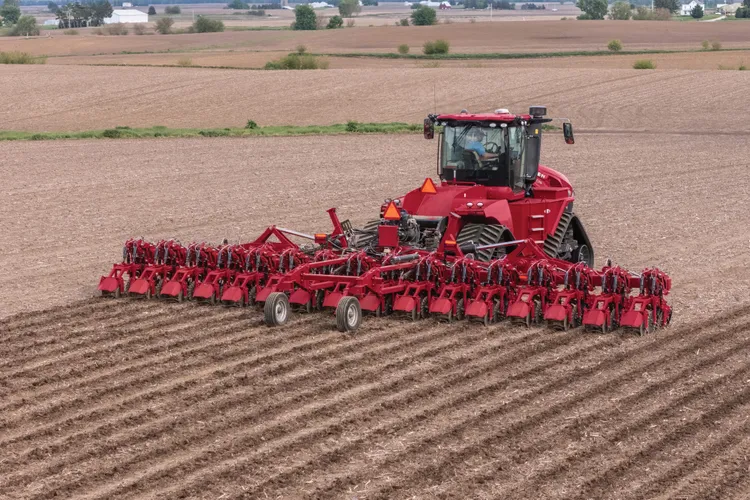
When Case IH introduced the Nutri-Tiller 1000 earlier this year, the company was re-envisioning what strip till could do. The machine was designed to clear residue, work the planting zone, place fertilizer and build a consistent berm while leaving the soil between the rows relatively undisturbed. Now Case IH is scaling that concept up with a new 16-row folding configuration aimed at farmers who need to cover more acres during narrow fall and spring fieldwork windows.
The addition expands the Nutri-Tiller 1030 lineup to 8-, 12- and 16-row configurations, while the smaller Nutri-Tiller 1010 remains available as a six-row rigid-mounted machine. Case IH has also introduced a new knife/coulter row-unit configuration, giving growers another option for matching the machine to their soils, residue levels and fertility programs.
Matching the Planter Row for Row
When Tractor Tuesday looked at the Nutri-Tiller earlier this year, much of the story centered on what the machine could accomplish within each strip. Residue managers clear the row, the soil is worked where the crop will be planted, and fertilizer can be concentrated in the root zone rather than broadcast across the entire field.
The 16-row model doesn’t fundamentally change that approach. What it does change is capacity, while creating a more natural match for farms already planting with a 16-row machine. A farmer can prepare 16 strips in one pass and return with a 16-row planter working at the same width, simplifying the relationship between the tillage and planting passes.
That connection is particularly important because Case IH has designed the Nutri-Tiller to work alongside its 2000 Series Early Riser planters. Guidance lines created during strip-till can be stored and shared through Case IH FieldOps, while Active Implement Guidance can compensate for implement drift to help keep the planter centered over the previously prepared strips.
Built to Cover More Ground
Going from 12 to 16 rows represents a 33% increase in working width when row spacing remains the same. For a farmer working on 30-inch rows, for example, that means moving from a 30-foot machine to a 40-foot machine. Actual acres covered per hour will depend on field speed, turning time and field conditions, but the additional width could make a meaningful difference when the window for strip-till is short.
Case IH also designed the larger Nutri-Tiller 1030 to follow field contours rather than simply making the toolbar wider and more rigid. The 8-, 12- and 16-row configurations use a three-section flexing frame with up to 21 degrees of upward wing movement, helping the individual row units maintain more consistent engagement across uneven or rolling ground.
That flexibility becomes increasingly important as implements get wider. A 40-foot toolbar traveling across terraces or rolling terrain has considerably more ground variation to contend with than a six-row rigid machine, particularly when the goal is to create a consistent seedbed that a planter will need to follow later.
Another Row-Unit Option
Along with the wider toolbar, Case IH is adding a knife/coulter row-unit configuration to the Nutri-Tiller lineup. It joins the existing shank and coulter options, allowing growers to choose a setup based on soil conditions, residue and how aggressively they want to work the strip.
Regardless of configuration, the basic strip-till philosophy remains unchanged. Soil is disturbed where the crop will be planted while residue remains between the rows, helping protect the soil from wind and water erosion. Fertilizer can also be placed within the strip, potentially combining operations that might otherwise require separate trips across the field.
Operators can make residue-manager adjustments from inside the tractor cab, another feature carried over from the Nutri-Tiller’s original introduction. That allows adjustments as residue conditions change across the field without repeatedly stopping to manually reset the machine.
Case IH Is Connecting the Passes
The more interesting part of the 16-row announcement may be how closely Case IH is connecting its tillage and planting equipment. The Nutri-Tiller, Early Riser planter, Pro 1200 display, FieldOps and Active Implement Guidance can all contribute to a workflow in which the strip created during one pass becomes the target for the planter during another.
That’s particularly valuable in strip-till because building a good berm is only part of the equation. If the planter doesn’t remain centered on that prepared strip, some of the agronomic benefit can be lost. Matching a 16-row Nutri-Tiller with a 16-row planter, while carrying the same guidance information from one operation to the next, gives Case IH a more complete system to offer growers.
The new model also shows where strip-till equipment is headed. As adoption expands beyond smaller or more specialized operations, manufacturers are building wider machines capable of fitting into high-acreage farming systems without giving up the precision that makes strip-till attractive in the first place. For Case IH, adding four more rows to the Nutri-Tiller makes the system practical for more acres and more farms.


Leave a Reply