
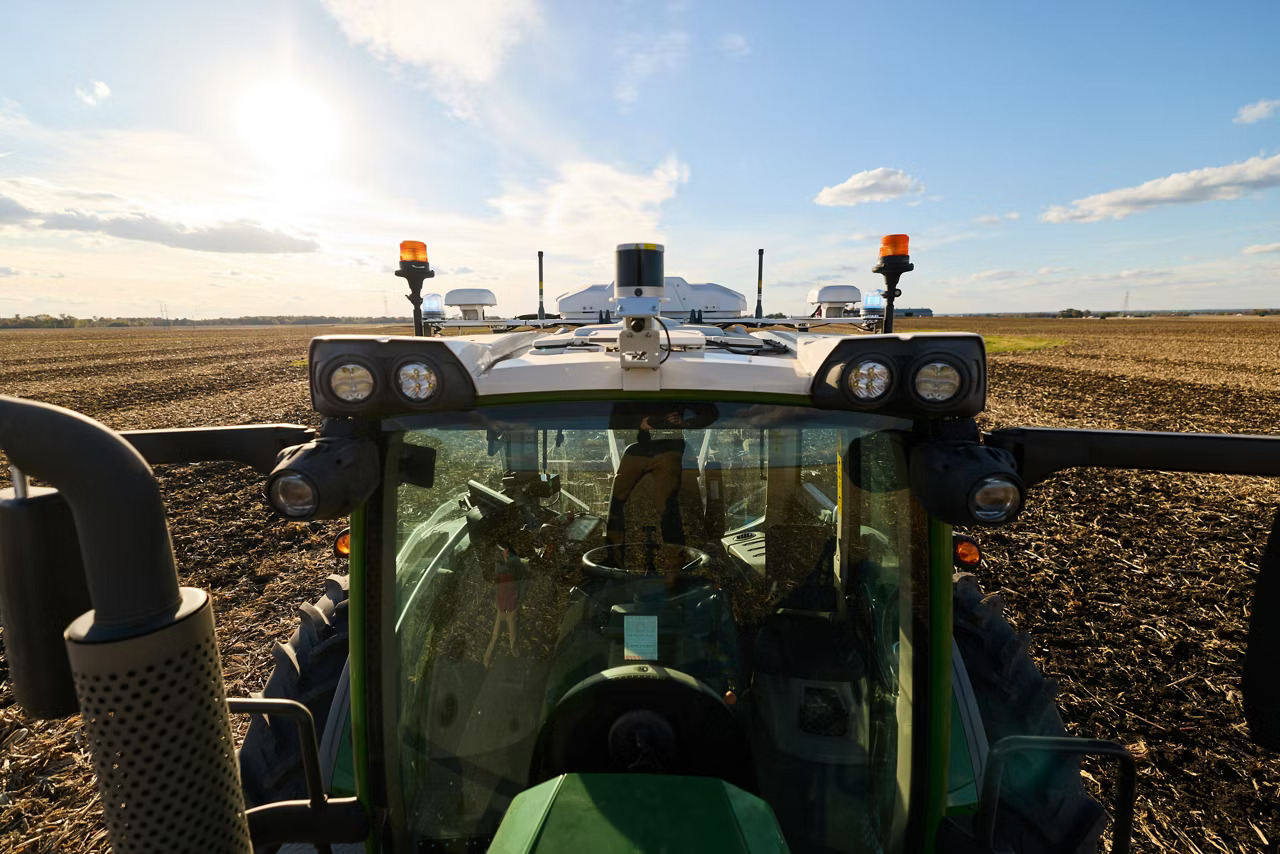
For years, autonomous tractors have seemed perpetually just over the horizon. Guidance systems became commonplace, headland turns became automated and tractors learned to control implements with increasingly little input from the person in the cab. But removing that person altogether remained a much bigger step, and manufacturers are getting closer to making it a practical option on more farms.
A recent Agriland report examined the progress manufacturers are making toward higher levels of tractor autonomy, highlighting Fendt, John Deere and Kubota in particular. All three are working toward machines capable of completing fieldwork without an operator in the cab, but their approaches show there may be more than one road to the autonomous farm.
Fendt is leaning heavily into retrofit autonomy. Deere is building on an increasingly integrated ecosystem of positioning, connectivity, cameras and artificial intelligence, while Kubota is preparing tractors that can operate without anyone remaining at the worksite. The differences matter because the next phase of agricultural autonomy may be less about whether a tractor can drive itself and more about how farmers actually put that capability to work.
Fendt Pushes Existing Tractors Toward Level 4
Fendt has been unusually specific about where its technology falls on the autonomy scale. The company recently outlined how its existing tractor technology progresses through different levels of automation, culminating in what it describes as Level 4 operation with PTx OutRun.
Level 4 is a significant threshold. Rather than simply steering or automating a sequence of operations while a driver remains responsible for the machine, the system can perform an entire process within predefined conditions and a defined operating area. An operator can monitor the work remotely and step in when necessary.
PTx OutRun brings that capability to Fendt’s 900 and 1000 Vario tractors through a retrofit system rather than requiring an entirely new autonomous machine. OutRun first attracted attention as an autonomous grain cart solution, allowing a combine operator to call a driverless tractor and grain cart to the combine, position it for unloading and then send it to another location or assign another task. That potentially removes one of the additional operators normally required during harvest.
The platform expanded again in July with OutRun Tillage. After an initial manual pass to establish boundaries, identify obstacles and calibrate the implement, the tractor can perform subsequent tillage autonomously. The same OutRun hardware and software supports both the grain cart and tillage applications.
That retrofit component could prove important. Instead of asking a farm to replace a tractor simply to gain autonomous capability, the technology is being designed around machines already working in the field. Fendt says the autonomous grain cart system is currently available in North America, while OutRun Tillage is being introduced for compatible Fendt tractors.
Deere Is Building Autonomy Into a Larger Ecosystem
John Deere is arriving at a similar destination from a somewhat different direction. Deere has spent years assembling many of the individual technologies necessary for autonomous operation, with StarFire positioning, AutoTrac, automated headland turns, JDLink connectivity and Operations Center gradually taking individual tasks away from the operator.
The company’s autonomous tractor technology adds another critical layer: machine vision. Deere’s second-generation autonomy system uses 16 cameras positioned around the tractor to provide a 360-degree view of its surroundings. Images are processed onboard, with artificial intelligence used to determine whether the machine can safely continue operating.
Farmers can monitor the tractor through Operations Center Mobile. If it encounters an obstacle or mechanical problem, the system can stop the machine and alert the operator. Deere is also making a point of bringing autonomy to both new and existing equipment, with new tractors available with Autonomy Ready components and the company’s Autonomy Precision Upgrade intended to bring the necessary technology to compatible machines already in farmers’ fleets.
The approach builds autonomy on top of a precision-ag system many Deere customers already use. A farmer accustomed to creating field boundaries, transferring maps, managing prescriptions and monitoring machines through Operations Center is already using much of the digital infrastructure an autonomous tractor needs. The biggest leap is allowing the tractor to perceive and react to its surroundings without a person sitting in the cab.
Deere has initially focused its large-scale agricultural autonomy efforts heavily on tillage, where repetitive field operations and relatively controlled environments provide a logical starting point.
Kubota Wants the Operator to Leave the Worksite
Kubota’s latest development takes another approach. The company announced in August that it plans to launch its new Agri Robo Tractor MR Series in Japan in April 2027. Kubota says the unmanned versions will be the first domestically manufactured tractors in Japan capable of autonomous operation under remote monitoring.
The important distinction is that the operator does not need to remain at the worksite. Earlier autonomous agricultural equipment often still required someone to remain nearby and supervise the machine, while Kubota’s system is designed to let the operator leave and spend that time elsewhere.
The tractor uses AI-based cameras to detect people and radar to identify obstacles. If it detects a potential hazard, it can stop automatically. The operator receives information through a tablet and can inspect the situation remotely before issuing a command to restart the tractor.
Kubota says the unmanned tractors will support eight major types of work, including tillage, seeding, fertilization, weeding and subsoiling. The initial lineup includes 100- and 105-horsepower unmanned models, along with manned versions ranging from 80 to 105 horsepower. For now, Kubota says the new Agri Robo tractors are intended for the Japanese market.
Japan also helps explain why Kubota is emphasizing remote supervision so heavily. The country’s agricultural sector faces significant labor and skilled-worker shortages, making a machine that frees an operator to perform another job particularly valuable.
Autonomy Is Becoming a Labor Multiplier
The labor question may ultimately be the more important story behind autonomous tractors. The popular image of agricultural autonomy has often been a completely driverless farm, with machines replacing people throughout the operation, but the technology arriving today points toward a somewhat different near-term future.
Increasingly, autonomy is about allowing one person to manage more equipment. An operator running a combine could also direct an autonomous grain cart. A farm employee could start an autonomous tillage tractor and move on to another job, while a manager could monitor a machine remotely rather than spending hours sitting in its cab. For farms struggling to find experienced operators during narrow planting, harvest and tillage windows, that could be just as consequential as eliminating an operator entirely.
There are still limitations. These systems work within defined operating environments, and Level 5 autonomy, where a machine could independently handle virtually any situation without human monitoring, remains beyond what agricultural manufacturers are offering. Fields, however, provide manufacturers with something public roads often do not: relatively controlled environments and repetitive jobs. That makes agriculture particularly well suited to the incremental approach now taking shape.
Fendt is showing how autonomy can be added to an existing tractor and moved from one application to another. Deere is integrating autonomous operation into a much broader precision-ag and machine-management ecosystem, while Kubota is pushing remote monitoring far enough that the operator no longer has to remain at the field.
These are different approaches to the same challenge. As farms become larger, operating windows become tighter and experienced labor becomes harder to find, the question surrounding autonomous tractors may gradually change from whether farmers need a machine that can operate without a driver to how many machines a single person can effectively manage.

Leave a Reply