New Holland has picked up three honors in the 2026 EIMA Technical Innovation competition for new technology spanning specialty tractors, large square balers and combines.
The machines themselves are very different, but the technology behind them points in a similar direction. New Holland is developing equipment that can increasingly monitor what is happening around it, anticipate changing conditions, and adjust the machine automatically rather than waiting for the operator to react.
Two of the systems received EIMA’s highest Technical Innovation designation, while a third earned a Technical Evolution award. The technologies will be displayed at EIMA International 2026 in Bologna, Italy.
A Hybrid Tractor That Manages the Implements Too
One of the Technical Innovation awards went to New Holland’s prototype T4F e-Source Mild Hybrid system, developed for specialty applications such as vineyards and orchards.
The tractor uses a 48-volt hybrid system, but the interesting part isn’t simply adding electric power to a diesel tractor. New Holland has developed what it calls an Intelligent Power Flow Management System that controls how electrical power is distributed between the tractor and electrically driven implements.
For its EIMA demonstration, the T4F will operate a front-mounted Tecnovict 111E electric leaf stripper and a rear-mounted Nobili e-BV 16 mulcher.
Instead of treating the tractor and two implements as three largely independent machines, the system allows them to exchange information and manage available power together. The tractor can use implement demand and other sensor data to predict loads and determine where electrical power is needed.
EIMA says the setup can reduce fuel consumption by as much as 50% while improving productivity by approximately 8% compared with performing the operations separately using conventional diesel-powered equipment. New Holland puts potential fuel savings for the complete system as high as 52%.
The concept could be particularly useful in vineyards and orchards, where operators frequently perform multiple jobs during the same trip through a row.
A Baler That Can See a Heavy Windrow Coming
New Holland’s second Technical Innovation award may have even broader implications for North American farmers.
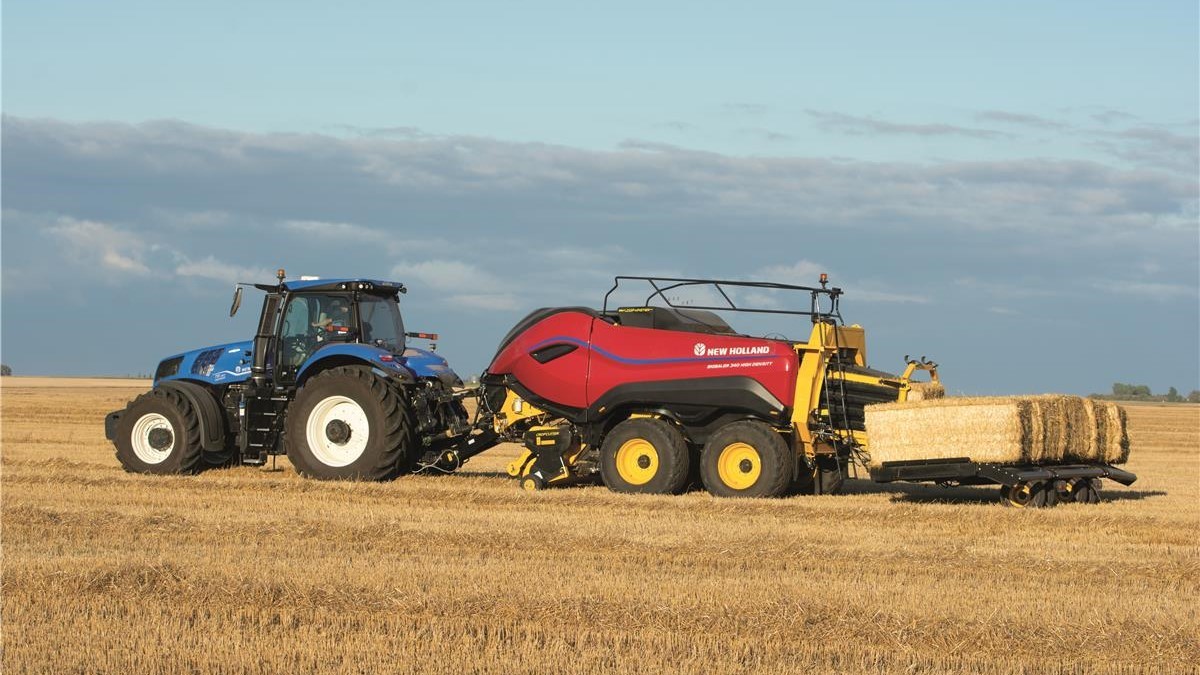
The BigBaler Enhanced Baler Productivity system is designed to keep a large square baler operating near its maximum capacity without the interruptions that can occur when a heavy slug of crop enters the machine.
Traditional overload protection is largely reactive. When torque exceeds a predetermined limit, a clutch can disengage to protect the driveline. New Holland’s system instead uses a hydraulically controlled slip clutch that can allow controlled slipping during temporary load spikes, smoothing those peaks without immediately stopping crop flow.
The system combines that driveline with real-time torque sensing and machine-learning-based estimates of upcoming loads.
EIMA’s description reveals another particularly interesting possibility: forward-looking sensors such as lidar can monitor the windrow ahead of the baler. If the system sees a heavier section approaching, it can anticipate the additional load and adjust tractor speed before the crop ever enters the machine.
New Holland says auto-tuning and self-calibration can also account for changing crop conditions, component wear and temperature.
It is effectively an extension of the tractor-baler automation already appearing on modern equipment. Current New Holland BigBaler High Density models can use IntelliCruise technology to automatically change tractor speed based on crop entering the baler. The experimental system adds another layer by potentially looking ahead rather than relying entirely on what is already happening inside the machine.
A Combine That Decides Where It Needs Traction
New Holland’s third EIMA honor went to Smart Traction Control, a prototype combine system designed to automatically send torque where it is needed as field conditions and machine weight change. The technology received a Technical Evolution award, EIMA’s designation for significant improvements to existing machines or systems.
A combine’s traction requirements can change substantially during harvest. The grain tank gets heavier as it fills, terrain changes and wet spots can dramatically alter the amount of grip available at each axle.
New Holland’s system monitors inputs including field slope, grain tank level, fuel level and gear selection. The hydrostatic drive can then continuously adjust the balance of torque between the front and rear axles.
The goal is to reduce wheel slip, fuel consumption and soil damage while lowering the chance of getting a combine stuck in wet or hilly conditions.
That could also take another repetitive decision away from the operator. Rather than waiting for excessive slip and manually reacting to it, the combine can continuously determine how best to use the traction it already has.
The Focus Is Predictive Equipment
None of these technologies represents a fully autonomous machine, and two are explicitly described as prototypes. New Holland has also not announced North American availability for the three award-winning systems. But together, they illustrate an important direction for farm equipment technology.
For years, much of agricultural automation has focused on maintaining a target after an operator sets it. Guidance keeps a tractor on a line. Cruise systems maintain a speed or engine load. Combine automation adjusts settings to maintain harvesting performance. The next step is increasingly predictive.
New Holland’s baler can potentially look at the windrow ahead and prepare for a change in crop volume. Its combine can use machine weight and terrain information to determine where traction will be needed. Its hybrid specialty tractor can monitor demand from multiple implements and decide how available energy should be distributed.
The operator still decides what job needs to be done. Increasingly, however, the machine is being asked to figure out the best way to do it. That may ultimately be the most significant technology represented by New Holland’s three EIMA awards.
Leave a Reply