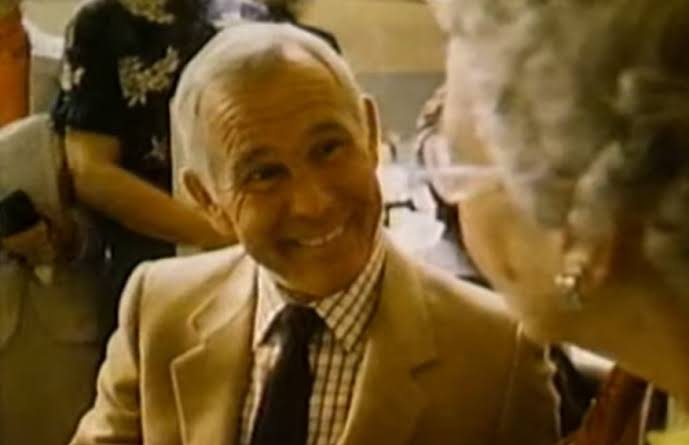
In March 1986, a Nebraska widow stood outside her farmhouse as an auctioneer prepared to sell the land her family had owned for generations. Her husband had died just months earlier, and the bank was foreclosing. More than a hundred neighbors had gathered, but nobody wanted to bid on a farm that had belonged to one of their own.
Then a stranger wearing a brown coat and a seed cap raised his hand. He eventually outbid an outside investor, purchasing the farm for $250,000. When the paperwork was prepared, he instructed the attorney to put the property in the widow’s name.
That stranger, according to the story, was Johnny Carson.
It’s a remarkable tale involving one of America’s most beloved television personalities, a struggling Nebraska farm family, and a debt that supposedly went unpaid for 46 years. But did it actually happen?
A Promise Made During a Nebraska Blizzard
The story comes from a video published October 4, 2026, by the YouTube channel Johnny Carson Legacy. It describes an encounter between a teenage Carson and a young Nebraska farmer named Lloyd Brandt in the winter of 1940.
Carson, then 14, was performing magic shows around his hometown of Norfolk under the name The Great Carsoni. According to the account, Brandt drove Carson through a blizzard to a performance at a rural Grange Hall, digging their truck out of snowdrifts along the way.
When Carson offered to share his five-dollar performance fee, Brandt refused. Instead, he jokingly told the aspiring entertainer to repay him when he became famous.
Carson supposedly wrote an IOU on the back of a promotional handbill, promising to repay the ride once he achieved fame. Brandt kept the paper for decades, even as Carson became the host of The Tonight Show and one of the most recognizable men in America.
Fast-forward to 1986. Brandt had died, his widow was facing foreclosure, and their daughter reportedly mailed Carson a copy of the old IOU. The television star then traveled to Nebraska, attended the auction anonymously, and purchased the property before returning it to the family.
The video concludes with Carson writing two words beneath his original promise: “Paid in full.”
There’s just one problem with this extraordinary story. The channel acknowledges that it’s a dramatized retelling inspired by Carson’s life, with events and dialogue recreated for storytelling.
We could find no independent documentation confirming that Lloyd and Marion Brandt owned the farm described, that the March 22, 1986, auction occurred, or that Carson purchased a foreclosed Nebraska farm and returned it to its owners.
That doesn’t necessarily prove the event never happened, but the account should be treated as a fictionalized story rather than established history.
The Farm Crisis Behind the Story Was Very Real
Although the Carson auction remains unverified, the circumstances surrounding it closely resemble what thousands of Midwestern farm families experienced during the 1980s.
After years of rising land prices and agricultural expansion, farmers were hit by falling commodity prices, high interest rates, and collapsing farmland values. Many had borrowed heavily to purchase additional acreage and equipment, only to discover that their assets were worth substantially less than the debts against them.
Nebraska was particularly hard hit. According to the University of Nebraska’s 1987 Farm Real Estate Market Survey, the state’s average farmland value declined 59% between 1981 and early 1987.
Foreclosure auctions became a painful reality across rural America. Farms that had remained in families for generations were sold, equipment was liquidated, and entire communities felt the consequences.
The story’s depiction of neighbors refusing to bid on a struggling family’s property also has historical roots.
During the Great Depression, farmers in Madison County, Nebraska, where Norfolk is located, organized what became known as penny auctions. At one foreclosure sale in 1931, approximately 150 farmers gathered at the Von Bonn family farm and discouraged competitive bidding. Equipment reportedly sold for a combined $5.35.
These organized efforts were intended to prevent banks from taking everything from financially distressed neighbors. Similar protests and auction tactics resurfaced during the agricultural crisis of the 1980s.
Johnny Carson Never Forgot Nebraska
While the farm auction story lacks documentation, Carson’s generosity toward his home state is beyond dispute.
Born in Corning, Iowa, in 1925, Carson grew up in Norfolk, graduated from Norfolk High School in 1943, and later attended the University of Nebraska. His childhood interest in magic and performing eventually led to a television career that made him a household name.
Despite spending much of his adult life in California, Carson maintained strong connections to Nebraska and supported numerous projects in his hometown.
In 1988, he donated $650,000 toward a radiation treatment center at Norfolk’s hospital. He later contributed $600,000 toward a performing arts theater at Norfolk High School and $50,000 to the Northeast Nebraska Zoo.
His support extended to higher education. According to the University of Nebraska Foundation, donations from Carson, his estate, and the Johnny Carson Foundation have exceeded $50 million, supporting scholarships, performing arts facilities, and educational programs.
Carson was also known for making charitable contributions without seeking publicity. Following his death in 2005, Norfolk residents recalled his generosity and his continued interest in the community where he grew up.
That history helps explain why a story about Carson secretly rescuing a Nebraska farm family might seem believable.
A Story That Still Resonates
Whether Johnny Carson ever stood in a frozen Nebraska farmyard and outbid a bank remains an unanswered question. The specific events described in the video have not been substantiated, but the agricultural hardships surrounding the fictional auction were very real.
For families who lived through the 1980s farm crisis, the prospect of losing a farm represented far more than a financial setback. It could mean the end of generations of work, the loss of a family home, and the disappearance of a way of life.
Carson’s documented generosity toward Nebraska needs no fictional embellishment. His contributions continue benefiting the state decades after his death.
Perhaps that’s why this particular tale is so appealing. It brings together a famous Nebraska son, a struggling farm family, and the idea that an act of kindness, however small, might someday be repaid in a way nobody could have imagined.
And while we may never find evidence that Carson saved the Brandt family farm, the history of Nebraska farmers helping their neighbors through difficult times is a story worth remembering.

Leave a Reply