
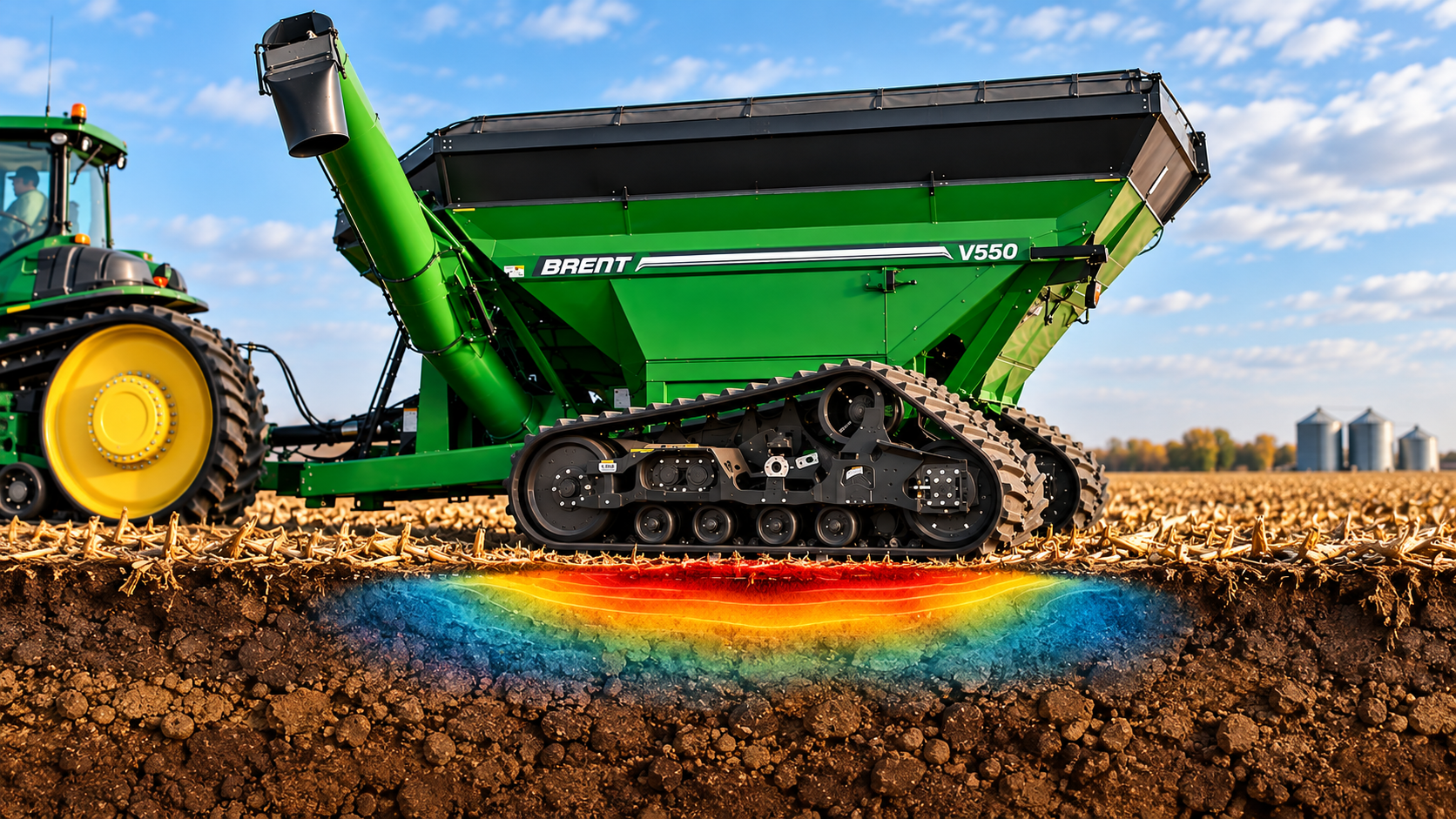
In my part of the world, we call them auger wagons. Most of our customers at Tractor Tuesday out east call them grain carts. Whatever name you use, the worry is the same everywhere: compaction. Nothing else crosses a field as heavy, as often, or in worse conditions than a full cart chasing a combine.
So when buyers ask whether tracks are worth the extra money, the real question is whether tracks fix compaction. I went through the published track specs and the university research to find out.
The short answer: tracks clearly win at the surface. They do not fix the deep compaction, because that comes from how much weight sits on the axle, and tracks don’t make a cart any lighter.
How heavy is a full 1,200 to 1,500 bushel cart?
Heavier than most people guess. A Kinze 1421 on tracks weighs 25,190 lb empty. Fill it with 1,400 bushels of corn at 56 lb a bushel and you add 78,400 lb, for a total near 104,000 lb, or about 52 tons rolling on one axle and a hitch.
University of Minnesota extension educator Jodi DeJong-Hughes puts a loaded 1,200-bushel single-axle cart at 35 to 40 tons per axle.
Penn State soil scientist Sjoerd Duiker draws the line at 10 tons per axle, and prefers under 6. Above 10 tons on moist or wet soil, compaction almost always reaches deeper than 20 inches. That puts an ordinary 1,200-bushel cart at three to four times the line before anyone talks about tracks or tires.
Tracks also add weight. Kinze lists its 1051 cart at 15,100 lb empty on radials and 23,000 lb on tracks. That is close to 8,000 lb more iron for the soil to carry, every trip.
Surface pressure: round one goes to tracks
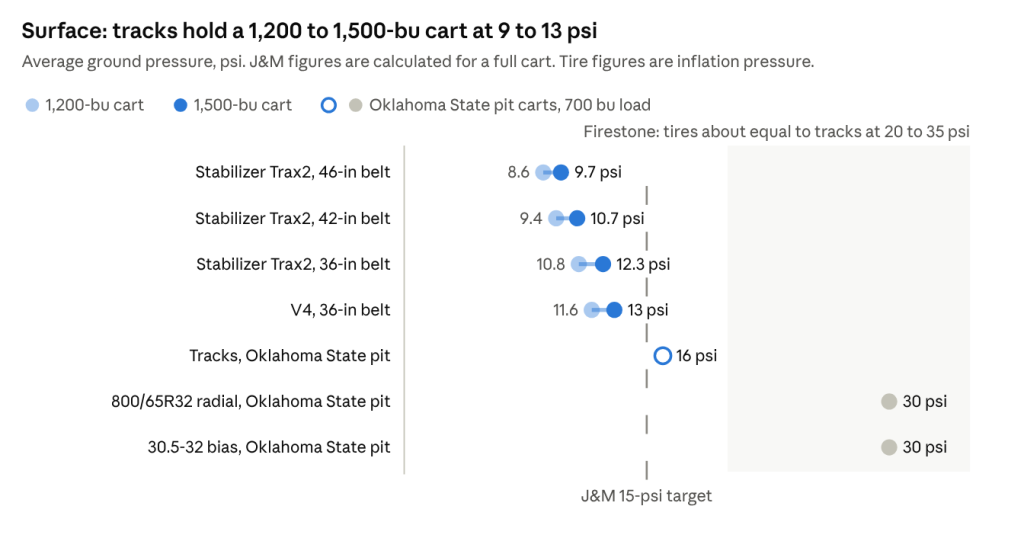
J&M published ground pressure for models 1222 and 1522 (jm-inc.com/tracks); Oklahoma State pit, Randy Taylor; Firestone Ag via Modern Tire Dealer
J&M publishes average ground pressure for every belt on every cart it builds, and on a full 1,200 to 1,500 bushel cart every belt stays under the company’s 15-psi target. Going from 1,200 to 1,500 bushels adds roughly 1 to 1.5 psi on every belt. Footprints run from 7,710 square inches per track on the V4 to 11,170 on the 46-inch Stabilizer Trax2.
Keep in mind those are calculated, not measured. J&M assumes a full cart at 56 lb a bushel, grain spread evenly, and a footprint of wheelbase times belt width. Real pressure peaks under the wheels, which I’ll get to below.
On tires, the number is whatever’s in the tire
A tire’s contact pressure follows its air pressure, so the question is never really the tire. The Oklahoma State pit carts in the chart were at 30 psi while carrying only about 700 bushels. Iowa State work presented at ASABE in 2016 found road inflation settings caused significantly more soil stress than field settings on the same tractor and planter.
IF and VF tires are what let a cart run low. Firestone lists its IF900/60R32 CFO as carrying its maximum cyclic field load with no added air. Firestone’s ASABE tests on tractors give a simple rule:
- Under 20 psi, tires put less pressure on the soil than tracks.
- From 20 to 35 psi, they’re about the same.
- Over 35 psi, tracks win.
That rule comes from tractors, not 40-ton cart axles, and it assumes the air actually got let out after the road trip. A track’s footprint doesn’t depend on anyone remembering.
Why tracks can’t fix the deep stuff
Soil scientists split compaction into two problems, and tracks only solve one of them.
Surface pressure (psi) sets the top 6 to 12 inches. That is your seedbed and the root zone you see next spring. Wider tires, lower air, duals and tracks all bring psi down, and tillage, freeze-thaw and roots can work this layer back out over time.
Axle load (tons) sets how deep it goes. Spreading the same weight over a bigger footprint lowers psi at the surface, but the weight still pushes down into the subsoil. Penn State found a wide tire and a narrow tire carrying the same load showed no difference in soil stress at 22 inches. Ontario soil sensor demos under grain carts found the same thing: lower tire pressure cut stress at 6 and 12 inches, and the heavy carts still loaded the soil at 20 inches.
That deep layer is the expensive one. Subsoilers only partly reach it, and freeze-thaw doesn’t fix it.
A track’s psi is an average
The psi a track maker publishes is the weight divided by the whole footprint. Real pressure peaks under each bogie wheel and drops between them. The Ontario demos measured lower stress under the center of a tracked cart’s belt than under the outer third, right beneath the rollers. Firestone’s field engineers point out that wet soil gets damaged by those peaks, not by the average. A properly aired IF or VF radial spreads its load more evenly across a smaller patch.
What happened when researchers drove carts across fields
Every grain cart study I found lands in the same place. Tracks cut the yield hit. None of them make it go away.
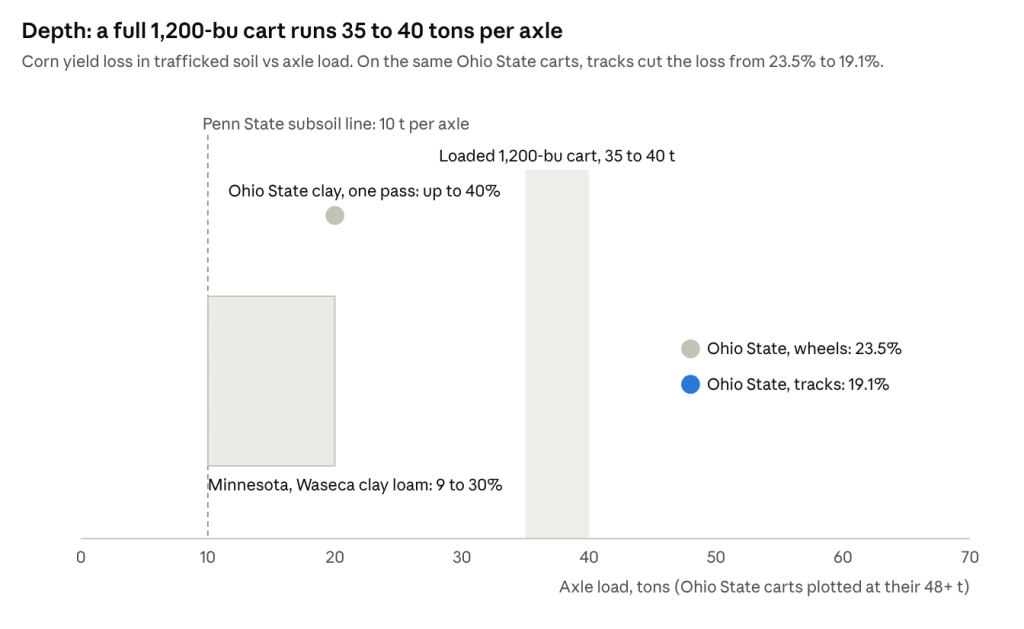
Ohio State (Klopfenstein 2016 thesis; Lal); University of Minnesota, Waseca; Penn State (Duiker); 1,200-bu axle load from DeJong-Hughes, University of Minnesota, 2026
Oklahoma State soil pits. Randy Taylor ran a 729-bushel cart on tracks at 16 psi, loaded with 700 bushels of corn, against carts on 800/65R32 radials and 30.5-32 bias tires, both at 30 psi. Tracks packed the top 6 to 8 inches less. Deeper down, tracks and tires looked about the same. Taylor ranks tracks ahead of duals or triples, because extra tires widen the compacted strip while a track only lengthens it.
Ohio State yield strips. Andrew Klopfenstein’s 2016 thesis ran two grain carts with axle loads over 48 tons on Equalizer tracks, conventional tracks and flotation tires. J&M cites the same work as a study of 1,000-plus bushel carts, right in the class most of us run. Wheeled carts cut corn yield 23.5% across all events. Equalizer tracks averaged 19.1%. One, two or three passes made no significant difference. Klopfenstein has also reported compaction as deep as 34 inches from a loaded 2,000-bushel cart.
The cart makers read that same research as about 17 bu/ac more yield in the traffic lanes on tracks (J&M) or a 4.4% gain field-wide (Kinze). Both numbers are fair. But the tracked cart still lost close to a fifth of the crop where it drove.
What Ohio State says now. Scott Shearer, who chairs the Ohio State ag engineering department, says tracks show less yield hit than wheels in poor soil conditions, but neither tracks nor IF and VF tires eliminate the problem. He also points out that spreading weight over a bigger footprint can push compaction deeper.
What else the research says
Decades of university and manufacturer work point the same direction: heavy axles on wet, heavy soil cost yield for years, no matter what they roll on.
| Study | What they ran | Soil | What they found |
|---|---|---|---|
| Ohio State, Rattan Lal | Single-axle grain carts at 10 and 20 tons, one pass | Clay, silt loam | Up to 40% corn loss on clay after one harvest, with effects lasting up to 8 years. Silt loam mostly escaped. |
| Ohio State, Randall Reeder | 600-bu cart at 20 tons per axle vs 10 tons and under 4 tons | Crosby, Kokomo, Hoytville | Hoytville silty clay loam lost 25 bu/ac corn and 11 bu/ac soybeans a year. The other two soils showed no effect. |
| University of Minnesota, Waseca and Lamberton | 10 and 20 ton axle loads | Webster clay loam; dry Ves | 9 to 30% corn loss at Waseca. 6% first-year loss on dry soil, with compaction to 18 in. that nine winters of freeze-thaw did not clear below 5 in. |
| Multi-state study, 1988 to 2002 | One deep compaction event | Several states | Corn and soybean yields about 5% lower for 12 years with no more traffic. |
| Ohio State combine study (SAE 952159) | Combine on singles, duals, half-tracks and wide tires, plus a loaded grain cart | Kokomo, Crosby | The grain cart did the most damage, a 12.9% porosity loss. On the combine, wide tires at rated pressure did least (2.0%) and half-tracks 6.1%. |
| Ohio State, Reeder, 1994 | Rubber track at 10 psi vs tires at 25 to 30 psi | Ohio | About the same compaction from both. |
| Ontario soil stress demos | Grain carts on bias, radial, tandem and tracks over buried sensors | Ontario | Lower air cut stress at 6 and 12 in. Heavy carts still loaded 20 in. Track stress peaked under the rollers. |
| IFAO Compaction Action, Ontario | Quadtrac vs wheeled Steiger on duals at 13 to 16 psi | Ontario | Tracks ran about 4 psi lower at the surface despite 6,400 kg more weight. No difference at 12 and 20 in. |
| Meta-analysis of 51 studies | Axle load, passes and inflation | Many | Traffic compaction cut corn, wheat, barley and soybean yields 6 to 34% on average, with damage below 40 cm. |
Soil type and moisture decide whether a heavy axle costs you. When it does, you pay for years, and the undercarriage only changes the bill at the margin.
So, does it track?
For surface pressure, yes. On a 1,200 to 1,500 bushel cart, tracks hold the average in the low teens or better, and a tire only matches that if someone actually lets the air out. For deep compaction, no. A loaded cart in that class is still three to five times the 10-ton line on tracks or tires, and the Ohio State carts lost close to a fifth of their yield even on tracks.
What moves the number this harvest:
- Lighten the axle when it’s wet. Ohio State’s Randall Reeder suggests keeping the cart about half full on wet ground and parking it at the field ends. A tandem axle splits the load. A bigger footprint does not.
- Stay off wet soil when you can. The studies with the big losses were on wet or heavy ground. Dry soil carries the same cart with far less damage.
- Drive the same lanes. Ohio State work puts about 85% of compaction on the first pass, so keep the cart in one path instead of cutting new ones.
- On tracks, buy width. On a 1,500-bushel cart the 46-inch belt runs about 3 psi lower than a 36-inch V4.
- On tires, air for the load, not the road. IF and VF cart tires only compete with tracks when they are run at field pressure.
If you are shopping, tracks are the more reliable way to keep surface pressure down without depending on anyone to touch the air. Just don’t buy them expecting a fix for axle weight. Only a lighter load does that.
Sources
- J&M Manufacturing: grain cart tracks, ground pressure table and calculation assumptions
- Kinze 1421 dual-auger cart specs (Lowe & Young)
- Kinze 1051 cart specs (H&R Agri-Power)
- Klopfenstein, A. (2016). An Empirical Model for Estimating Corn Yield Loss from Compaction Events with Tires vs. Tracks, High Axle Loads. Ohio State thesis
- Farm Progress: Tires or tracks? (Randy Taylor, Oklahoma State)
- Grainews: Supersized grain carts a weighty problem (Scott Shearer, Ohio State)
- Penn State Extension: Avoiding Soil Compaction (Sjoerd Duiker)
- DeJong-Hughes, J. (2026). Compaction: quick to cause, slow to remedy. University of Minnesota
- Modern Tire Dealer: Tracks vs. tires (Firestone Ag ASABE findings)
- Firestone Ag: Rubber tracks vs tires
- AG Tire Talk: Grain cart tire trends (IF CFO ratings)
- Iowa State, ASABE 2016: road vs field inflation and soil stress
- Field Crop News: Ontario grain cart soil stress demos
- Ontario Grain Farmer: IFAO Compaction Action, tracks vs duals
- Ag Proud: Ohio State long-term compaction (Rattan Lal)
- No-Till Farmer: Reeder’s 20-ton axle plots
- Strip-Till Farmer: Heavier equipment, deeper compaction
- Farm Progress: Compaction squeezes yields (Minnesota)
- SAE 952159: Combine tractive devices, effects on soil compaction
- Meta-analysis of traffic-induced compaction, 51 studies
- Farm Progress: Run equipment on the same route
- Ohio State CFAES: Fall soil compaction (Reeder)


Leave a Reply