
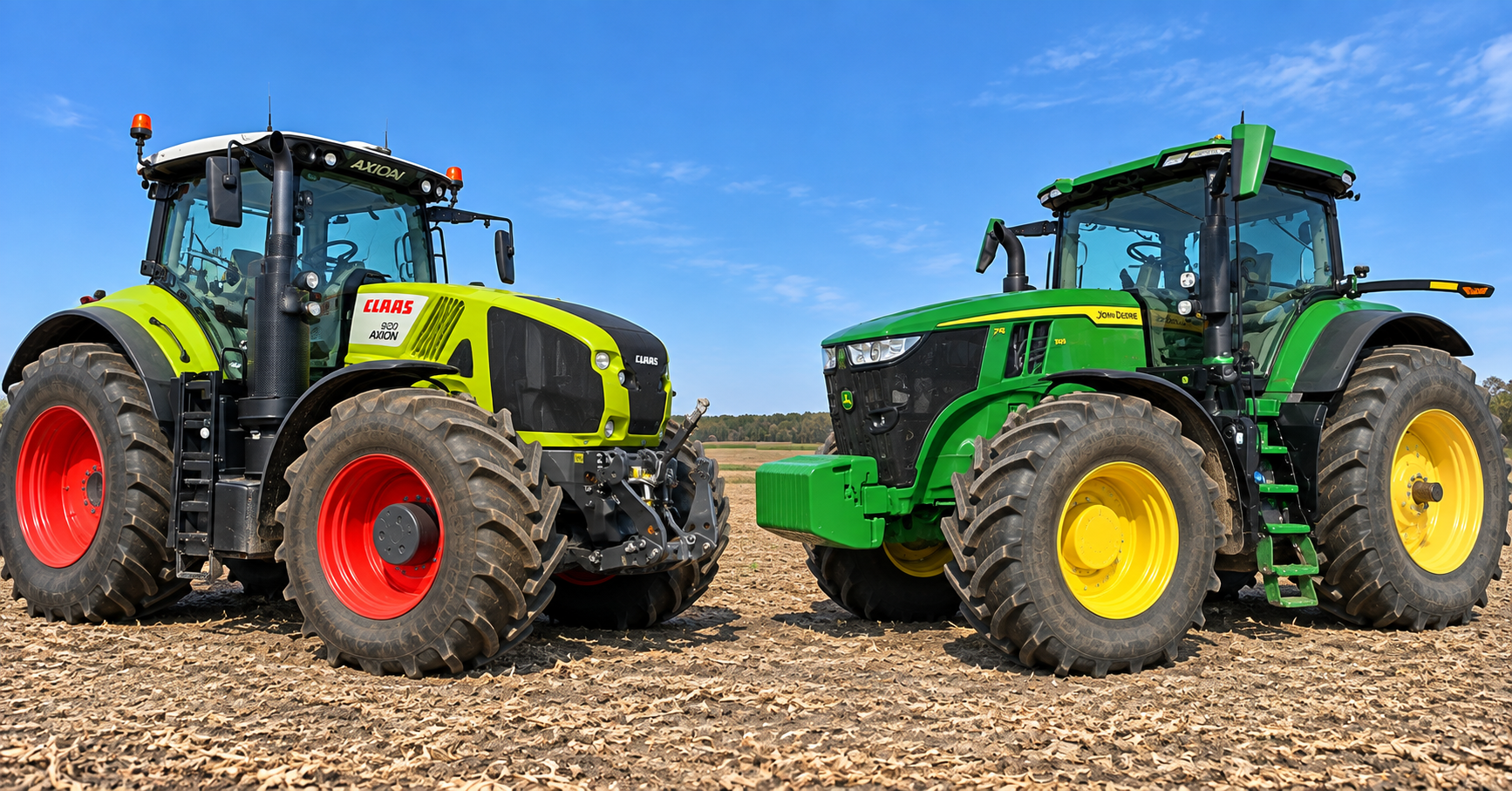
When diesel is cheap, a difference of a gallon or two per hour might not get much attention when comparing tractors. At more than $6 a gallon, it probably should.
The U.S. Energy Information Administration reported Midwest on-highway diesel averaging $6.259 per gallon for the week ending October 12, after reaching $6.680 in September. Farmers buying dyed off-road diesel won’t necessarily pay the highway price, but the recent spike makes tractor fuel efficiency a much bigger part of the ownership equation. At $6.29 per gallon, saving one gallon per operating hour is worth $6,290 over 1,000 hours.
So which tractor actually gets the most work out of a gallon? To get beyond manufacturer claims, we looked at published Nebraska Tractor Test results for six tractors from John Deere, CLAAS, Fendt, New Holland, Case IH and Massey Ferguson.
There’s an important catch up front: these are not all current models tested in the same year. The available tests range from 2015 to 2024. This is a comparison of independently tested tractors for which we could find usable data, not a ranking of the manufacturers’ current 2026 lineups. Newer tractors, particularly models that have been redesigned since these tests, could perform substantially differently.
Gallons per hour doesn’t tell the whole story
Simply comparing how many gallons a tractor burns isn’t particularly useful. A tractor burning 15 gallons per hour while putting 260 horsepower to the ground may be more efficient than one burning 13 gallons while producing 210 horsepower.
A better measurement is horsepower-hours per gallon, which measures how much usable power the tractor produces from each gallon of diesel. The higher the number, the more work you’re getting from the fuel.
The Nebraska Tractor Test Laboratory provides standardized testing that lets us make these comparisons without relying on advertised fuel economy. We concentrated on maximum drawbar performance because it gives us an indication of how efficiently each tractor converts diesel into pulling power.
| Tractor | Test Year | Max. Drawbar HP | Fuel Use | HP-Hr/Gal |
|---|---|---|---|---|
| John Deere 7R 310 | 2020 | 246.09 | 14.3 gal/hr | 17.21 |
| CLAAS AXION 920 | 2024 | 268.28 | 15.61 gal/hr* | 17.19 |
| Fendt 930 Vario | 2019 | 222.20 | 13.3 gal/hr | 16.71 |
| New Holland T8.350 | 2015 | 213.10 | 13.0 gal/hr | 16.39 |
| Case IH Magnum 310 | 2015 | 234.51 | 14.5 gal/hr | 16.17 |
| Massey Ferguson 8737 | 2015 | 269.80 | 17.4 gal/hr | 15.51 |
*CLAAS fuel consumption calculated from its published drawbar horsepower and horsepower-hours-per-gallon result.
John Deere and CLAAS are effectively tied at their respective maximum-drawbar operating points. The 7R 310 produced 17.21 horsepower-hours per gallon compared with 17.19 for the AXION 920. Fendt followed at 16.71, New Holland at 16.39, Case IH at 16.17 and Massey Ferguson at 15.51.
That creates nearly an 11% spread between the highest and lowest results, but the model years matter. The Case IH Magnum 310 and New Holland T8.350 results, for example, date to 2015. A decade of engine, transmission, emissions and software development separates them from the 2024 CLAAS test.
We found references to newer Nebraska tests for tractors including the Case IH Optum 340, but couldn’t obtain sufficiently complete performance data to make an equivalent comparison. The 2015 Magnum result should therefore not be interpreted as evidence that today’s Case IH tractors are less fuel-efficient than today’s Deere, CLAAS or Fendt models. Newer Case IH models could be markedly improved; we simply don’t have comparable published numbers to demonstrate how much.
What does that mean at $6.29 diesel?
Using the efficiency measurements above, we can estimate how much fuel each tractor would require to produce 200 drawbar horsepower if it maintained its maximum-drawbar efficiency at that output.
| Tractor | Projected Fuel Use at 200 HP | Cost Per Hour |
|---|---|---|
| John Deere 7R 310 | 11.62 gal/hr | $73.10 |
| CLAAS AXION 920 | 11.63 gal/hr | $73.18 |
| Fendt 930 Vario | 11.97 gal/hr | $75.27 |
| New Holland T8.350 | 12.20 gal/hr | $76.76 |
| Case IH Magnum 310 | 12.37 gal/hr | $77.80 |
| Massey Ferguson 8737 | 12.90 gal/hr | $81.11 |
These aren’t measured fuel-consumption figures at 200 horsepower. They’re projections based on each tractor maintaining its tested maximum-drawbar efficiency, and actual partial-load efficiency can differ.
Still, they show why efficiency becomes important when diesel gets expensive. At $6.29 per gallon, the difference between the highest and lowest rates in our group works out to roughly $8 per operating hour at a 200-horsepower load. That’s around $4,000 over 500 hours or $8,000 over 1,000 hours.
How you run the tractor matters, too
The newer CLAAS test provides a good example of how much operating conditions can affect efficiency. At one tested point around 2,000 engine RPM, the AXION 920 produced 234.09 drawbar horsepower at 15.65 horsepower-hours per gallon. Under another operating condition around 1,550 RPM, it produced 268.28 horsepower at 17.19 horsepower-hours per gallon, nearly a 10% difference in efficiency.
It would be wrong to attribute that entire improvement to engine speed because horsepower, travel speed and other conditions changed too. But it demonstrates that a tractor doesn’t have one fixed fuel-efficiency number.
Modern CVT and powershift transmissions, engine-management systems and automatic modes are increasingly designed to accomplish the required work while keeping the engine in an efficient operating range. Ballast, tire pressure, wheel slip, travel speed and matching the tractor to the implement also matter. Buying an efficient tractor and operating it inefficiently can erase some of the advantage.
This isn’t a ranking of today’s tractors
It’s worth emphasizing the limitation again because of the age difference between these machines. Our tests range from 2015 to 2024 and include different transmissions, configurations, weights and power levels.
Several remain relevant to farmers shopping the used-equipment market, but this table does not tell us that John Deere currently builds a more efficient tractor than Case IH, New Holland or Massey Ferguson. To make that claim, we’d need comparable tests of their latest machines.
Maximum drawbar efficiency also isn’t the same thing as pulling your planter, grain cart or tillage equipment across your own fields. A tractor that leads at maximum drawbar power might not lead at 50% or 75% load, while soil conditions, wheel slip, ballast and operator settings can further change the result.
That’s what makes Nebraska testing useful in the first place. It removes many variables and gives us a standardized benchmark, but it can’t predict exactly what you’ll see on your farm.
Fuel efficiency matters a lot more at $6 diesel
Among the tractors for which we found comparable data, the John Deere 7R 310 and CLAAS AXION 920 were virtually tied for the best maximum-drawbar fuel efficiency, with the Fendt 930 Vario close behind. Because the test years vary so widely, that’s more useful as a look at how significant fuel-efficiency differences can be than as a brand leaderboard.
The bigger lesson is that gallons per hour alone doesn’t tell you much. What matters is how much work you’re getting from every gallon you burn.
At $3 diesel, a few percentage points of efficiency might be easy to overlook when making a six-figure equipment purchase. At $6.29, those same percentage points add up quickly. If a tractor is going to accumulate thousands of hours on your farm, fuel efficiency deserves a spot much higher on the list of specifications you compare before you buy.


Leave a Reply