
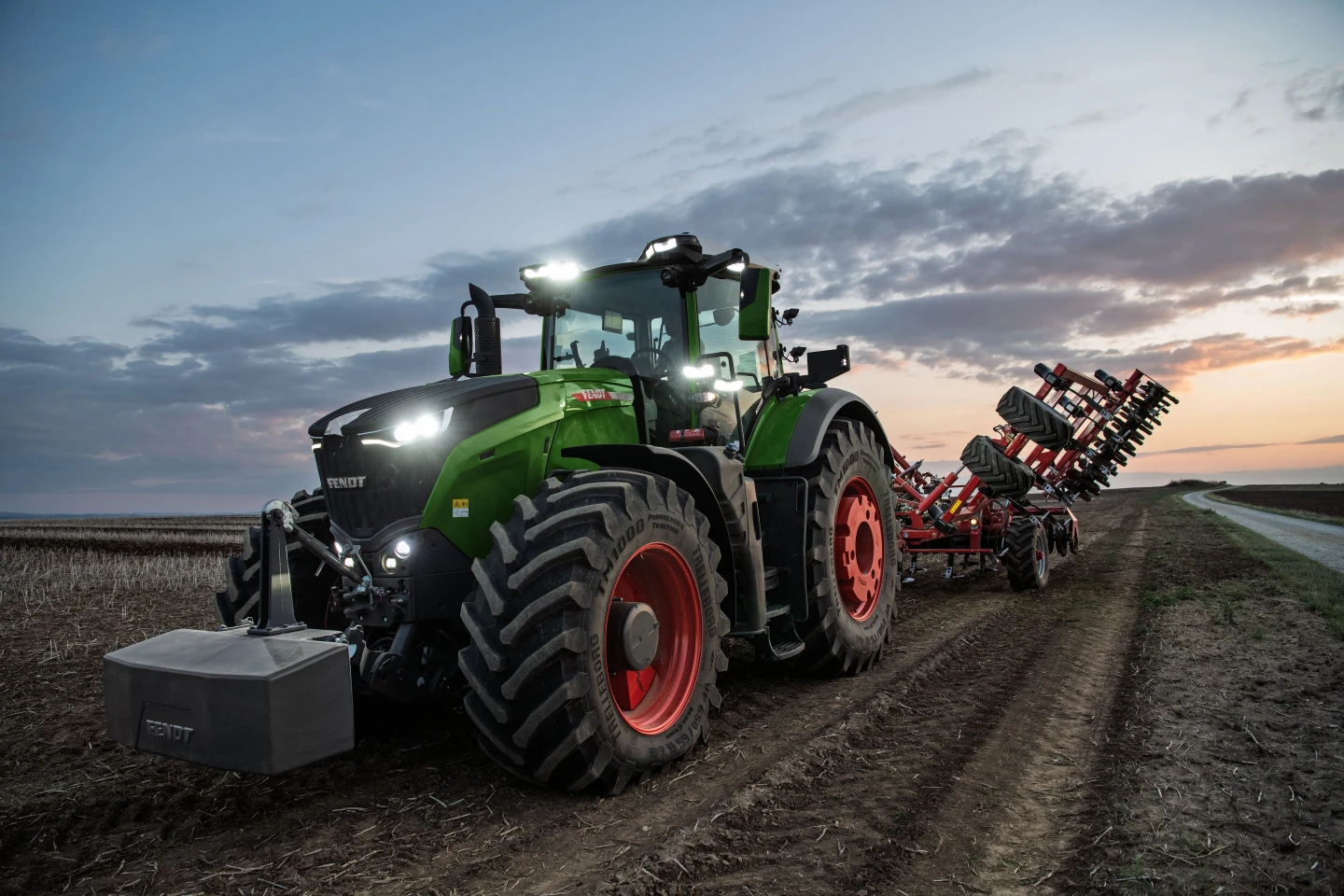
Autonomous farm equipment has been demonstrated for years, but Fendt and parent company AGCO are making their latest push look increasingly practical.
During Fendt’s 2026 Harvest Tour, farmers in Ohio got a look at a Fendt tractor operating without a driver while handling grain-cart duties. Using PTx OutRun, the combine operator can call the tractor and grain cart from a tablet, have it position itself alongside the combine for unloading on the go, and send it back to a designated location afterward.
It is an application that addresses a familiar problem on many farms: finding enough skilled people during harvest.
Starting With Jobs That Are Hard to Staff
Grain-cart operation is a logical place to start with autonomy. Harvest can require several people working at once, and keeping the grain cart moving is essential to keeping an expensive combine moving.
At the Ohio demonstration, farmer Jared Baudendistel told WDTN that his son is in school until 3 p.m., which can make finding someone to operate the grain cart difficult. With OutRun, the combine operator can stage the tractor using an app and command it to come alongside when needed.
AGCO is applying the same approach beyond harvest. OutRun Tillage allows a compatible tractor to perform tillage autonomously after an operator establishes field boundaries, identifies obstacles and calibrates the implement. The tractor can then complete the job while being monitored remotely through the OutRun app, which provides progress information, system messages, imagery and a live 360-degree video stream.
That could allow a farm to accomplish more with the people it already has. Instead of dedicating one employee to a grain cart or tillage tractor for hours at a time, some jobs could increasingly be supervised while that person handles other responsibilities.
Moving Toward Level 4 Autonomy
Fendt says its current machines can already reach Level 3 automation with available FendtONE functions, depending on configuration. At that level, the machine can perform defined processes independently while a person remains responsible for monitoring and intervening when necessary.
Fendt classifies PTx OutRun applications as Level 4 monitored automation. The system can perform the assigned process within predefined conditions and operating areas while a person monitors it locally or remotely. OutRun uses sensors to monitor the tractor’s surroundings and incorporates obstacle detection, virtual boundaries, restricted areas and automated alerts. If an obstacle is detected, the system can slow or stop the tractor and alert the operator.
For farmers watching from the edge of the field, the most obvious difference is simpler: there is nobody in the cab.
Autonomy Without Replacing the Tractor
AGCO is also taking an approach that could make autonomous technology more accessible to existing farms. OutRun is a modular retrofit platform rather than an entirely separate autonomous machine.
Fendt says the same underlying OutRun hardware and software can support grain-cart and tillage applications, with additional autonomous jobs potentially added over time. OutRun is currently available in North America, Australia and South America for Fendt 900 and 1000 Vario tractors.
New Fendt tractors in the U.S., Canada and Australia can also be configured with an autonomy basic package that provides the interface needed for systems such as OutRun.
AGCO’s ambitions extend beyond Fendt equipment. At its 2026 Tech Day, the company emphasized that its PTx precision-agriculture business is being developed around mixed fleets, using both retrofit and factory-installed technology. The goal is to connect equipment across different brands rather than requiring a farm to standardize around one manufacturer.
That could matter considerably in North America, where mixed fleets are common and many farmers have large investments in machines that still have years of useful life remaining. Adding autonomous capability to an existing tractor is a different proposition than replacing that tractor solely to gain access to the technology.
Connecting Autonomy, AI and the Rest of the Farm
AGCO’s recent Tech Day showed how autonomy fits into a broader technology strategy. PTx FarmENGAGE is designed to connect mixed fleets through one digital platform, while Panorama brings together machine and agronomic data. AGCO’s Aurora AI assistant is being developed to let farmers interact with that information using text or voice.
AGCO also demonstrated how several of these technologies could work together in the field. A Fendt IDEAL combine harvested while OutRun handled autonomous grain-cart logistics, with a Fendt Rogator following the harvest to apply fertilizer for the next crop.
The company points to the narrow fall window when harvesting, grain handling, tillage and fertilizer application can all compete for the same workers. Automating even some of those jobs could allow a smaller crew to keep several operations moving at once.
From Demonstration to Daily Work
Farmers have been hearing about autonomous tractors for a long time, and cost, reliability, support and trust will still determine how quickly the technology is adopted. But Fendt and AGCO are increasingly attaching autonomy to recognizable jobs rather than treating a driverless tractor as the product itself.
Grain-cart operation and tillage are repetitive, time-consuming jobs that can put considerable pressure on a farm’s labor supply during critical windows. They also provide a relatively straightforward way for farmers to understand what autonomy could actually do for their operation.
The combination of retrofit technology, mixed-fleet compatibility and remote supervision could be especially important. Farmers may not need to replace an entire fleet or turn over every field operation to autonomous machines at once. They could start with the jobs where labor is hardest to find and expand from there.
That is a much more practical path for autonomous tractors to make their way onto working farms.

Leave a Reply