
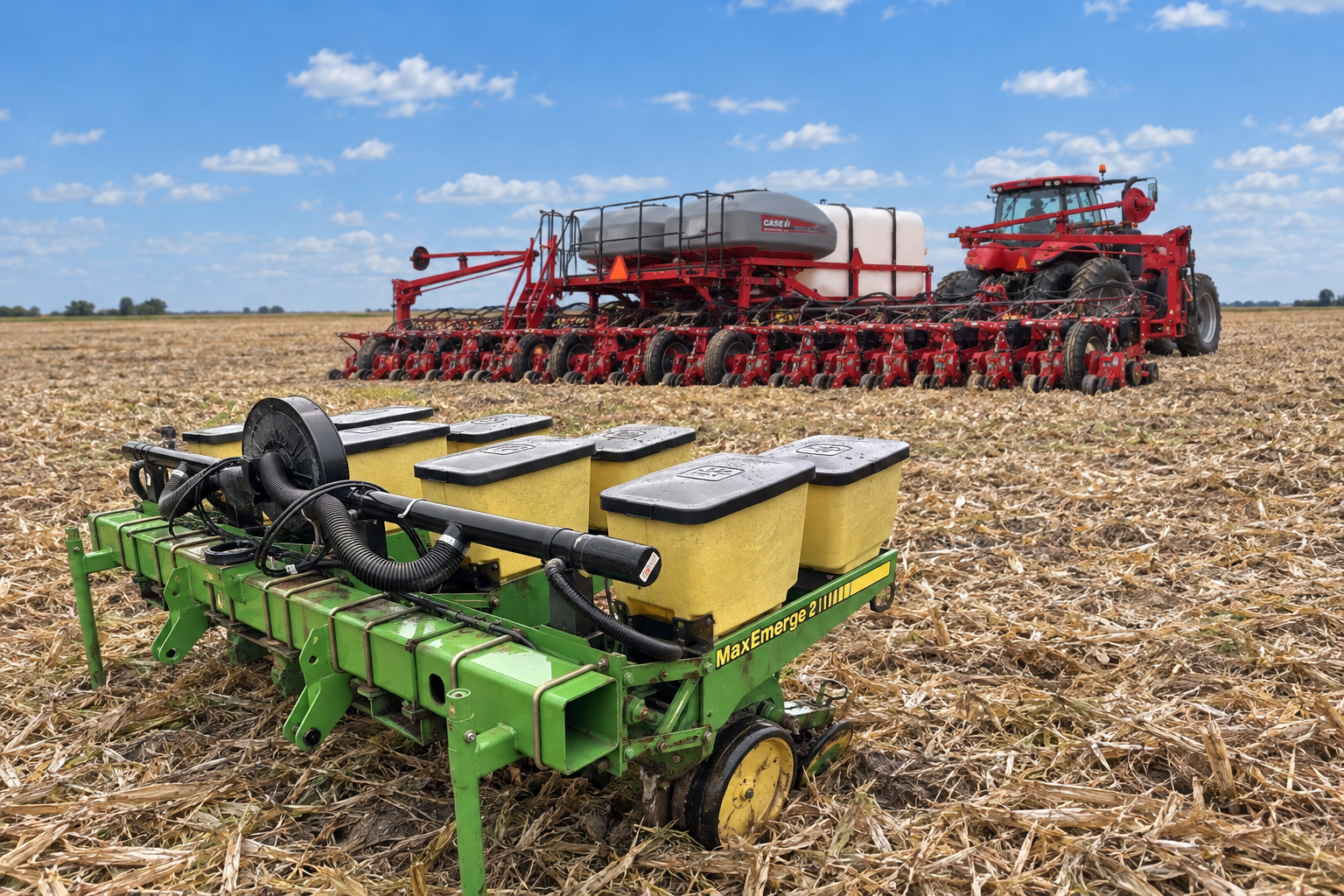
Farmers have plenty of reasons to upgrade a planter. Better seed meters, hydraulic downforce, row cleaners, section control, larger seed capacity and increasingly sophisticated monitoring can all make planting faster and easier. But will a new planter actually grow more corn?
Researchers at Purdue University recently put that question to the test, comparing a modern Case IH 2150 against a John Deere 7200 roughly 30 years its senior, as recently covered by No-Till Farmer. The result was surprisingly close: Purdue found no statistically measurable difference in corn yield between the two planters.
That doesn’t mean farmers should start hunting for old 7200s. It does raise an increasingly important question, though. If newer equipment doesn’t necessarily produce more bushels, what exactly are you paying for when you upgrade?
New Technology Meets Old Iron
The 2025 trial took place on a 20-acre field at Purdue University’s Pinney Agricultural Center. On one side was a 12-row Case IH 2150 equipped with vacuum meters, active hydraulic downforce and row cleaners. On the other was a four-row John Deere 7200 using finger-pickup meters, spring downforce and no row cleaners.
The differences went beyond planter technology. The Case IH applied starter fertilizer in a 2x2x2 configuration, while the Deere did not, although both treatments ultimately received the same total amount of nitrogen.
Researchers planted alternating 12-row strips across the field and harvested the middle six rows to reduce border effects. After cleaning the yield-monitor data and accounting for variability across the field, Purdue researchers couldn’t identify a statistically significant yield advantage for the newer planter.
It’s an eye-catching result, but Purdue cautions against reading too much into a single field trial. Different soil conditions, weather, planting conditions and farming practices could produce different results. Still, the experiment raises a worthwhile question about how farmers measure the value of equipment.
Yield Isn’t the Only Return
A planter doesn’t necessarily have to increase yield to make money. Section control can reduce wasted seed, bulk seed systems can reduce refill time, and active downforce and adjustable row cleaners can help operators respond to changing field conditions without repeatedly climbing out of the cab. Better monitoring can also catch problems before dozens of acres have been planted incorrectly.
Then there’s speed. A farmer who can cover considerably more acres during a good planting window may reduce weather risk even if the planter doesn’t add a single bushel under ideal conditions. A larger, more automated planter can also allow one operator to accomplish work that once required more time or labor.
Those benefits become increasingly important as farms get larger. But the calculation can look very different on a smaller operation where an older planter is well maintained, planting capacity isn’t a limiting factor and the operator already understands how to make it perform.
An Important Question in Today’s Equipment Market
The Purdue experiment arrives as farmers are already becoming more cautious about equipment purchases. U.S. tractor sales fell 16.4% in September compared with a year earlier, according to Association of Equipment Manufacturers data reported by Farm Progress. Combine sales declined nearly 11%, while four-wheel-drive tractor sales dropped more than 20%. Through September, total tractor sales were down 12.6% for the year.
With farm income under pressure and operating costs elevated, keeping a paid-for machine another season can become considerably more attractive. That makes the question raised by Purdue especially relevant. The comparison isn’t simply between old technology and new technology. It’s between the cost of upgrading and the actual economic problem that upgrade solves.
What Are You Buying?
For one farm, a newer planter might allow a single operator to cover thousands more acres during a narrow planting window. For another, section control and better seed placement could produce meaningful savings. Another operation might place the greatest value on reliability, monitoring or reducing the skill required of an operator. For some farmers, the answer may simply be that the planter already sitting in the shed does the job.
Purdue’s experiment doesn’t prove that modern planter technology isn’t valuable. In fact, many of its advantages weren’t measured by yield alone. Instead, it offers a useful reminder when evaluating any major equipment purchase: Start with the problem you’re trying to solve.
If an upgrade saves labor, reduces inputs, increases capacity, limits downtime or lowers risk, those benefits can be calculated against its cost. But if the primary justification is simply that newer equipment should perform better because it’s newer, a 30-year-old John Deere planter just provided an interesting counterexample.
Sometimes the best measure of a machine isn’t how much technology it has, but what that technology actually does for the bottom line.


Leave a Reply