
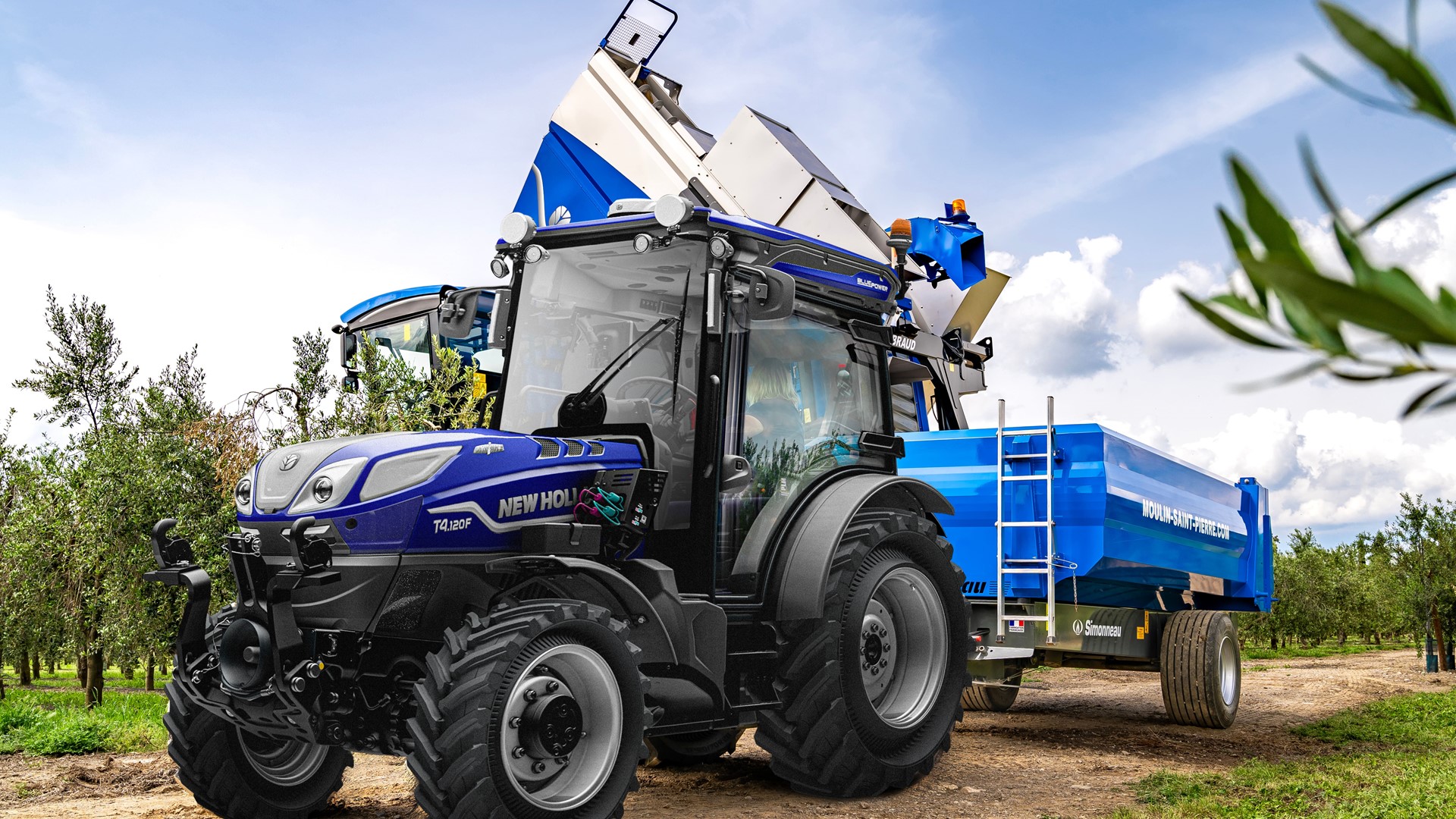
New specialty tractors, row-level digital management and LiDAR-based guidance could help growers reduce chemical waste, improve efficiency and automate demanding fieldwork.
Precision farming technology is moving beyond traditional row-crop agriculture. At EIMA International 2026 in Bologna, Italy, New Holland introduced a connected lineup of specialty tractors and digital tools designed specifically for vineyards, orchards and other high-value crops.
Announced November 10, the developments include expanded T4 F/N/V Auto Command tractors, a new SpecialtyOps management platform and advanced vision-based guidance technology planned for 2027. Together, they aim to bring the automation and connectivity found in larger agricultural machines to operations where narrow rows, tree canopies and repeated maneuvers present different challenges.
Big-Tractor Technology in a Smaller Package
New Holland’s updated T4 F/N/V range covers 90 to 120 horsepower, powered by four-cylinder FPT engines. The addition of the Auto Command continuously variable transmission (CVT) gives growers precise speed control without conventional gear changes, particularly useful for spraying, mowing and other operations requiring consistent ground speeds.
The tractors offer hydraulic flow of up to 115 liters per minute, multiple front axle configurations and advanced operator controls. Available technologies include automated headland-turn functions, guidance with RTK accuracy down to 2.5 centimeters and a cab designed to improve comfort during long working days.
While CVTs and automated controls are familiar on larger tractors, packaging these capabilities into narrow specialty machines could help growers improve productivity without sacrificing maneuverability.
SpecialtyOps Brings Precision Management to Individual Rows
Alongside the tractors, New Holland introduced SpecialtyOps, a digital platform built around the needs of orchards and vineyards.
Unlike traditional field-management systems that often focus on entire fields, SpecialtyOps allows growers to track activities at the individual-row level. Using a smartphone connected to a compatible GPS antenna, operators can record chemical applications, equipment movements and manual work, then review the information through mapped activity records.
The platform shares login credentials with New Holland’s existing FieldOps system and includes a marketplace for additional services, sensors and third-party technologies. Core functions are free, with optional hardware and services available separately.
Initially developed for European customers, SpecialtyOps is planned for expansion into North America, although New Holland has not announced a specific launch date.
LiDAR Guidance Could Reduce Unnecessary Spraying
Perhaps the most significant development is New Holland’s Specialty Vision Sensor, which uses LiDAR technology to navigate orchard and vineyard rows without relying on GPS.
Tree canopies, netting and surrounding terrain can interfere with satellite positioning, creating challenges for conventional automated guidance. The vision system instead detects its surroundings to steer through rows, recognize headlands and assist with turning maneuvers.
It can also work with compatible ISOBUS sprayers to control spraying at row ends and identify missing trees or plants. By shutting off spray sections where no crop is present, the system has the potential to reduce chemical consumption, water use and operating costs.
Developed by New Holland’s engineering team in Modena, Italy, the technology received an EIMA Technical Innovation Award in 2024 and is now being showcased as part of the company’s broader specialty-crop strategy. Commercial introduction is planned for 2027.
What It Means for Growers
Specialty-crop operations face many of the same pressures as larger farms, including labor availability, rising input costs and the need to improve efficiency. But their equipment requirements are often more demanding because of restricted working spaces and the value of individual plants.
New Holland’s approach combines more capable tractors with digital recordkeeping and automated implement control. The potential benefits are meaningful, particularly for growers making frequent chemical applications or managing multiple varieties across different blocks.
However, the economics will depend on equipment pricing, compatibility with existing implements, dealer support and the measurable savings growers can achieve. New Holland has not yet provided enough commercial detail to establish a reliable return on investment for the complete system.
For American growers, availability is another consideration. SpecialtyOps is launching in Europe first, and the advanced vision system remains a future introduction.
Even so, the developments point toward a broader shift in agricultural technology. Precision farming is increasingly moving beyond GPS-guided tractors in open fields toward machines that can recognize their surroundings, manage individual crop rows and adjust their work to actual field conditions.

Leave a Reply