
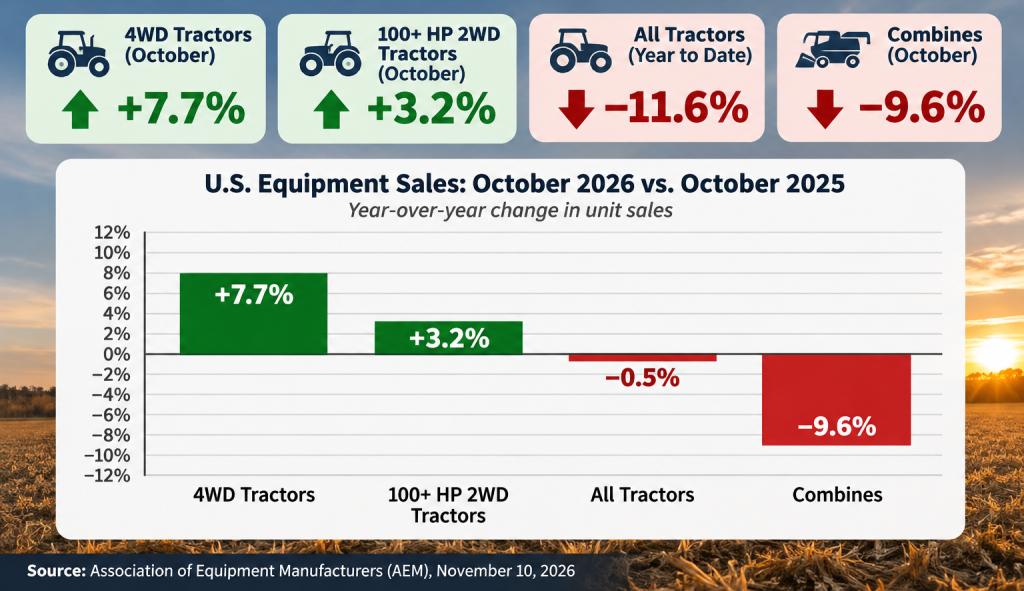
After months of declining farm equipment sales, the U.S. tractor market showed a modest sign of improvement in October. Four-wheel-drive tractor sales increased 7.7% compared with the same month last year, while sales of larger two-wheel-drive tractors also moved higher.
According to the Association of Equipment Manufacturers (AEM), U.S. dealers sold 337 four-wheel-drive tractors in October 2026, compared with 313 in October 2025. Sales of two-wheel-drive tractors rated at 100 horsepower or more rose 3.2% to 2,171 units.
The improvement is noteworthy because larger agricultural tractors have been among the equipment categories hardest hit by declining farm profitability. However, the broader numbers suggest manufacturers and dealers still face a difficult market.
A Bright Spot in a Difficult Year
Total U.S. tractor sales slipped just 0.5% in October, a much smaller decline than the industry has experienced in several recent months. But through the first ten months of 2026, manufacturers reported 152,306 tractor sales, down 11.6% from 172,204 during the same period in 2025.
Four-wheel-drive tractors have experienced an even sharper contraction. Despite October’s improvement, year-to-date sales totaled just 1,785 machines, down 19% from 2,204 a year earlier.
Combine sales also remained weak, falling 9.6% in October to 340 units. Through October, combine sales were down 9.1% for the year.
The contrasting results suggest that demand may be stabilizing in certain categories, but the industry has not yet demonstrated a sustained recovery.
Why High-Horsepower Tractors Matter
Large four-wheel-drive tractors are closely associated with commercial row-crop operations, where machinery purchases depend heavily on grain prices, financing conditions and expectations for future farm income.
When margins tighten, farmers often postpone replacing expensive equipment, particularly if existing machines can continue operating reliably. Those delayed purchases can eventually create replacement demand as tractors accumulate hours and maintenance costs increase.
That possibility has attracted attention from manufacturers. In recent industry commentary summarized by University of Illinois Farm Policy News, AGCO executives pointed to an aging tractor fleet as one reason equipment demand could improve in 2027.
However, replacement needs do not automatically translate into purchases. Farmers must still weigh the cost of new machinery against commodity prices, borrowing costs and the expense of maintaining existing equipment.
What Dealer Inventories Reveal
The latest AEM report also provides a useful look at equipment inventories entering October.
U.S. dealers and manufacturers reported 578 four-wheel-drive tractors in inventory, compared with 7,358 two-wheel-drive tractors rated at 100 horsepower or more. Across all tractor categories, reported inventory totaled 95,628 machines.
These figures reflect different market sizes and should not be interpreted as evidence of shortages or oversupply without considering sales volumes. Nevertheless, inventory levels influence how aggressively dealers price equipment and how much flexibility buyers may have when negotiating.
For farmers considering a purchase, the situation can vary significantly by horsepower class, configuration and manufacturer. A dealer carrying several comparable machines may be more willing to negotiate than one with limited inventory of a particular model.
What Does This Mean for Used Equipment?
A recovery in new tractor demand could eventually influence used machinery markets, although the relationship is not straightforward.
When farmers purchase new equipment, trade-ins can increase the supply of late-model used tractors. Conversely, when owners postpone replacement, fewer desirable machines may reach dealer lots and auctions.
October’s improvement in large-tractor sales is too small to establish either trend. AEM’s figures track new equipment sales rather than used transaction prices, so they cannot determine whether used tractor values are rising or falling.
Buyers and sellers should continue watching completed auction results, dealer inventories and demand for specific horsepower ranges rather than relying on overall sales figures alone.
Is 2027 Looking Better?
Equipment manufacturers have expressed cautious optimism about a possible improvement in 2027, supported by aging machinery fleets and the potential for deferred replacement purchases. Yet uncertainty surrounding farm income, trade policy and financing remains significant.
AEM Senior Vice President Curt Blades described October’s four-wheel-drive gains as an encouraging development while emphasizing that the agricultural equipment market continues to face challenges.
The next several monthly reports will help determine whether October represents the beginning of a more durable improvement or simply a temporary rebound.
For now, the message is mixed. High-horsepower tractor sales have shown some life, but the industry remains well behind last year’s pace. Farmers and dealers may welcome the positive numbers, although a genuine recovery will require more than one strong month.

Leave a Reply