

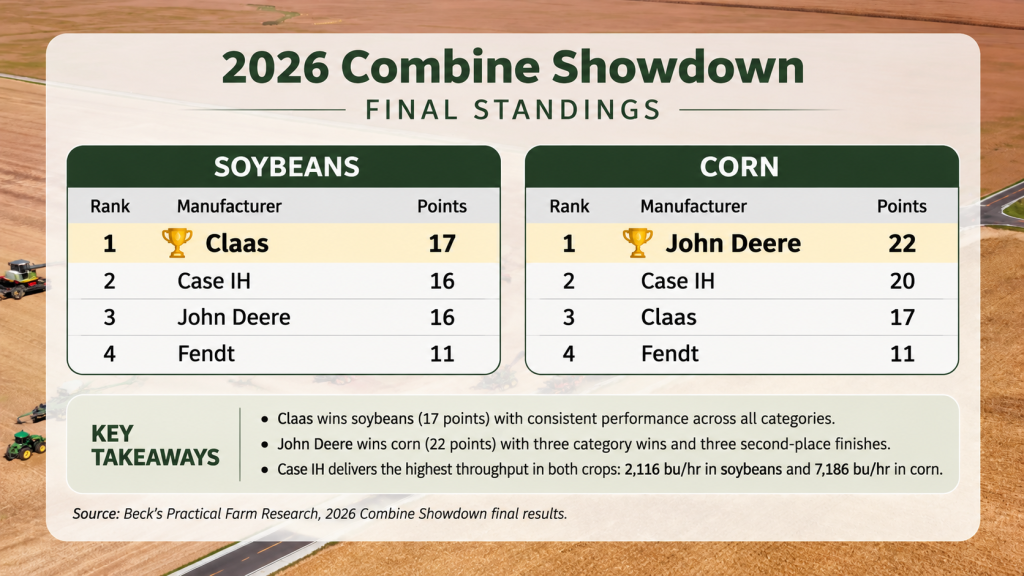
John Deere and Claas emerged as the overall winners of Beck’s 2026 Combine Showdown, a head-to-head comparison of harvesting systems from four major manufacturers. Claas claimed the soybean championship, while John Deere took the top spot in corn.
The results also revealed standout performances from Case IH and Fendt, demonstrating that the highest-scoring machine wasn’t necessarily the best performer in every category.
Beck’s Practical Farm Research evaluated six performance categories in both crops: header loss, chaffer and rotor loss, grain damage, foreign material, throughput and fuel efficiency. Corn testing included a seventh category assessing overall system technology.
Manufacturers earned four points for first place in each category, three for second, two for third and one for fourth. Corn and soybeans were scored independently.
Claas Wins a Close Soybean Competition
Claas finished first in soybeans with 17 points, narrowly ahead of Case IH and John Deere, which each earned 16. Case IH won the tiebreaker for second place, leaving John Deere third and Fendt fourth with 11 points.
Claas distinguished itself through consistent performance, finishing among the top three manufacturers in all six categories. Its Convio Flex 1530 header recorded the lowest soybean header loss at 0.33 bushels per acre, while its second-place performance in chaffer and rotor loss gave Claas the lowest combined measured grain loss.
Other manufacturers led individual categories. Fendt’s IDEAL 9T recorded the lowest chaffer and rotor loss at just 0.2 bushels per acre, while John Deere’s X9 1100 finished first in grain damage and fuel efficiency, consuming 24.3 gallons per hour.
Case IH’s AF10 delivered the highest soybean throughput at 2,116 bushels per hour. It also produced the cleanest soybean sample, with just 0.1% foreign material.
John Deere Takes the Corn Championship
John Deere earned 22 points to win the corn competition, followed by Case IH with 20, Claas with 17 and Fendt with 11.
The X9 1100 finished first in three of seven categories and second in three others. Its CR16 corn head recorded the lowest header loss at 0.9 bushels per acre, while the combine also led in grain damage and the overall technology evaluation.
Case IH again dominated throughput, with the AF10 processing 7,186 bushels of corn per hour, more than 600 bushels per hour ahead of the next competitor. It also produced the cleanest corn sample, reinforcing its strong performance in harvesting capacity and grain cleanliness.
Claas led corn chaffer and rotor loss at 0.6 bushels per acre and recorded the lowest hourly fuel consumption at 26 gallons. Fendt finished second in chaffer and rotor loss at 1.2 bushels per acre.
Technology Makes a Difference
Beyond mechanical performance, Beck’s judges evaluated technologies designed to improve harvesting efficiency and reduce operator workload.
John Deere’s integrated combine and grain-cart automation earned particular praise, helping secure its first-place technology ranking in corn. Case IH impressed judges with an engine-load system that automatically adjusts ground speed to maintain consistent crop flow through the rotor.
Fendt’s demonstration included PTx Trimble’s OutRun grain-cart automation, which judges highlighted for its potential to reduce labor demands during harvest. Claas also received recognition for allowing operators to make certain crop-changeover adjustments from inside the cab, improving convenience and potentially reducing exposure to hazards.
These features illustrate how automation is becoming an increasingly important consideration alongside traditional measures of combine performance.
What the Results Mean for Farmers
The Combine Showdown demonstrates why equipment buyers should look beyond overall rankings when comparing machines.
For operations facing narrow harvest windows, Case IH’s throughput advantage could be particularly valuable. Farmers prioritizing grain retention may be more interested in Claas and Fendt, while John Deere’s grain-quality performance and technology integration offer different advantages.
Fuel consumption also deserves careful interpretation. Although the study reported gallons per hour, the cost of harvesting depends on how much grain or acreage a machine processes during that time. A combine consuming more fuel per hour may still be more efficient per bushel if its throughput is substantially higher.
Similarly, small differences in grain loss can become financially significant across thousands of acres, particularly in high-yielding crops.
The study provides valuable comparative measurements, but it does not establish which combine offers the lowest total ownership cost. Purchase prices, maintenance, depreciation, dealer support and long-term reliability remain important considerations.
For farmers preparing to invest in harvesting equipment, the results reinforce a practical lesson: the best combine is the one whose strengths match the operation’s priorities, rather than simply the machine that wins the overall competition.


Leave a Reply