
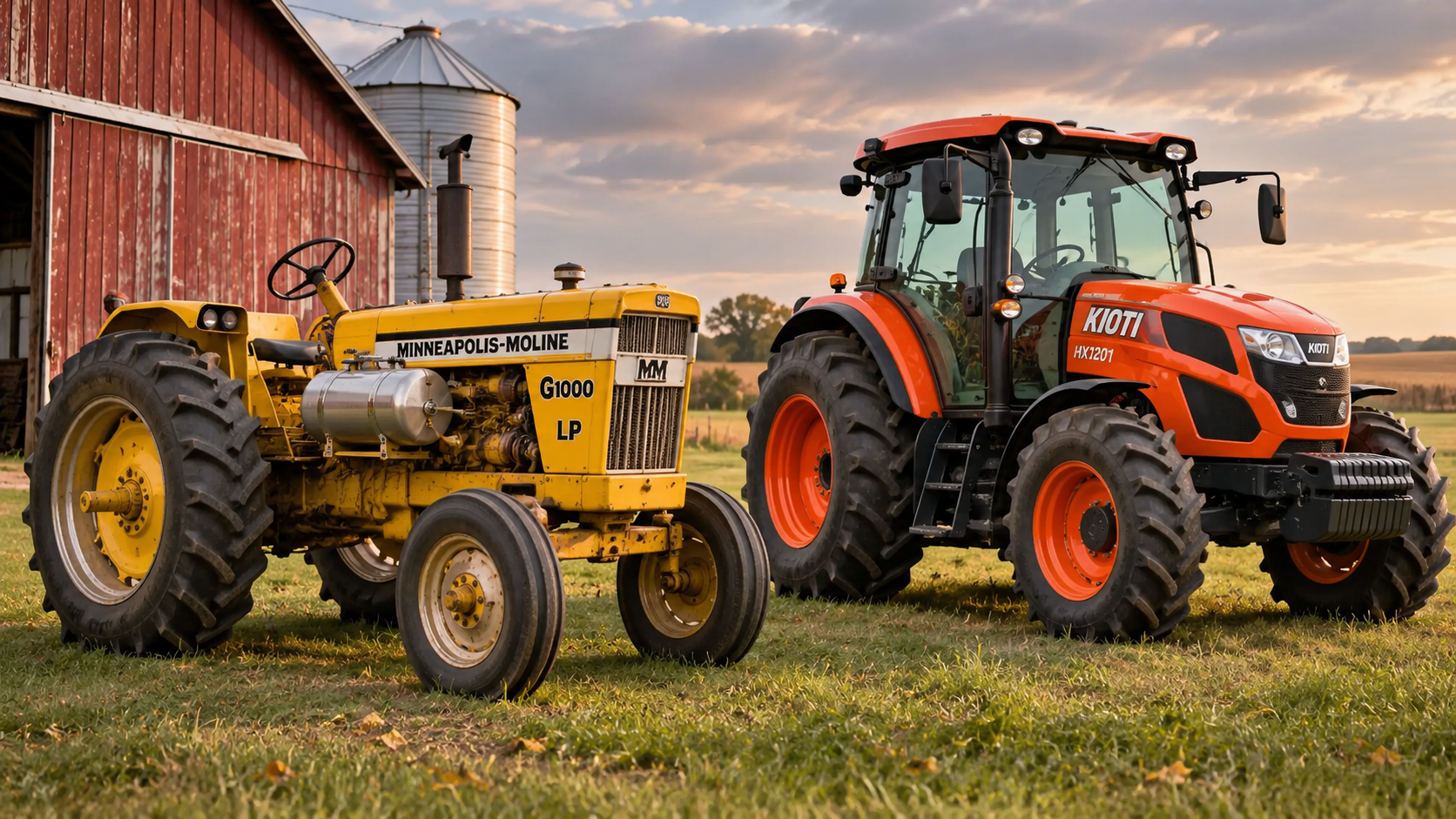
For much of the mid-20th century, American farmers could purchase tractors powered by gasoline, diesel or propane. Diesel eventually became the industry’s preferred fuel, but more than half a century after propane tractors disappeared from manufacturer offerings in North America, the technology could be making a comeback.
The Propane Education & Research Council (PERC) has partnered with KIOTI parent company Daedong and Southwest Research Institute (SwRI) to develop two propane-powered demonstration tractors in the 100–140 horsepower range. Field demonstrations are targeted for 2028, with the project evaluating whether modern propane engines can deliver comparable performance to diesel while reducing operating costs and mechanical complexity.
Why Propane Tractors Disappeared
Propane tractors were particularly popular during the 1950s and 1960s, with manufacturers including Minneapolis-Moline, John Deere and International Harvester offering LPG-powered models. Relatively inexpensive fuel, clean combustion and existing farm propane supplies made them an attractive alternative to gasoline tractors.
Diesel’s advantages in fuel efficiency, energy density and heavy-load performance gradually displaced propane as agricultural machinery became larger and more powerful. According to PERC, the last new factory-produced propane tractor was sold in North America in 1974.
The economics of diesel ownership have since changed. Modern emissions regulations have introduced additional equipment and maintenance considerations, creating an opportunity to reconsider alternative fuels.
A Modern Approach to an Old Technology
SwRI’s engineering team is working to convert a Tier 4 Final diesel engine platform into a propane-powered, spark-ignition engine capable of producing comparable horsepower and torque. The development involves redesigned pistons, a revised turbocharger, new engine controls and extensive calibration.
One of the primary engineering challenges is preventing engine knock under heavy loads at low engine speeds, a particularly important operating condition for agricultural tractors. Higher exhaust temperatures also require careful component selection and durability testing.
A major potential advantage is the elimination of diesel exhaust fluid (DEF) and the associated selective catalytic reduction system. Propane engines still require emissions controls, but their exhaust treatment can be simpler than that of comparable modern diesel engines.
Can Propane Compete on Fuel Costs?
Propane’s lower price per gallon can be attractive, particularly for farms already purchasing it in bulk for grain drying, irrigation or building heat. PERC estimates that more than 800,000 American farms already use propane-powered equipment.
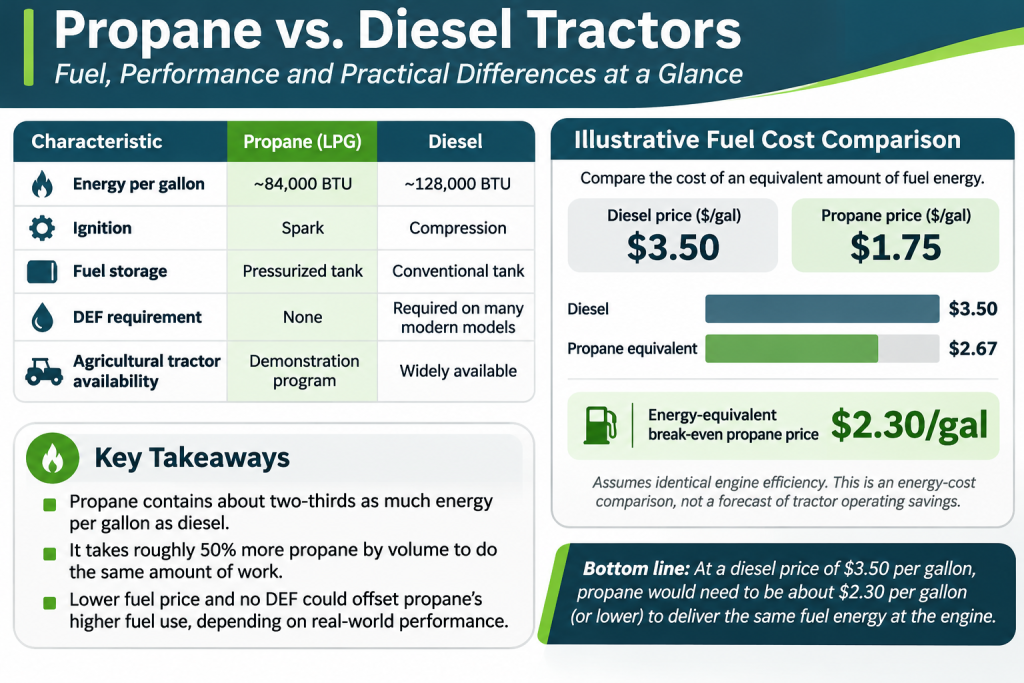
However, propane contains only about two-thirds as much energy per gallon as diesel. Even if both engines converted fuel energy into useful work with equal efficiency, a propane tractor would require approximately 50% more fuel by volume to complete the same task.
For example, at a diesel price of $3.50 per gallon, propane would need to cost roughly $2.35 per gallon to offer comparable fuel energy costs. Actual operating economics would also depend on engine efficiency, workload, maintenance and refueling requirements.
The elimination of DEF expenses and potentially lower emissions-system maintenance costs could improve propane’s competitiveness, but those savings must be demonstrated through real-world testing.
The Challenge of Carrying Enough Fuel
Another obstacle is storing sufficient propane to complete a full working day. Unlike diesel, propane must be stored under pressure, requiring specialized tanks that are generally more difficult to integrate into existing tractor designs.
SwRI’s preliminary engineering work identified a tank configuration intended to provide a full day’s operation without interfering with tractor functionality. The upcoming demonstrations will help determine whether that configuration provides adequate runtime under actual working conditions.
Farms with existing propane infrastructure may have an advantage, although appropriate liquid-fuel dispensing equipment would still be required. Roadside mowing fleets and other operations that return to a central location each day could also be promising applications.
When Could Farmers Buy One?
The two demonstration tractors are expected to undergo a year of field testing following engine development and durability evaluations. The project will examine performance, fuel consumption, reliability, emissions and practical usability before any potential commercial introduction.
KIOTI has not announced production pricing or a commercial release date. Further durability testing and regulatory certification would be necessary before the tractors could reach dealerships.
After decades of diesel dominance, propane could offer farmers another viable choice in the mid-horsepower tractor market. Whether it earns a lasting place in American agriculture will depend on its ability to deliver comparable field performance at a competitive total cost of ownership.


Leave a Reply