
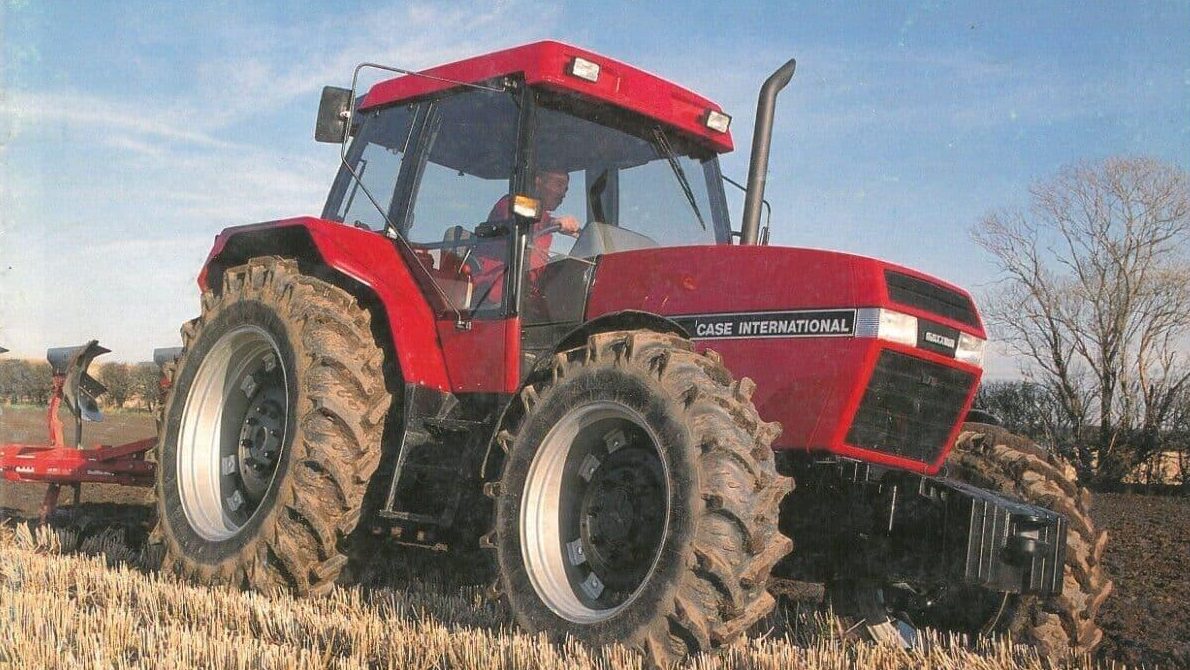
The Case IH Maxxum did not arrive as a headline-grabbing flagship. It was not meant to replace the biggest tractors in the field, nor the smallest chore machines around the yard. It was designed to solve a problem that farmers had been working around for years, the lack of a truly capable, modern, mid-range tractor that could handle daily work without compromise. What followed is one of the most quietly successful tractor stories in modern agriculture.
Why the Maxxum Was Born
The late 1980s were a reset moment for Case IH. The merger between J.I. Case and International Harvester had created a combined engineering bench, but it also exposed gaps in the lineup. The Magnum series had already established itself as a high-horsepower leader, but there was a clear need for something more versatile in the middle of the lineup. Farmers needed a tractor that could move seamlessly between loader work, hay production, and moderate fieldwork without the size, cost, or specialization of a row-crop machine.
The Maxxum, introduced in 1989, was built specifically for that role. It was positioned as a multi-purpose tractor with maneuverability, efficiency, and ease of use at its core. The story goes deeper than just filling a horsepower gap, though. According to Successful Farming, the Maxxum traces back to a global engineering effort known as Project P100, which aimed to develop a shared transmission platform that could be used across multiple machines while keeping development costs in check. That foundation shaped the Maxxum into a tractor that prioritized practicality from the very beginning.
Early Adoption: Right Tractor, Right Time
When the first Maxxum models reached farms, they entered a cautious market. The agricultural economy of the 1980s had been difficult, and buyers were not interested in taking risks on unproven equipment. Tractors needed to justify themselves quickly, and they needed to do it through reliability and versatility rather than marketing.
The Maxxum found its footing by doing exactly what it was designed to do. It handled a wide range of daily tasks without requiring constant adjustment or specialized setup. Operators appreciated its simplicity and durability, and it quickly became known as a tractor that could be counted on through long days and changing conditions. Adoption grew steadily because it delivered consistency rather than flash, and that reputation stuck.
How It Evolved
As farming practices changed, the Maxxum evolved alongside them. Through the 1990s and early 2000s, updated series like the MX and MXU brought improvements in hydraulics, transmission options, and overall operator comfort. The machines became more refined without losing the core identity that made them successful in the first place.
As precision agriculture began to take hold, the Maxxum incorporated new technology in a way that felt natural rather than overwhelming. Guidance systems, improved controls, and better cab environments were added gradually, allowing operators to benefit from new capabilities without giving up the straightforward usability they relied on. This steady evolution helped the Maxxum stay relevant even as expectations for farm equipment continued to rise.
What the Maxxum Is Today
Today’s Maxxum carries far more technology than its early predecessors, but its purpose remains largely unchanged. Modern models offer integrated precision farming capabilities, advanced transmission options including CVT, refined hydraulics, and significantly improved operator comfort and visibility. These updates reflect broader shifts in agriculture, where efficiency and data-driven decision making have become essential.
Despite these advancements, the Maxxum continues to occupy that critical middle ground in farm operations. It is often the tractor that gets used every day, moving from loader work to field tasks without hesitation. In many operations, it becomes the machine that accumulates the most hours because it is the one that fits the widest range of jobs.
A Tractor Built Around Real Work
The Maxxum story is not defined by a single breakthrough or a dramatic turning point. It is defined by alignment with how farms actually operate on a daily basis. It was born out of a need for efficiency during a challenging time, gained traction by proving itself in real-world conditions, and evolved carefully without losing sight of its purpose.
That is why it continues to matter. In an era where machinery can easily become overly complex, the Maxxum remains grounded in a simple idea. Build a tractor that farmers will rely on every day, and make it capable enough to handle whatever the day brings.


Leave a Reply