
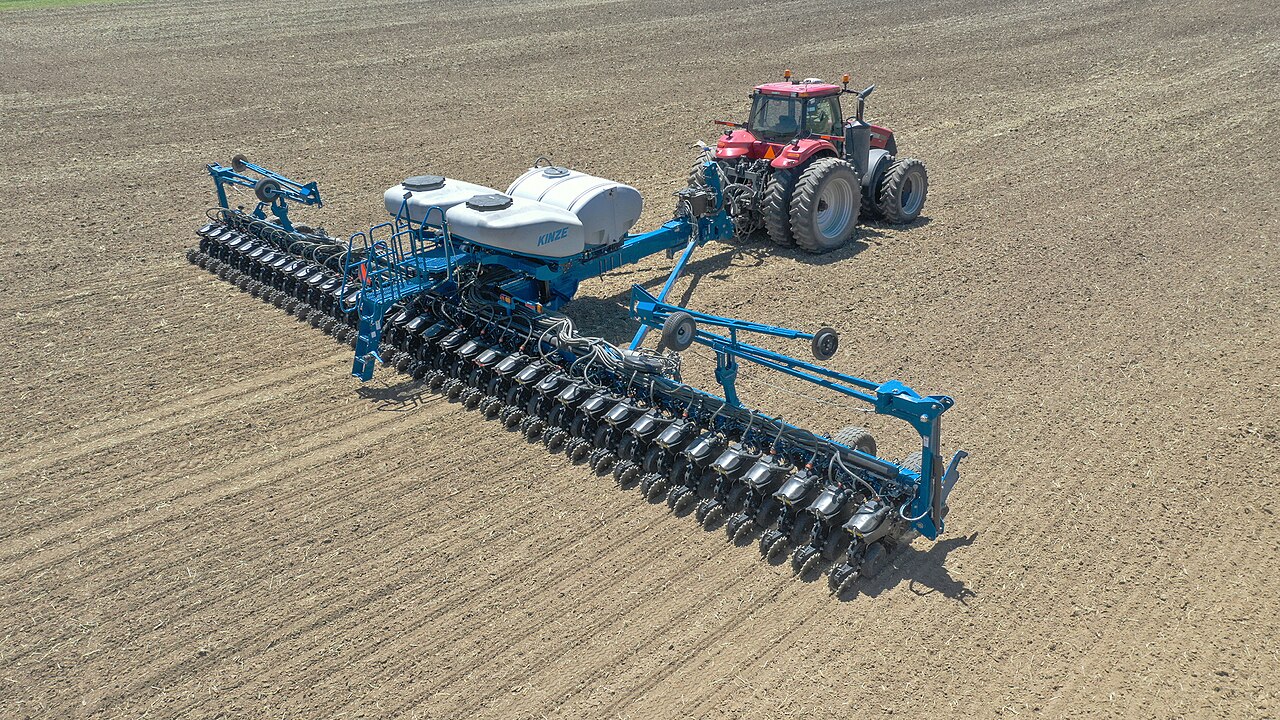
There was a time when most farm equipment companies followed the same basic formula. Large manufacturers controlled the market, farmers bought what local dealers sold, and major innovations usually came from the industry giants.
Then a small welding and repair shop in Iowa started building machinery that would permanently change modern farming.
Today, Kinze Manufacturing is one of the most respected names in planting equipment, especially across the Corn Belt. The company built a reputation around practical innovation, farmer-focused engineering, and a willingness to challenge industry norms. While brands like John Deere dominated headlines and market share, Kinze quietly became one of the most influential companies in modern row crop agriculture.
Its story starts with a farmer, a welding torch, and a belief that equipment could work better.
The Beginning of Kinze
The company traces back to founder Jon Kinzenbaw, who grew up farming near Williamsburg, Iowa. Like many mechanically minded farmers of his era, Kinzenbaw spent countless hours repairing and modifying machinery simply because existing equipment did not always meet the needs of real operations.
In 1965, he opened a small repair shop that focused on rebuilding and improving farm equipment. At first, the business handled general fabrication and repair work. But it did not take long before custom modifications became the company’s identity.
Farmers wanted equipment that was bigger, more efficient, and capable of covering more acres in tighter planting windows. Kinzenbaw recognized those needs early. That practical, farmer-first mindset became the foundation of the company.
The Innovation That Changed Planting
Kinze’s breakthrough came in the 1970s with one of the most important planter innovations ever introduced: the folding planter.
At the time, farmers were trying to run increasingly wider planters to improve productivity. The problem was transportation. Large rigid-frame planters were difficult and dangerous to move down roads, through gates, and between fields.
Kinzenbaw developed a hydraulic folding system that allowed large planters to fold vertically for transport while maintaining wider working widths in the field. It sounds simple today, but at the time it was revolutionary.
The concept transformed modern planting equipment. Soon, folding planters became standard across the industry. Many of the transport systems farmers take for granted today trace back to those early Kinze innovations.
Kinze also became known for building grain carts during an era when on-the-go harvesting logistics were rapidly evolving. Their grain carts earned a reputation for durability and practical design, helping establish the company as more than just a niche planter manufacturer.
Going Head-to-Head With Deere
What made Kinze particularly interesting was its willingness to compete directly with Deere in the heart of Deere country. For decades, Deere had dominated row crop agriculture across much of the Midwest. Many smaller companies focused on specialized niches or complementary equipment rather than directly competing against the industry leader.
Kinze took a different approach.
The company built planters specifically designed to rival Deere’s most important product category. In some cases, Kinze even used Deere planter row units as the basis for early machines before eventually developing its own systems and technologies.
That history became part of Kinze folklore. Farmers respected the company because it felt independent, practical, and farmer-built rather than corporate.
Over time, Kinze developed a fiercely loyal customer base. Many operators appreciated the simplicity of the machines, the serviceability, and the fact that Kinze often focused on practical functionality instead of chasing every technology trend. That did not mean the company ignored innovation. Quite the opposite.
Precision Planting and High-Speed Competition
As precision agriculture transformed farming in the 1990s and 2000s, Kinze evolved with the industry. The company introduced advanced meter systems, electronic monitoring, bulk fill systems, and high-speed planting technology designed to compete in an increasingly data-driven environment.
Today, planting has become one of the biggest technological battlegrounds in agriculture. Row unit performance, singulation, spacing accuracy, downforce systems, automation, and planting speed all directly affect yield potential.
Kinze remained relevant because it adapted while still maintaining its core identity. Many farmers viewed the brand as a middle ground between old-school mechanical simplicity and modern precision farming capability. That balance helped the company survive while many regional machinery manufacturers disappeared or were absorbed into larger corporations.
The Cult Following Around Kinze
One reason Kinze stories resonate with farmers is because the brand inspires unusually strong loyalty.
Talk to longtime Kinze owners and many describe the company almost the same way people describe brands like Gleaner or Versatile. Owners often feel like they are part of a smaller community that values engineering, independence, and practicality over flashy branding.
There is also a strong appreciation for the company’s Iowa roots and farmer-driven culture. In an era where agriculture is increasingly dominated by global corporations, Kinze still feels closely connected to the American Midwest. That identity matters to many producers.
Why Kinze Still Matters
Modern agriculture moves incredibly fast. Equipment grows larger, technology becomes more complex, and planting windows continue shrinking as farms scale up.
Yet many of the solutions farmers rely on today trace back to ideas pioneered by companies like Kinze decades ago. The folding planter fundamentally changed how large-scale planting works. Grain carts reshaped harvest logistics. Precision systems helped push planting accuracy to new levels.
Kinze may not always receive the same level of national attention as the largest equipment manufacturers, but its impact on modern farming is impossible to ignore.
For many farmers, Kinze represents something larger than just machinery. It represents the idea that some of agriculture’s best innovations still come from people who actually understand life in the field.


Leave a Reply