When American farmers talk about major farm equipment brands, the conversation usually revolves around green, red, blue, or yellow paint. Yet across much of the world, one company has quietly built a reputation for producing some of the most advanced harvesting equipment on the planet while remaining relatively underappreciated in the United States.
That company is CLAAS.
To those who run them, especially custom harvesters and large grain operations, CLAAS machines are often described with almost fanatical loyalty. Owners talk about throughput, grain quality, fuel efficiency, cab comfort, and engineering in ways that sound less like brand preference and more like admiration. Even many farmers who do not own CLAAS equipment still recognize names like the CLAAS LEXION or CLAAS JAGUAR as machines with almost mythical reputations.
Yet despite its global influence, CLAAS still feels like an outsider brand in much of North America. That may be exactly what makes the company so interesting.
A Family Company That Became a Global Power
CLAAS traces its roots back to Germany in the early 1900s, when August Claas and his brothers began developing agricultural machinery for European farms. One of the company’s earliest breakthroughs came in the form of a knotter system for binders, which helped establish CLAAS as a serious agricultural engineering company long before combines became its identity.
Over the decades, the company steadily expanded into harvesting technology and eventually became one of the most dominant combine manufacturers in Europe. Unlike many major equipment brands that passed through mergers, acquisitions, or corporate restructuring, CLAAS remained family-owned throughout its growth. That independence helped shape the company’s engineering-focused culture and long-term approach to product development.
Today, CLAAS machines operate around the world, from European grain fields to massive Australian harvest operations and North American corn and soybean acres.
The Combine Brand That Built a Reputation
For many farmers, CLAAS begins and ends with the combine business. That is understandable, because harvesting technology is where the company built much of its reputation.
The CLAAS LEXION helped establish CLAAS as a serious competitor to Deere, Case IH, and New Holland in high-capacity harvesting. While American manufacturers often leaned heavily into traditional rotary or walker systems, CLAAS developed its APS hybrid threshing concept, combining aggressive threshing acceleration with rotary separation.
The result was a machine known for exceptional throughput while still maintaining strong grain quality. Operators who switched to LEXION machines often commented on how much crop they could push through the combine without sacrificing sample quality or overloading the machine.
The LEXION also gained attention for features that felt ahead of their time in North America. Tracks became increasingly common on large CLAAS combines years before they became mainstream elsewhere. Cab visibility, automation, cooling systems, and machine monitoring systems all contributed to the perception that CLAAS approached harvesting differently than many American manufacturers.
For years, seeing a giant silver LEXION rolling through Midwest fields felt almost exotic compared to the sea of green and red combines surrounding it.
The CAT Partnership Era
Part of what made CLAAS memorable in America was its partnership with Caterpillar dealers during the late 1990s and 2000s. Many farmers still refer to older LEXION machines simply as “CAT combines.”
That partnership gave CLAAS a foothold in North America and introduced many producers to the brand for the first time. CAT dealers provided distribution and support while CLAAS supplied the harvesting technology behind the machines.
Even today, some farmers still specifically seek out older CAT-branded LEXION combines because of their reputation for capacity and durability.
The partnership eventually ended, but it helped establish CLAAS as more than just a European curiosity in the North American market.
More Than Just Combines
Although combines dominate the discussion, CLAAS has built respected product lines far beyond harvesting.
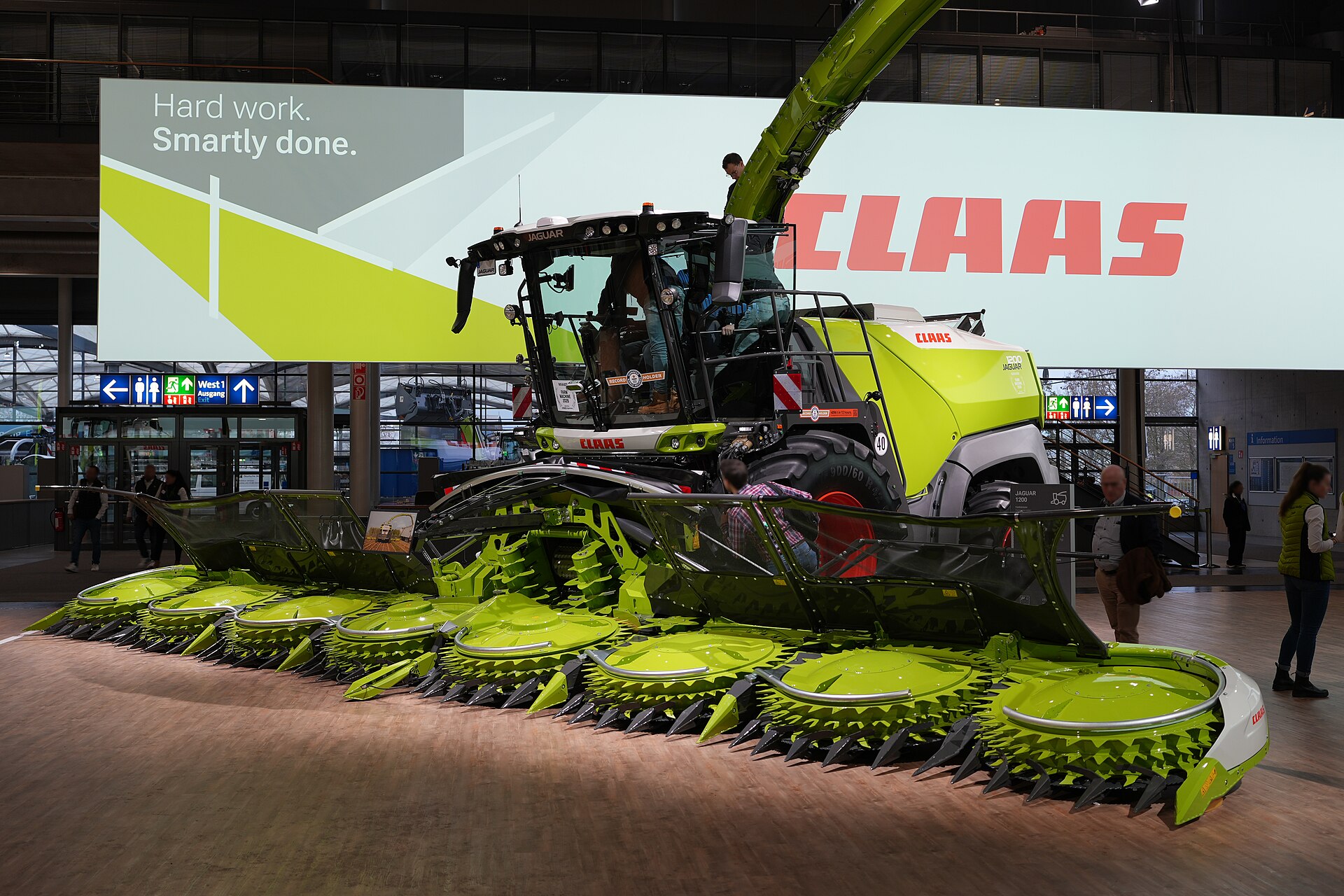
The CLAAS JAGUAR became one of the most recognized self-propelled forage harvesters in the world. In large dairy and silage operations, JAGUAR machines developed a reputation for productivity and chop quality that made them a favorite among custom operators.
Then there is the CLAAS XERION, a machine that still looks futuristic even years after its introduction. With equal-sized tires, massive horsepower, available rotating cabs, and unconventional layouts, the Xerion stood apart from nearly every other tractor on the market. It became especially popular in large forage, manure, and heavy tillage operations.
CLAAS also expanded its conventional tractor lineup through machines like the CLAAS AXION and CLAAS ARION, helping the company become a more complete full-line manufacturer.
Why CLAAS Feels Different
One reason CLAAS developed such a loyal following is that its machines often feel engineered from a different perspective than traditional North American equipment.
European agriculture shaped much of the company’s thinking. Farms there often deal with narrower roads, different crop conditions, smaller transport corridors, and intense efficiency requirements. As a result, CLAAS engineers historically focused heavily on maximizing productivity, visibility, crop flow, automation, and machine efficiency.
Many operators describe CLAAS equipment as highly refined. Controls tend to emphasize ergonomics and operator comfort. Harvesting systems often prioritize smooth crop flow and reduced bottlenecks. Machines are packed with automation systems designed to constantly optimize performance in changing field conditions.
Modern systems like CEMOS use onboard sensors and machine learning concepts to help operators maximize efficiency while reducing losses and fuel consumption. Features like these helped reinforce CLAAS’ reputation as an engineering-first company.
The Dealer Network Challenge
Despite its strengths, CLAAS has faced one major challenge in North America that has limited broader adoption: dealer coverage.
Many farmers are hesitant to move away from brands with large established dealer networks and nearby parts support. Even producers impressed by CLAAS machines often worry about long-term support availability compared to larger domestic competitors.
That challenge has likely prevented CLAAS from gaining market share as quickly as its products alone might deserve.
Still, the company has continued investing in North America, expanding facilities, strengthening dealerships, and growing its visibility among larger grain and forage operations.
An Underrated Giant
Globally, CLAAS is not a niche company. It is one of the most important harvesting equipment manufacturers in the world and has influenced modern agricultural machinery in major ways.
Yet in America, the brand still feels somewhat under the radar compared to its actual impact on farming technology.
Maybe that is beginning to change. As farms grow larger, automation becomes more important, and producers focus increasingly on efficiency and throughput, many of the areas where CLAAS built its reputation are becoming even more valuable.
For now, CLAAS remains one of agriculture’s most respected “if you know, you know” brands. That may be exactly why so many farmers who run the machines refuse to switch back.


Leave a Reply