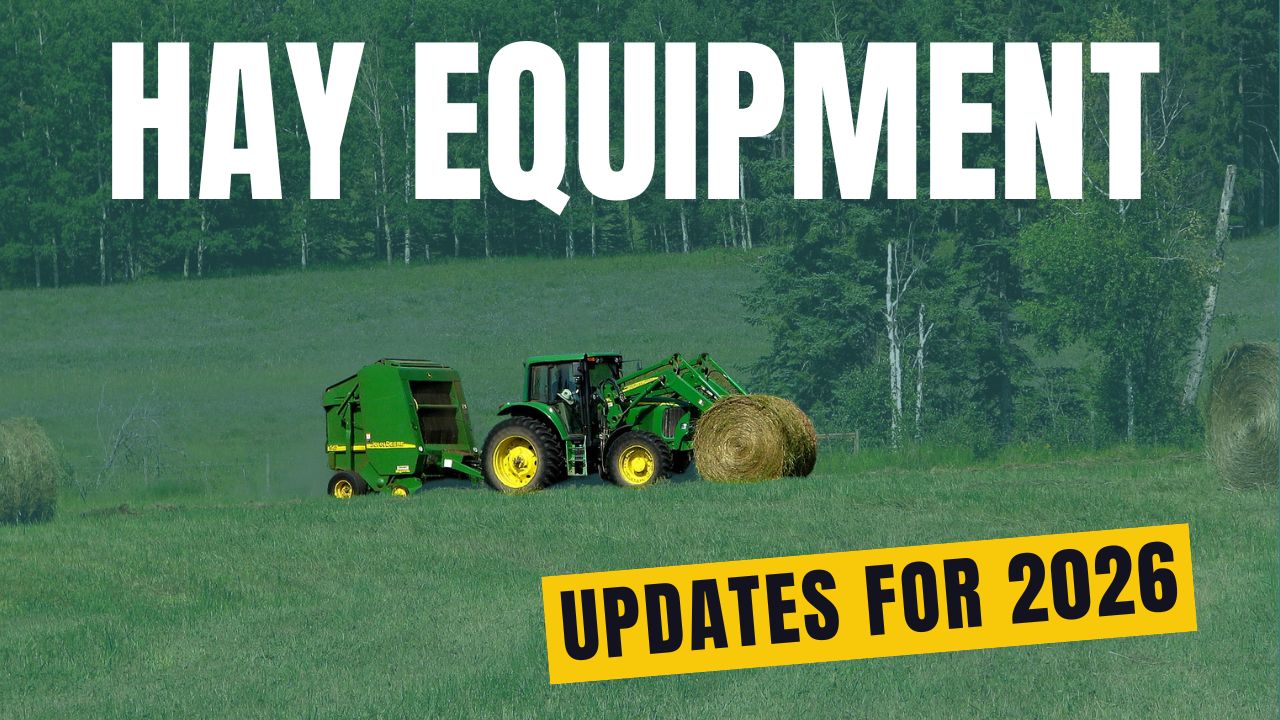
Hay season has always been a race against weather, labor shortages, and shrinking windows to get crop put up in ideal conditions. Manufacturers seem to recognize that. Many of the biggest updates arriving in hay equipment for 2026 are not centered around adding more horsepower or building dramatically larger machines. Instead, companies are focusing on efficiency, automation, reduced maintenance, and collecting more useful data while operators are in the field.
The result is equipment that increasingly behaves like precision ag technology rather than purely mechanical machinery.
Balers Are Becoming Data Tools as Much as Hay Tools
For decades, a baler’s job was straightforward. Pick up crop, form a bale, and move to the next windrow. New machines are taking on additional responsibilities.
Integrated moisture sensing, bale weighing systems, telematics, and productivity tracking are becoming more common across major brands. Operators can increasingly monitor bale weights, moisture content, output rates, and machine performance through in-cab displays or connected apps. Manufacturers are betting that information will become nearly as valuable as the bales themselves.
This shift reflects changes in the hay market. Producers selling premium hay often need consistency in moisture, density, and bale size. Knowing those numbers in real time can help reduce spoilage, improve storage decisions, and create a more uniform product for buyers.
Not long ago, much of that information was estimated by experience or written down manually. Machines are beginning to record it automatically.
John Deere Is Putting More Emphasis on Automation and Throughput
Among Deere’s updates is the V452M round baler, aimed at operators working in heavier crop conditions. The machine introduces a larger chamber, higher-density silage capability, faster gate cycling, and expanded integration with digital platforms.
The gate speed improvements may seem minor at first glance. However, shaving even a few seconds from each bale cycle can translate into significant productivity gains over the course of a season. During narrow weather windows, efficiency improvements that sound small on paper often become much more important in practice.
Like much of Deere’s recent product strategy, the broader trend appears clear: increase automation, collect more operational data, and reduce time spent stopped.
Case IH Is Targeting Downtime and Maintenance Costs
Case IH’s updated RB6 balers focus heavily on durability and sustained productivity during long baling days. Improvements include upgraded bearing protection systems designed to reduce contamination, along with changes intended to improve performance in heavy windrows.
The company is also expanding telematics integration and incorporating more in-chamber bale measurement technology. Rather than emphasizing flashy features, much of the messaging centers on keeping machines running longer with fewer interruptions.
That theme appears repeatedly across nearly every manufacturer introducing hay equipment updates this year. Reducing unexpected downtime during hay season may provide greater value than adding entirely new capabilities.
A machine that avoids breakdowns during a short weather window can sometimes matter more than one with additional features.
New Holland Continues Focusing on Efficiency and Connectivity
New Holland’s refreshed Roll-Belt lineup follows a similar direction. Early updates emphasize durability improvements, bearing upgrades, and changes intended to increase throughput while reducing wear over time.
The company has also continued transitioning portions of its commercial hay equipment toward the yellow color scheme increasingly associated with New Holland’s global forage lineup. While paint color does not affect field performance, branding consistency has become a noticeable priority among major manufacturers attempting to strengthen recognition across equipment categories.
Underneath the cosmetic changes, the larger focus remains improving machine uptime and integrating equipment into connected digital ecosystems.
Vermeer Introduced One of the More Unusual Concepts in Hay Equipment
Perhaps one of the most interesting launches comes from Vermeer with its ZR-2200 self-propelled baler.
Rather than towing a baler behind a tractor, the machine combines propulsion and baling into a single platform. The concept incorporates automated bale tying, bale ejection functions, temperature monitoring, and real-time operational data collection.
Self-propelled balers remain uncommon compared to traditional setups, but they raise an interesting question about where hay equipment could eventually move. Combines and forage harvesters largely transitioned toward self-propelled platforms decades ago. Whether balers follow a similar path remains uncertain, though manufacturers appear willing to explore the idea.
Hay Equipment Advances Extend Beyond Balers
Many of the updates arriving for 2026 involve the entire haymaking process rather than a single machine category. Manufacturers are introducing larger wheel rakes, wider mower configurations, updated tedders, improved conditioning systems, and hydraulic refinements intended to help operators cover more acres in less time.
The underlying objective remains simple. Producers want to reduce passes across the field, minimize labor requirements, and finish hay before weather conditions change.
Technology may evolve, but those priorities have remained remarkably consistent.
The Bigger Trend Is Difficult to Ignore
The most important hay equipment development for 2026 may not be any specific baler, mower, or rake.
Instead, it is the continued movement toward digitization.
Machines increasingly measure moisture, track productivity, monitor performance, communicate with software platforms, and store operational history automatically. The hay field is gradually becoming another environment shaped by precision agriculture.
For farmers who grew up adjusting equipment by feel and judging crop conditions through experience alone, the pace of change is substantial.
The machinery is still built from steel, chains, belts, and bearings. Increasingly, though, software is becoming part of the package too.
As manufacturers compete to save time, reduce maintenance, and improve consistency, the next generation of hay equipment may look less like traditional implements and more like connected systems designed to make decisions alongside operators.
That shift is already underway.

Leave a Reply